
FORMES UTILES GENERATION / RESEARCH
GENERATION
FRENCH DESIGN SCHOOLS, WORKSHOPS AND NETWORKS
A generation cannot be decreed. It recognizes itself through intersecting paths, shared mentors, training institutions, design offices, friendships, and repeated opportunities to work together. It is within this network of relationships that the Useful Forms Generation is built.
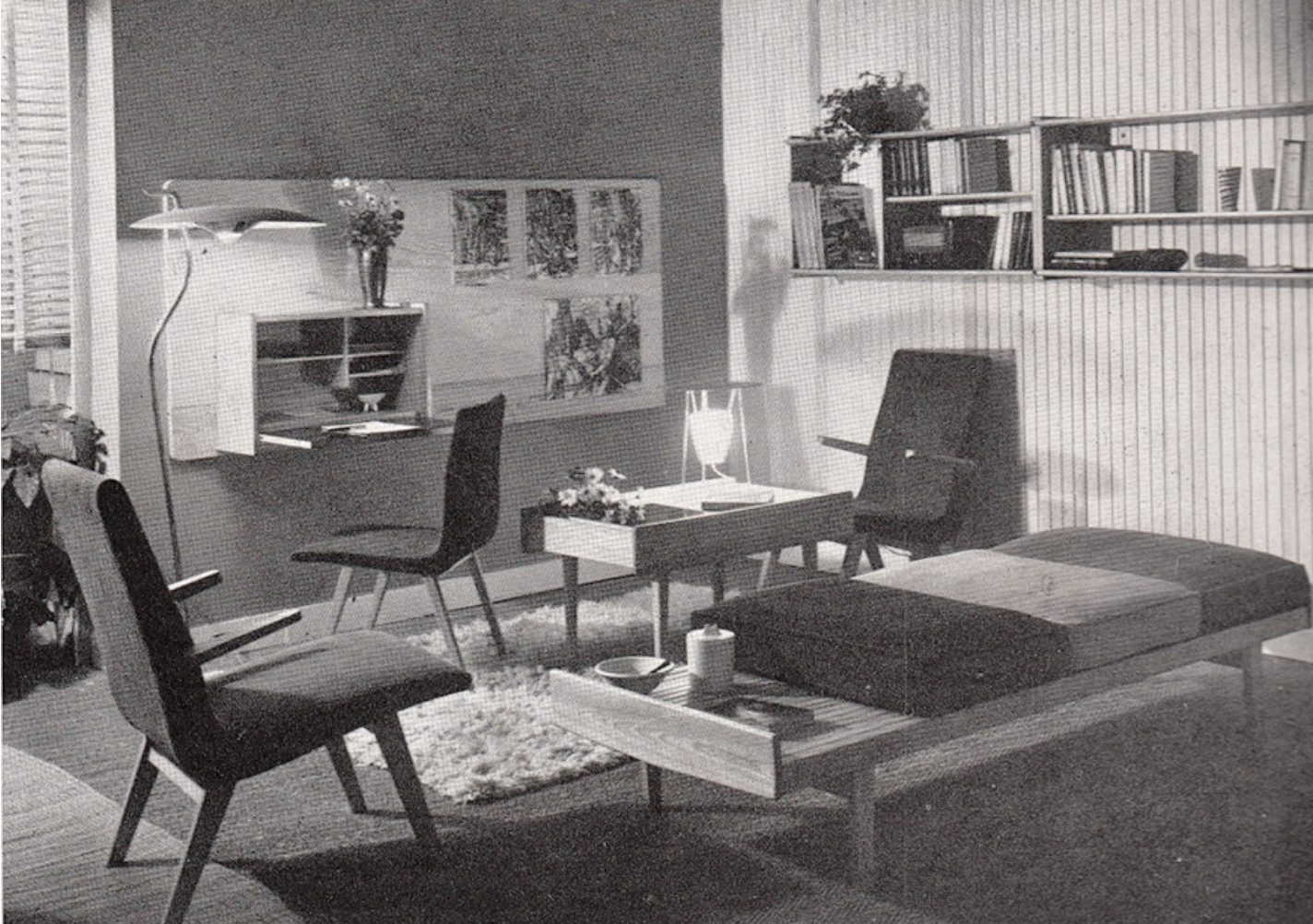
Pierre Paulin, self-published stand, "Foyer d'aujourd'hui" section, 1953. Today's Decor, No. 78, 1953. Final credit to be confirmed.
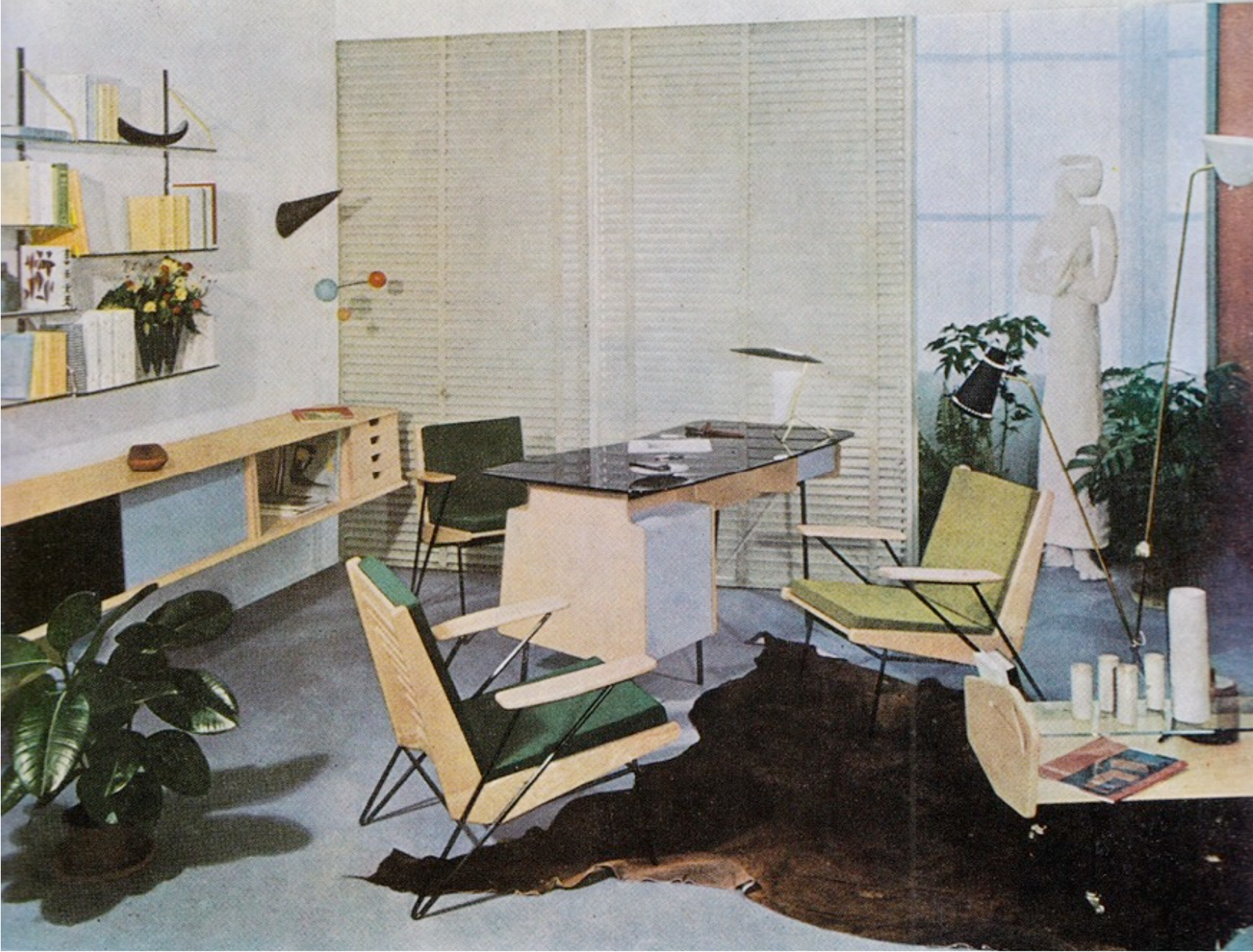
Pierre Guariche, stand, Galerie MAI edition, section "Foyer d'aujourd'hui", 1953. Today's Decor, No. 78, 1953. Final credit to be confirmed.
NEITHER SCHOOL NOR MOVEMENT
The very choice of the term "generation" is essential. The creators gathered under the name Génération Formes Utiles (Generation Useful Forms) are not founding a common manifesto or a lasting association. Their coherence is expressed differently: they are close in age, are experiencing the same economic and social transformations, attend the same schools, work in the same design offices, and meet at the same trade shows.
This proximity produces less a uniform style than a community of principles: rigor of design, economy of means, constructive legibility, accuracy of materials, attention to ergonomics and a desire to design models intended for series production.
LEARN
The École nationale supérieure des Arts décoratifs played a major role. Under the direction of Léon Moussinac, the institution trained "decorator-builders" and "designers of models." Louis Sognot, Jacques Dumond, René Gabriel, Étienne-Henri Martin, and Maxime Old participated in a curriculum where drawing, furniture construction, and interior architecture were conceived as a unified whole.
Alain Richard, André Monpoix and Pierre Guariche were all part of this environment. Other paths led through the School of Applied Arts or Camondo, but the training principles remained similar: understanding construction, mastering detail, working on proportions and preparing for the transition to industry.
TO TRANSMIT
The generation is also shaped by contact with its elders. René Gabriel, Marcel Gascoin and Jacques Dumond are not only theoretical references: their workshops are places of professional training where young creators confront drawing with manufacturing, the constraints of housing and the economic realities of series production.
Marcel Gascoin's office, ARHEC, thus became one of the great laboratories of this modernity. Michel Mortier, Joseph-André Motte, Pierre Guariche and other young creators discovered there a practice where furniture, storage and home layout are conceived as a coherent system.
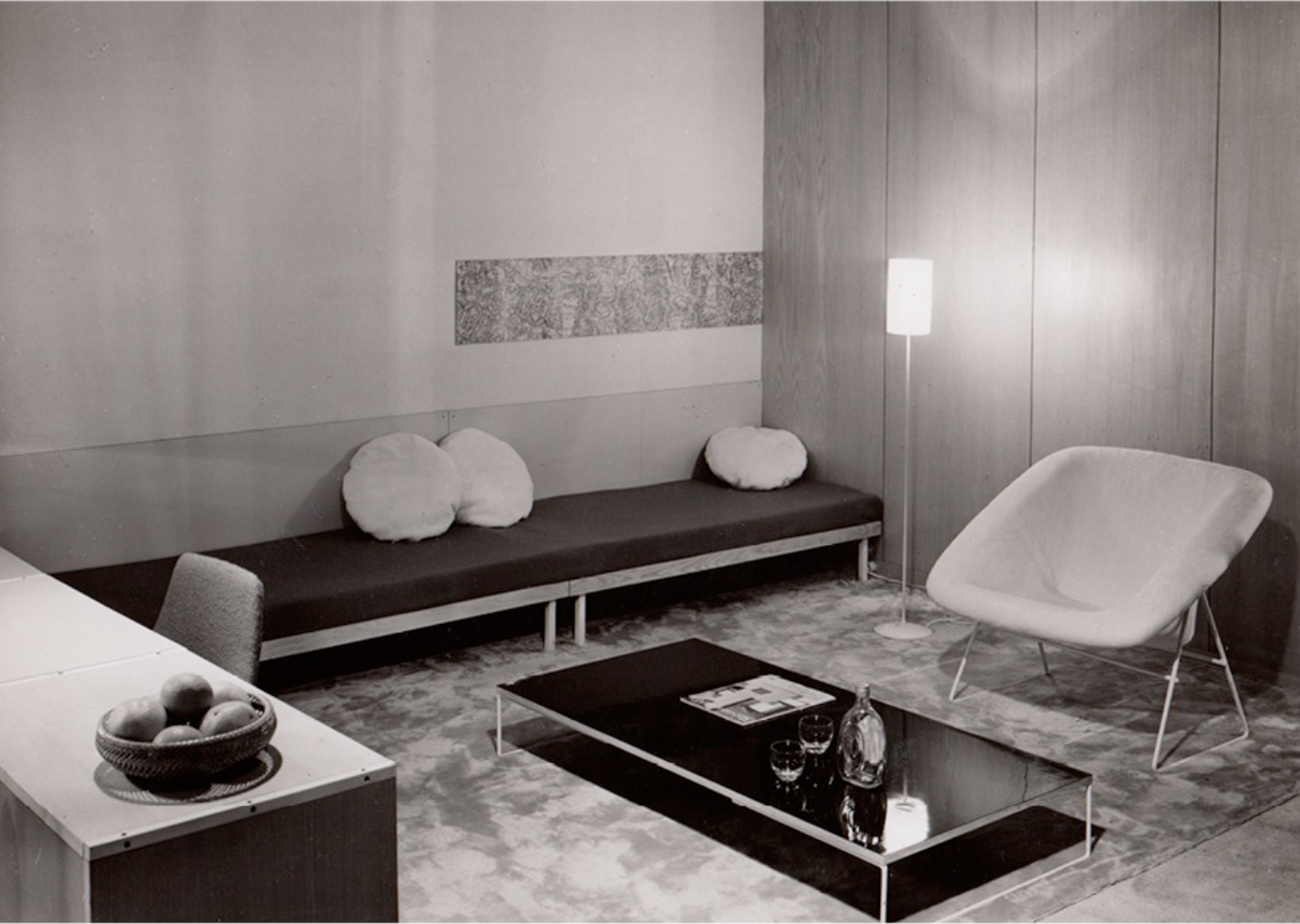
ARP, Airborne, Disderot, Minvielle and Steiner publishers, 1956. Black and white photograph, Jean Darvogne-Huchers Minvielle Archives, Villeneuve-au-Chêne. Final digitized file to be replaced after validation.
LIVING ROOMS AS A PUBLIC STAGE
Once trained and gradually established on their own, these young creators need to make themselves visible. Two events play a decisive role: the Salon of the Society of Decorative Artists and the Salon of Household Arts.
These events bring together design, publishing, promotion, and distribution. They provide an opportunity to present prototypes, win awards, meet manufacturers and publishers, and showcase modern domestic design to the general public. The Useful Forms section, linked to the UAM's legacy, particularly encapsulates this commitment to advocating a balanced approach to form, function, and use.
As European exchanges develop, the Milan Triennale and World Expos offer these designers an international space and enhance their visibility.
SCHOOLS
Decorative Arts · Applied Arts · Camondo
WORKSHOPS
René Gabriel · Marcel Gascoin / ARHEC · Jacques Dumond
SCENES
SAD · Household Arts Fair · Useful Forms · Milan Triennale
FROM NETWORK TO PROFESSION
These shared networks explain why careers intersect so often. The same names reappear among publishers, in collectives, competitions, book fairs, and public commissions. Groupe 4 and then ARP embody this logic of cooperation, but the phenomenon is broader than these collective signatures alone.
What emerged in the 1950s was also a new professional identity. The creator was no longer simply a decorator: they became the intermediary between use, materials, manufacturing, industry, and space. It is in this transition that the profession of designer gradually took shape.
Linked routes: Pierre Guariche · Joseph-André Motte · Michel Mortier · André Monpoix · Pierre Paulin · Alain Richard · René-Jean Caillette · Janine Abraham & Dirk-Jan Rol · Antoine Philippon & Jacqueline Lecoq · ARP.
← Back to Useful Forms Generation
Sources of work: Thibault Lannuzel, Generation Useful Forms — A study of a group of designers in France, 1945-1973, doctoral thesis, University Paris IV–Paris-Sorbonne, 2011–2016. Unpublished editorial draft.