
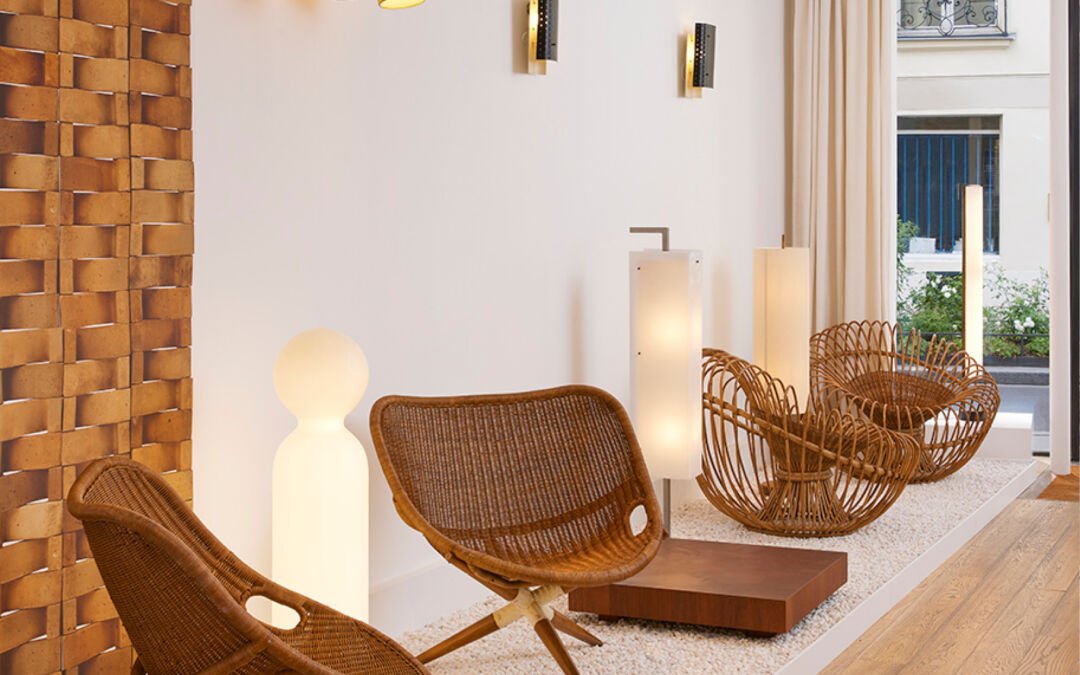
Cover photograph: Galerie Pascal Cuisinier — “Le Rotin 1950” dossier.
MATERIALS & CRAFT · DOCUMENTARY STUDY
How did a material associated with long-established craft practices contribute to the renewal of French furniture in the 1950s? Rattan offers a way to examine the relationships between material, form, construction and production.
This study brings together Thibault Lannuzel’s doctoral research and documents from Galerie Pascal Cuisinier, focusing on chairs by Joseph-André Motte, Janine Abraham and Dirk Jan Rol. It also brings an interior by Louis Sognot documented in the thesis into dialogue with a low table presented by Demisch Danant.
Rattan as a material for invention
In the examples studied here, curves, weaving and joints are integral to the design of the seat. The material remains visible: it shapes the volumes and the way the body can occupy them. Our hypothesis is that the modern character of this furniture lies as much in the transformation of techniques and uses as in the choice of material.
This proposition can be examined by comparing structures, without assuming that rattan alone determines form. Thibault Lannuzel’s thesis places these experiments within the material conditions of post-war France and a network of designers and manufacturers. It distinguishes bendable rattan cane from the rattan core used, notably, for weaving. Their use produces different surfaces and structures [1].
Rougier occupies a central place in this history. The thesis describes a small craft workshop with fewer than five employees, directed by Pia Rougier, with contributions from Joseph-André Motte, René-Jean Caillette, Janine Abraham and Dirk Jan Rol. A modern aesthetic did not necessarily require a large factory: it also emerged through exchanges between designers and craftspeople. Louis Sognot, Joseph-André Motte’s teacher at the École des arts appliqués, helped transmit this interest in rattan [1, p. 173].
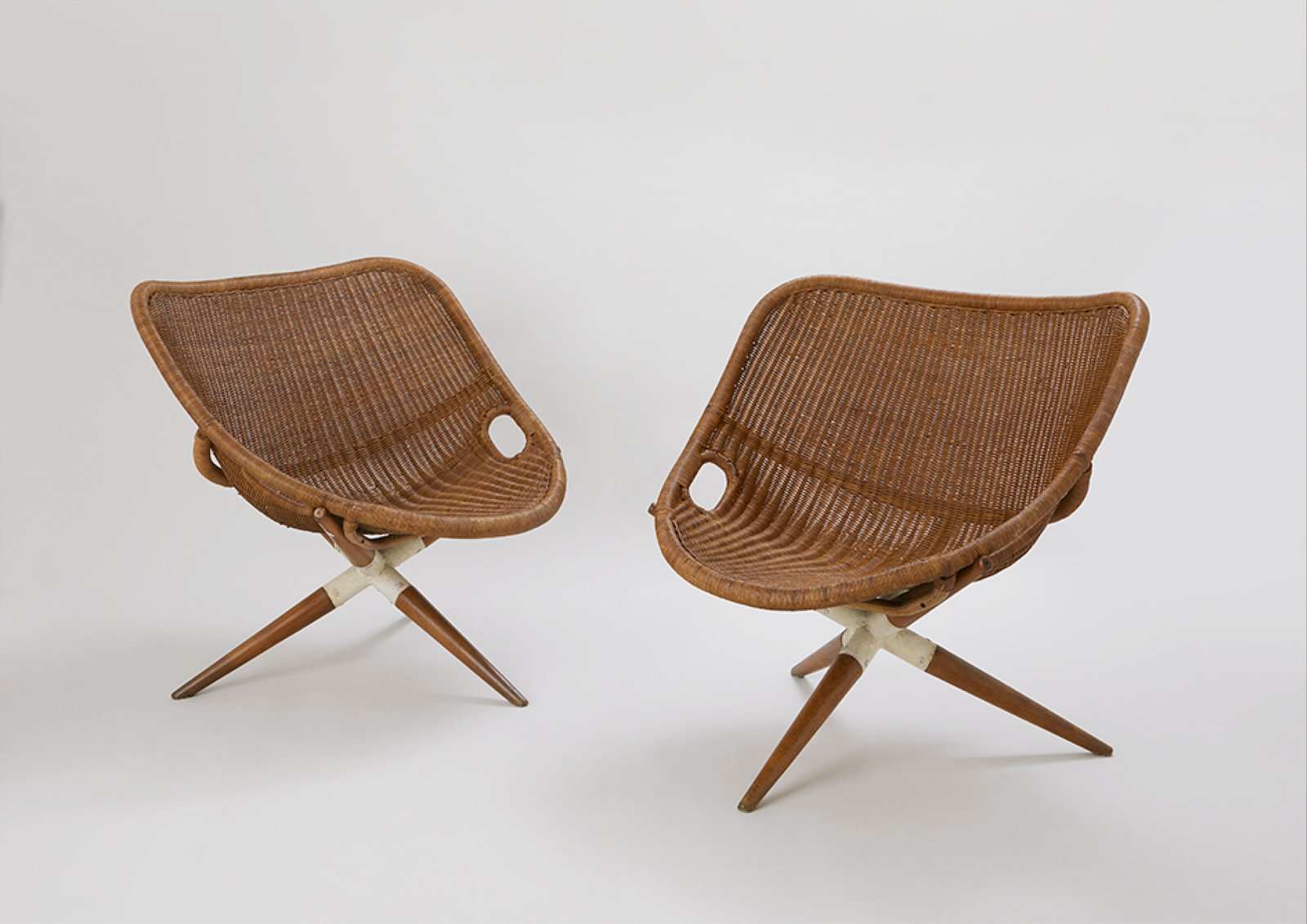
Joseph-André Motte: from Tripode to Catherine
Tripode: from basket to seat
The Tripode chair, designed in 1949 according to both sources, transforms a basket-like form into a seat with two handles. The thesis describes a woven rattan-core shell screwed onto six tapered wooden elements joined by a central metal component. Lightness and ease of handling contribute to the chair’s use as well as its appearance.
The design date should be distinguished from the date of its presentation at the Salon des arts ménagers, placed in 1953 in note 394 of the thesis [1, p. 173; 2].
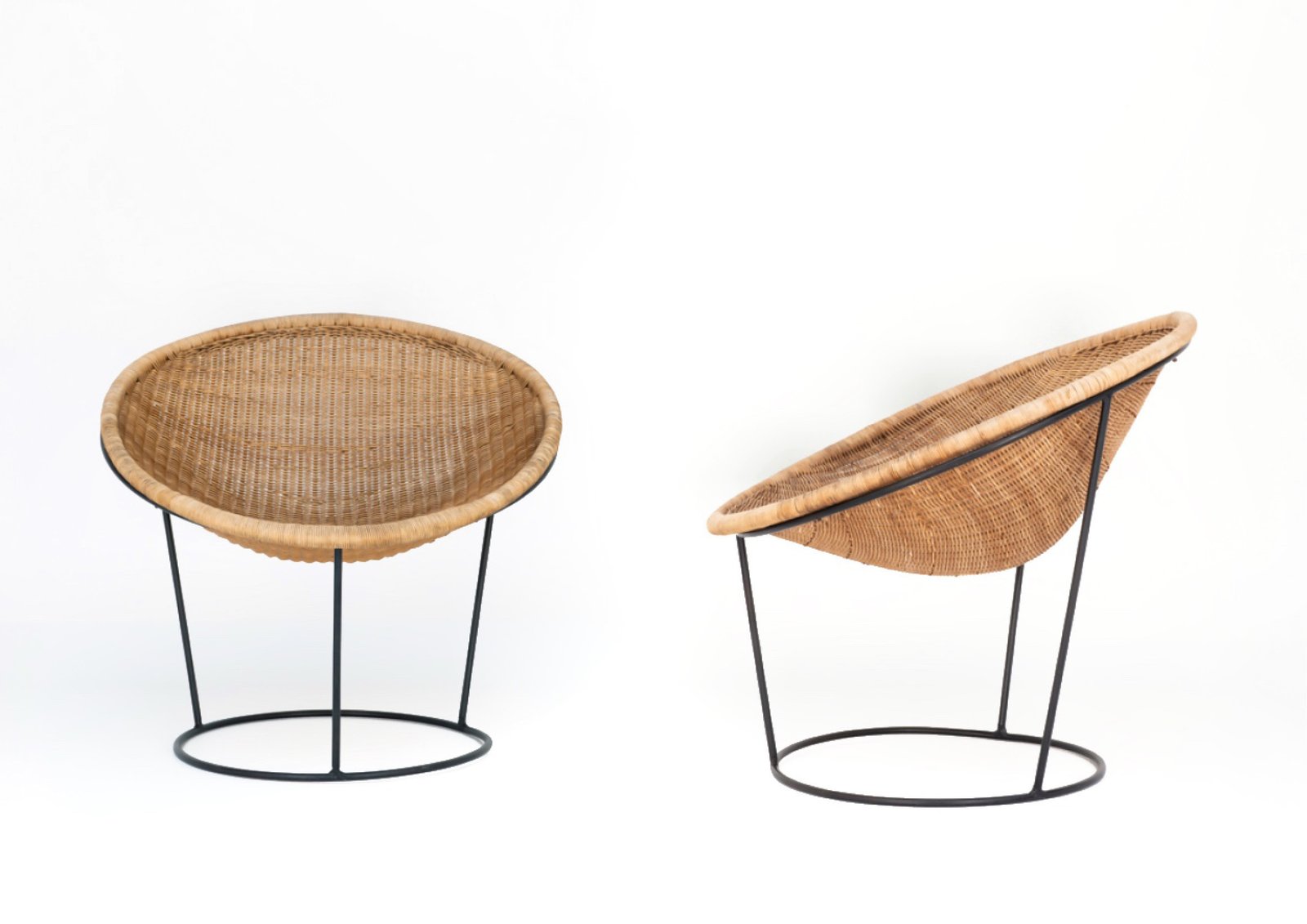
Catherine: separating shell and support
With the Catherine chair, dated 1952, the seat takes the form of a broad bowl carried on a metal structure. The contrast between the woven surface and the slender supports makes the construction particularly clear. Considering these two models together reveals the variety of solutions explored by Joseph-André Motte using the same material.
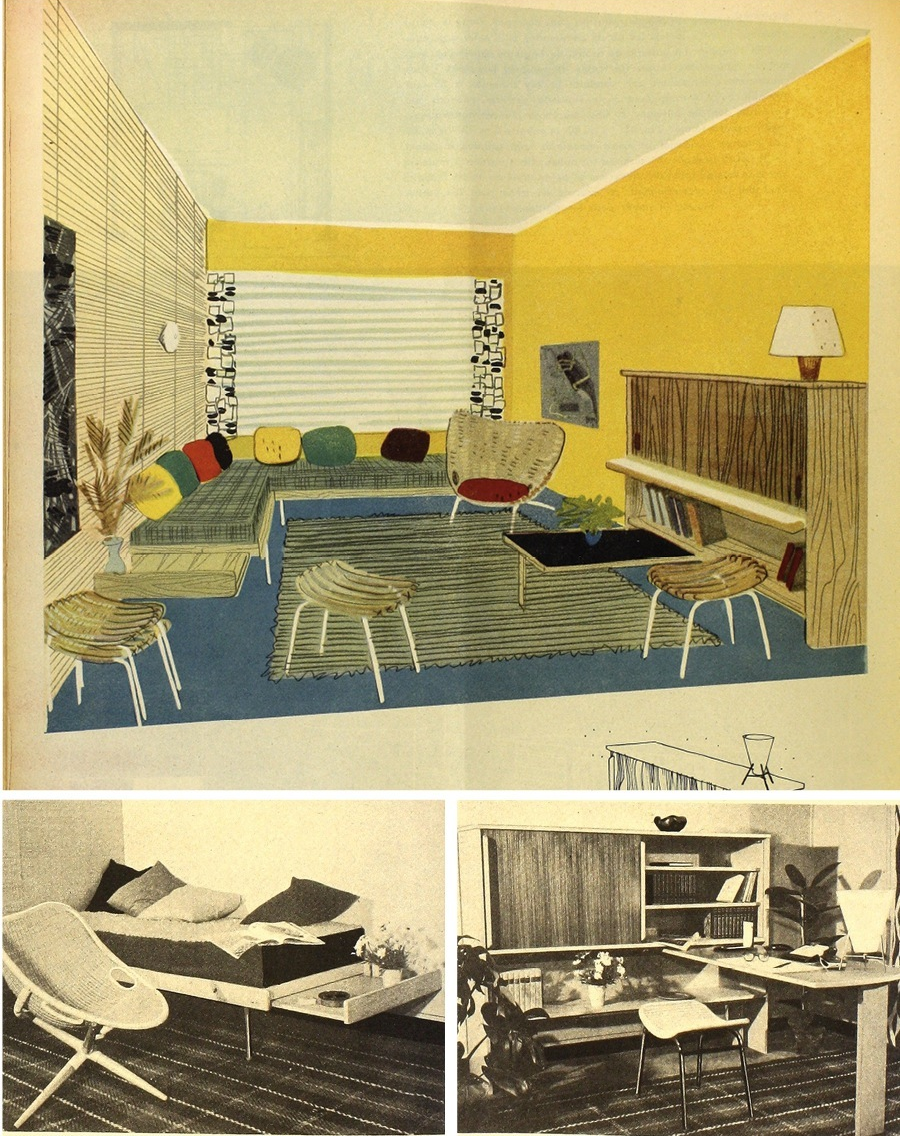
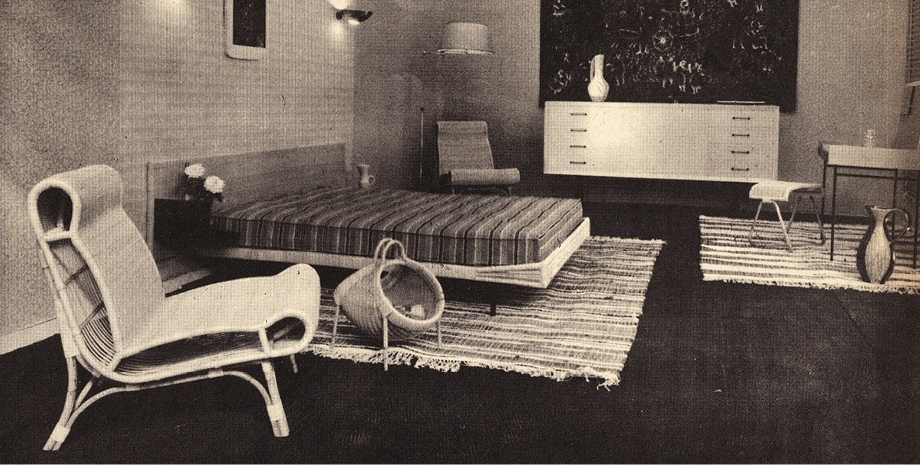
The presentation of Joseph-André Motte’s stand in the March 1953 issue of Meubles et décors places Tripode within a furnished interior. In the lower-left photograph, its woven shell and support appear beside a daybed: the chair belongs to an arrangement that brings seating, storage and sleeping together [1, p. 512, fig. 401].
Janine Abraham and Dirk Jan Rol: the geometry of Soleil
In the second half of the 1950s, the Soleil chair by Janine Abraham and Dirk Jan Rol developed another relationship between the seat and its surrounding space. Its curved elements form an open envelope around the seat. Repeated lines give the object its presence while allowing the eye to pass through it.
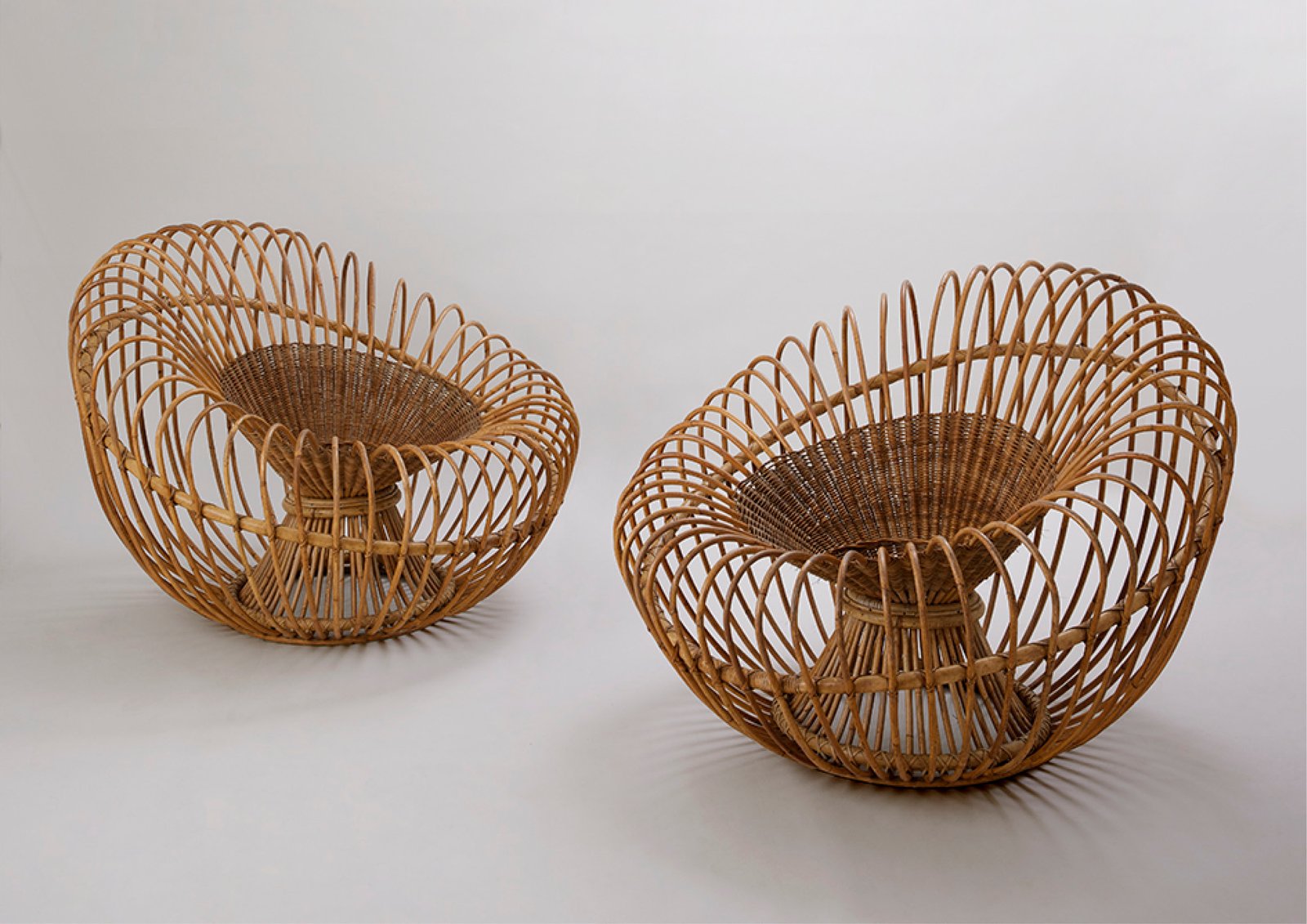
These experiments formed part of a collaboration with Rougier and the rattan trade association. The thesis documents the Ressort chairs and Citron armchairs by Janine Abraham and Dirk Jan Rol at the 1957 Salon des arts ménagers, combining rattan and metal with the involvement of the metalworker Zanin. Their modern character also depended on this distribution of skills between design, rattan work and metalwork [1, pp. 174–175].
The view of the Rougier stand at the 1955 Marseille Fair broadens the enquiry to interior design. It documents the place of rattan within a furniture ensemble by Janine Abraham, beyond the isolated chair [1, fig. 707].
Louis Sognot: building with cane and open space
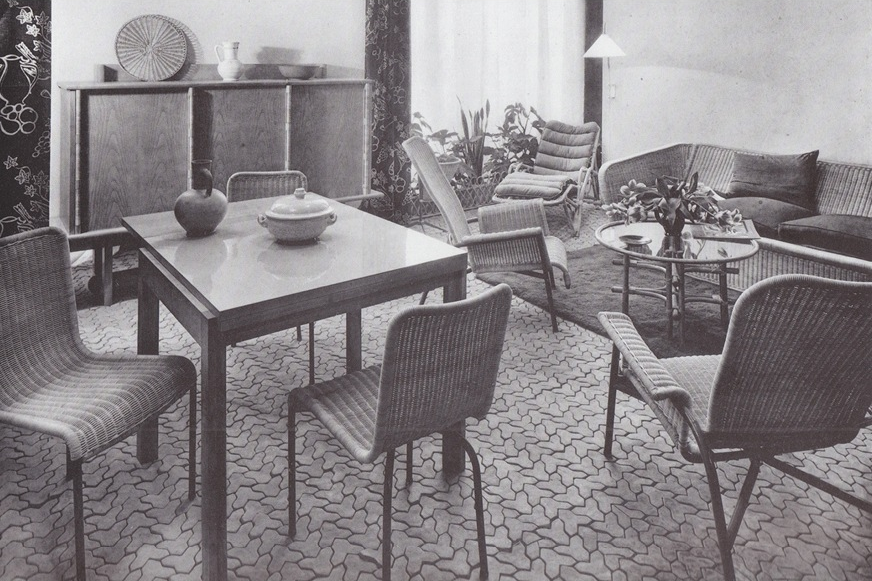
Louis Sognot’s interest in rattan extends the enquiry to furniture and interior design. The photograph of his stand with the rattan industries’ trade association at the 1951 Salon de la Société des artistes décorateurs shows the material used at different scales: dining chairs, armchairs, a settee and tables form an ensemble. Rattan contributes to the organisation of an interior, beyond the individual armchair [1, pp. 83–84; p. 477, fig. 223].
A low table by Louis Sognot, produced by Chevallier and dated 1950 in Demisch Danant’s entry, offers another point of observation [3]. Through the glass top, one can see the supporting canes, their connections and the openwork element below. Glass and rattan perform distinct roles: one provides a flat, transparent surface, while the other defines the frame and curves of the furniture.
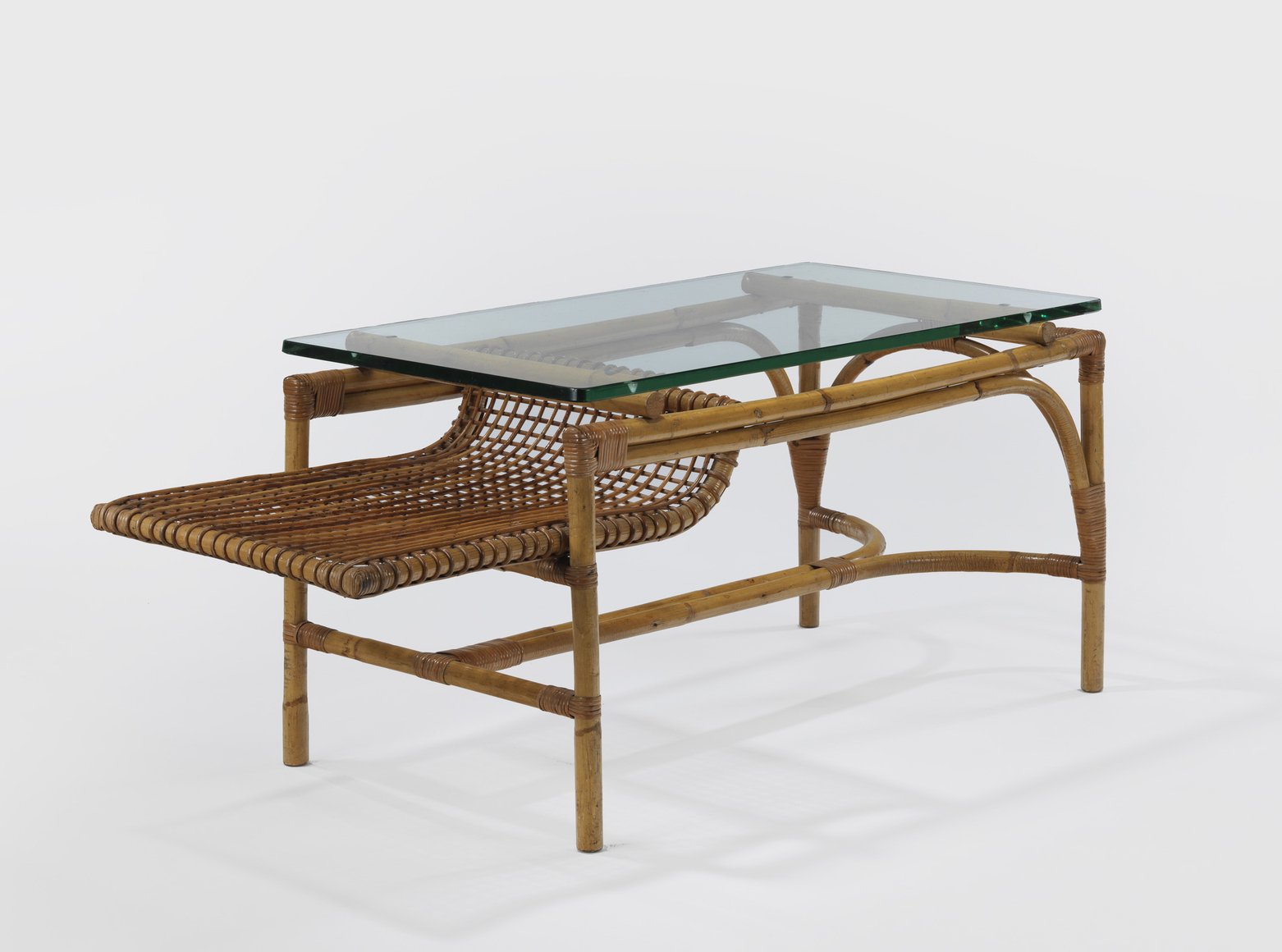
Bringing the archive together with this contemporary photograph invites us to examine how bending, bindings and the combination with glass make construction legible. It illuminates the variety of Louis Sognot’s work without identifying the table presented by Demisch Danant with the models visible in the 1951 stand.
Looking at and documenting rattan furniture
The comparison distinguishes three levels: the properties of the material, the designer’s decisions and the capabilities of the workshop or manufacturer. The differences between Tripode, Catherine and Soleil show that one material allows different constructions. Rattan can thus be studied as a set of technical possibilities, used in relation to specific projects.
A designer’s name, a design date or a manufacturer alone cannot establish the history of each example. Period photographs, publications, dimensions and construction details must be compared with the object. Production figures and the exact circumstances of commissions would require further verification in manufacturers’ archives.
Rattan illuminates a form of modernity rooted in the reinterpretation of craft knowledge. Weaving can produce a load-bearing surface, bending can define an envelope, and combining rattan with metal can distinguish seat from support. To understand French furniture of the 1950s, we need to examine what designers did with materials and the conditions under which their proposals became objects.
Explore DIZAGN research · Discover our approach to expertise.
Corpus and method. This research article brings together Thibault Lannuzel’s thesis, the descriptions and photographs in Galerie Pascal Cuisinier’s “Le Rotin 1950” newsletter, and Demisch Danant’s entry for a low table by Louis Sognot, Edition Chevallier. Formal comparisons are readings of the documents, without physical examination of the illustrated furniture. They establish neither direct lines of influence between designers nor the manufacturing chronology of individual examples.
Sources and references
- Thibault Lannuzel, Génération Formes Utiles. Étude d’un groupe de designers en France, 1945–1973, doctoral thesis in contemporary art history, Université Paris IV–Paris-Sorbonne, supervised by Arnauld Pierre, defended on 19 November 2016. Chapter IV, “L’industrie française innove”, section “Le rotin”, pp. 172–176; section on Louis Sognot, pp. 83–84; figs. 223 (p. 477), 401 (p. 512), 503–504 and 701–720. References follow the thesis’s printed pagination.
- Galerie Pascal Cuisinier, FOCUS // Le Rotin 1950 // Rattan 1950, newsletter dated 1 October 2026, dossier supplied to DIZAGN. Galerie Pascal Cuisinier.
- Demisch Danant, Louis Sognot, Low Table, 1950, Edition Chevallier, entry DS0001 and photograph, accessed 2 October 2026.
DIZAGN text based on Thibault Lannuzel’s doctoral research. A comparative synthesis of sources, not a physical appraisal of the illustrated examples.