
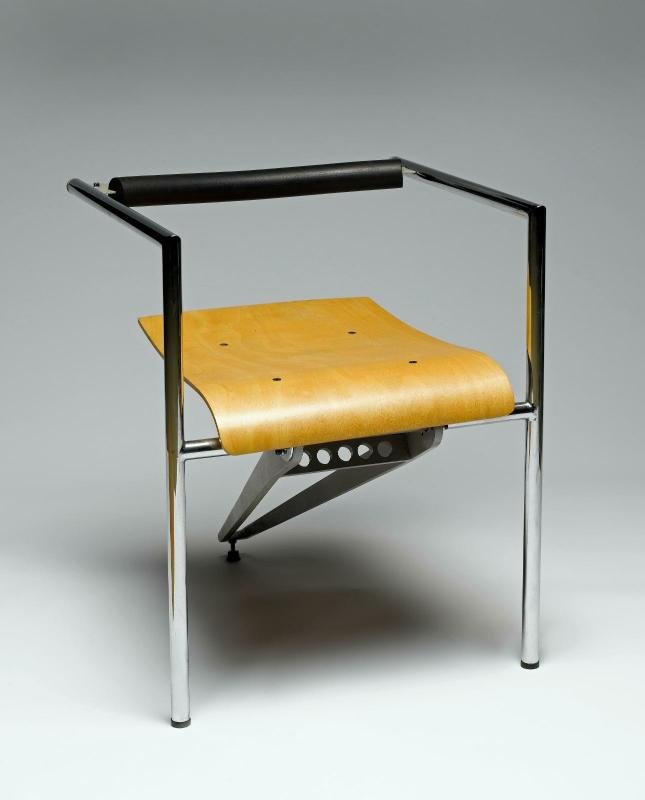
XM3 chair, 1986. Centre Pompidou, MNAM-CCI / VIA donation — all rights reserved.
XAVIER MATÉGOT
BORN IN 1956 · ARCHITECT · DESIGNER · FURNITURE · MEDICAL AND URBAN EQUIPMENT
Xavier Matégot belongs to a generation of French designers who, in the 1980s, renewed the dialogue between architecture, industry, and furniture. Trained and practicing as an architect, he dedicates part of his work to design, particularly in highly technical fields such as hospital and medical equipment.
His XM series, developed in the mid-1980s with publisher Christian Farjon and the support of VIA, constitutes the most documented expression of his furniture work. It combines steel, aluminum, molded wood and industrial components in deliberately legible, light and taut structures.
BIOGRAPHY
Born in Paris in 1956, Xavier Matégot began his career as an architect. This training explains his approach to furniture design: not as an independent decorative exercise, but as a construction subject to forces, assemblies, constraints of use, and a spatial logic. In his freelance practice, he works in several design sectors, with a particular focus on hospital and medical equipment, a field where ergonomic and technical precision is paramount.
He also works on residential furniture, office furniture, and urban equipment. This diversity is characteristic of French design in the 1980s, when the discipline moved away from the domestic sphere alone to encompass work systems, healthcare, public spaces, and new forms of industrial production.
In the mid-1980s, Matégot developed the XM collection. The project benefited from the VIA (Valorisation de l'Innovation dans l'Ameublement) program, an organization created to promote research, prototyping, and collaboration between designers and manufacturers. The Centre Pompidou now holds an XM3 chair, a product of this 1986 grant, which entered the collection through a VIA donation in 2010.
The series is produced by Christian Farjon. It comprises several types: XM3 armchairs and chairs, the XM4 desk, XM7 folding chairs, and other developments based on the same design principles. The collection reflects a desire to reduce furniture to a few clearly differentiated elements: a metal frame, a molded wood seat or backrest, aluminum components, and sometimes technical elements borrowed from industrial design.
The XM3 armchair is particularly iconic. Its steel and aluminum structure defines the armrests and the double front base, while a rear aluminum support creates an almost architectural tension. The molded wood seat appears to float within this network of lines. The backrest, treated as an independent band, reinforces the impression of lightness.
This design language is found in the other models in the range. Xavier Matégot's furniture avoids massive volumes, favoring structure, negative space, and the visible articulation of components. Metal is not merely a support; it becomes the design itself. Molded wood introduces a warmer, more tactile surface into a deliberately technical construction.
The presence of the XM3 in the collections of the National Museum of Modern Art confirms the place of this research in the history of French design in the 1980s. It also testifies to the major role played by VIA in the emergence of a generation of designers working between architecture, industry and experimentation.
Public documentation devoted to Xavier Matégot remains more fragmentary than that of many designers of the previous generation. Nevertheless, the XM series, the VIA archives, and the preserved or published models constitute a sufficiently coherent body of work to identify a personal style: architectural rigor, economy of materials, a deliberate use of industrial components, and a constant pursuit of lightness.
WORK AND FORMAL LANGUAGE
Xavier Matégot's furniture is characterized by a strong sense of construction. Steel tubes, cast iron or aluminum profiles, molded wood, foam, and mechanical elements remain visible and retain their autonomy. The designer does not seek to conceal the technical aspects; he uses them as a visual vocabulary.
This approach gives the pieces an airy, often asymmetrical silhouette, in which negative space plays a crucial role. The structure may evoke a framework, a machine, or a piece of technical equipment, but it retains a graphic precision that prevents the furniture from being gratuitously brutalist.
PUBLISHERS AND COLLABORATORS
Christian Farjon · VIA — Valorisation de l'Innovation dans l'Ameublement (Valuation of Innovation in Furniture) · collaborations related to the fields of architecture, medical furniture, office furniture and urban equipment.
SELECTIVE CHRONOLOGY
1956 — born in Paris 1980s — architectural practice and design research 1985–1987 — development of the XM series 1986 — XM3 supported by VIA grant for creation and published by Christian Farjon 2010 — entry of the XM3 into the collections of the Centre Pompidou by donation from VIA.
SELECT BIBLIOGRAPHY
Yvonne Brunhammer & Marie-Laure Perrin, French Furniture 1960–1998, Massin, 1998 · catalogue VIA Design 3.0, Centre Pompidou, 2009 · documentation VIA and Christian Farjon · Centre Pompidou collection notice dedicated to the XM3 chair.
PUBLIC COLLECTIONS
Centre Pompidou / National Museum of Modern Art, Paris: XM3 chair, 1986, steel and aluminum structure, molded wood seat, foam backrest, gift of VIA / French Furniture Industries, 2010, inv. AM 2010-1-90.
XAVIER MATÉGOT AT DIZAGN
AVAILABLE WORK
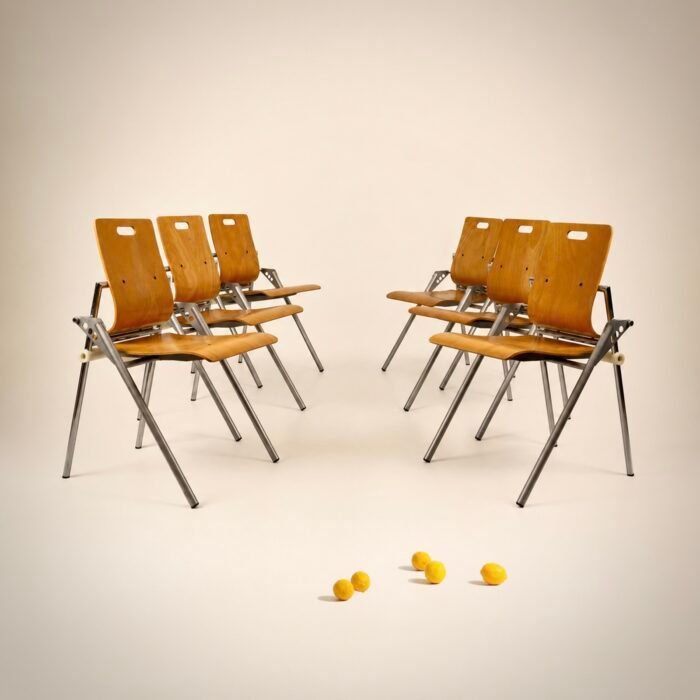
DIZAGN ARCHIVES — WORKS SOLD
Pieces already processed by DIZAGN and kept online for documentary purposes.


DIZAGN Expertise → Thibault Lannuzel →
Main sources: Centre Pompidou; VIA; DIZAGN documentation. Manifesto image: XM3 chair — all rights reserved.