
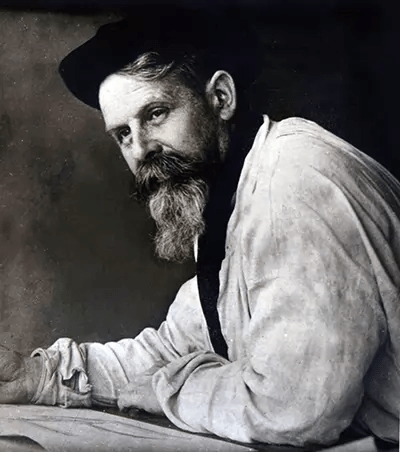
Louis Majorelle — period portrait, public domain.
LOUIS MAJORELLE
1859–1926 · Cabinetmaker · Industrialist of Art · Furniture · Ironwork · School of Nancy
Louis Majorelle is one of the major figures of Art Nouveau in Nancy. An artist, cabinetmaker, and industrialist, he helped transform a family business of furniture and decorative objects into a factory capable of producing and distributing on a large scale a modern language inspired by nature.
His work is characterized by the unity between design, material, and decoration: sculpted wood, marquetry, ironwork, and light fixtures all share the same organic vocabulary. The Villa Majorelle, built in Nancy for his family, represents the most spectacular synthesis of this concept.
BIOGRAPHY
Louis Majorelle was born in Toul in 1859. His father, Auguste Majorelle, was a decorator and art dealer. Settling in Nancy from 1860, he developed a furniture and earthenware business which would form the basis of the family business.
Louis initially received artistic training. In Nancy, he studied under Théodore Devilly and Charles Pêtre at the École des Beaux-Arts. In 1877, he was admitted to the École des Beaux-Arts in Paris, studying in the studio of the painter Aimé Millet. However, the death of his father in 1879 interrupted this path: he returned to Nancy and took over the family business alongside his mother, and later his brother Jules.
In its early days, the Majorelle company still produced furniture inspired by historical styles. But at the end of the 19th century, Louis Majorelle gradually moved away from these references and became interested in the new trends sweeping across Europe. He became close to Émile Gallé and the Nancy-based designers who were seeking to develop a modern art inspired by the plant world and regional craftsmanship.
Majorelle's furniture then adopted more flexible structures and an organic style. Lines were no longer simply applied to the surface; they seemed to extend the growth pattern of a plant. Stems, branches, flowers, vines, and veins inspired not only the shape of the legs but also the design of the crossbars, handles, and marquetry.
The company's success was confirmed at the 1900 Paris Universal Exposition. The Majorelle workshops were then able to combine high artistic ambition with a significant industrial organization. The company opened stores in several French cities and widely distributed its designs, contributing to the international renown of the Nancy School.
Ironwork also gained increasing importance. From 1897 onwards, the workshops developed this activity for handles and locks, then for railings, architectural elements, and lamp bases. This mastery of metal allowed Majorelle to extend his vocabulary to interior architecture and lighting.
The collaboration with the Daum factory was particularly fruitful. Majorelle designed metal frames to hold Daum glassware, creating light fixtures in which bronze or wrought iron and glass seemed to belong to a single entity. This partnership between two major Nancy-based companies contributed to the local Art Nouveau identity.
In 1901, Émile Gallé founded the Provincial Alliance of Art Industries, better known as the École de Nancy. Majorelle was one of the movement's leading figures. His role was essential because he embodied the link between artistic creation and industry: his designs were not merely exhibition pieces; they were conceived to be manufactured in a structured workshop and marketed beyond a circle of collectors.
Villa Majorelle, designed around 1901–1902 by Henri Sauvage for Louis Majorelle and his family, is a manifesto of this philosophy. The first fully Art Nouveau house in Nancy, it brings together the contributions of Jacques Gruber for the stained glass, Alexandre Bigot for the stoneware, Francis Jourdain and Henri Royer for the painting, while Majorelle himself created the furniture, woodwork and ironwork.
The house therefore does not function as a mere showcase for objects: architecture, decor, and furniture are conceived as a whole. The dining room, the living room, the staircase, and the ironwork all bear witness to the idea of "unity of art" so dear to the Nancy School.
In the years that followed, the Majorelle workshops developed several series that became iconic: Water Lilies, Orchids, Wheat, Viburnum, and Umbellifers. The names of the models reveal the importance of botany in their design. This reference, however, is never literal: the plant motifs are stylized and integrated into the structure of the furniture.
The First World War weakened the Nancy business, but the company continued production after 1918. However, tastes evolved towards more geometric forms, and the Art Nouveau style gradually lost its dominant position. Majorelle adapted some of his designs without completely abandoning the rich material and construction that had brought him success.
Louis Majorelle died in Nancy in 1926. The Majorelle Frères company continued its activity under another management until 1956. His work remains today inseparable from the identity of Nancy and the collections of the Musée de l'École de Nancy and the Musée d'Orsay.
WORK AND FORMAL LANGUAGE
Majorelle's design language is built around organic lines and the quality of materials. The structure of the furniture is often set in motion by curves that evoke stems or branches. Marquetry introduces flowers and foliage, while metalwork extends the same rhythms in the hardware and lighting fixtures.
Its originality also stems from the balance between craftsmanship and production. The workshops have significant industrial resources but retain demanding techniques: cabinetmaking, sculpture, marquetry, bronze work, and ironwork. This organization allows the same vocabulary to be applied across several ranges and levels of refinement.
WORKSHOPS AND COLLABORATIONS
Maison Majorelle then Majorelle Frères · École de Nancy · collaborations with Daum for lighting fixtures · Villa Majorelle with Henri Sauvage Jacques Gruber, Alexandre Bigot, Francis Jourdain, Henri Royer and Lucien Weissenburger.
SELECTIVE CHRONOLOGY
1859 — born in Toul 1877 — Paris School of Fine Arts 1879 — return to Nancy and takeover of the family business 1892 — partnership with his brother Jules under the name Majorelle Frères 1897 — development of ironwork 1900 — success at the Paris Universal Exposition 1901 — participation in the Nancy School 1901–1902 — construction of the Villa Majorelle 1900s — Water Lilies, Orchids, Wheat and Viburnum series 1926 — death in Nancy.
SELECT BIBLIOGRAPHY
Documentation from the Musée de l'École de Nancy · catalogue of the collections of the Musée d'Orsay · publications devoted to the École de Nancy and the Villa Majorelle · commercial catalogues of the Majorelle house.
PUBLIC COLLECTIONS
Museum of the School of Nancy and Villa Majorelle · Musée d'Orsay, Paris: furniture and lighting by Louis Majorelle, including beds, armchairs, bedside tables and lamps · numerous international collections of decorative arts.
Louis Majorelle — Museum of the School of Nancy · Louis Majorelle — Musée d'Orsay.
LOUIS MAJORELLE AT DIZAGN
DIZAGN ARCHIVES — WORKS SOLD
Pieces already processed by DIZAGN and kept online for documentary purposes.


DIZAGN Expertise → Thibault Lannuzel →
Main sources: Musée de l'École de Nancy; Musée d'Orsay; DIZAGN documentation. Portrait: public domain.