
OLIVIER MOURGUE
IN SEARCH OF THE DREAM
Master's thesis in Art History — University of Paris IV–Sorbonne — 2008–2010
Thibault Lannuzel — under the direction of Jean-Louis Gaillemin
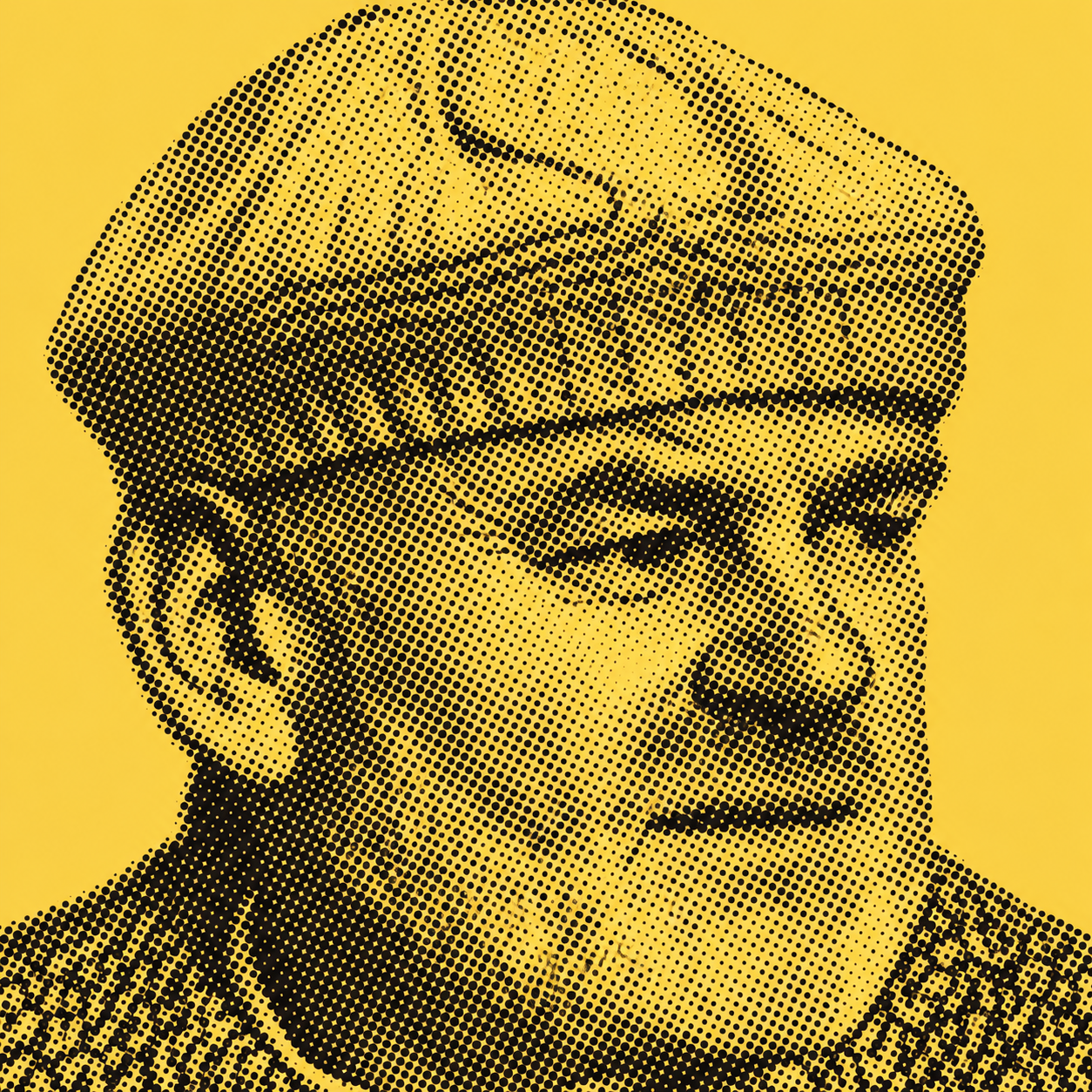
Olivier Mourgue, 1984. Airborne Catalogue. All rights reserved — photographer to be identified.
INTRODUCTION
Olivier Mourgue occupies a unique place in the history of post-war French design. His name is often associated with the Djinn series, designed in the mid-1960s for Airborne, which became one of the most instantly recognizable images of French furniture from that period. But to reduce his work to this industrial success would be to miss the point: Olivier Mourgue developed a much broader body of work, permeated by research on space, habitat, mobility, the body, materials, and the imagination.
Between 2008 and 2010, I devoted two years of research to this work as part of a Master II in Art History at the University of Paris IV–Sorbonne. This work, carried out in direct collaboration with Olivier Mourgue, was based on interviews, private and institutional archives, the systematic study of the press and period catalogues, as well as research with the Mobilier national, the Musée des Arts Décoratifs, the Centre Pompidou, the Kandinsky Library, the Archives nationales, the École des Beaux-Arts de Brest and numerous players in French design.
This DIZAGN page takes up this work today from an editorial perspective: to present Olivier Mourgue not as the author of a single iconic model, but as a creator who has continually shifted the boundaries between industrial design, interior architecture, experimentation and artistic practice.
KEY POINTS · SIX STAGES OF A JOURNEY
Summary chronology 1939–2026
- 1939–1959
Born in Paris, trained at the École Boulle and first Joker chair published by Airborne.
- 1964–1968
Djinn, Montreal, the Fleurs and Bouloum light fixtures: the body becomes a starting point.
- 1969–1972
Prisunic, Osaka, evolving housing and Visiona III: from furniture to environments.
- 1976–2005
Settling in Brittany, teaching in Brest, painting, imaginary gardens and small theatres.
- 2008–2010
Research In search of the dream, conducted by Thibault Lannuzel with Olivier Mourgue.
- 2026
Olivier Mourgue passed away on October 5th. His work and archives will be transferred.
1. RESEARCH BIRTHED IN BREST
The story of this research begins in May 2008. I was looking to dedicate my academic work to a French designer from the 1960s. The choice of Olivier Mourgue quickly became obvious, but one question remained: how to get in touch with him?
I learned that he had taught for nearly three decades at the Brest School of Fine Arts. Isabelle Laurent arranged a meeting. Arriving at the school, lost among the students, I asked a passing man where Olivier Mourgue was. He led me to the studio before turning around and introducing himself. This first encounter already encapsulated something of his personality: a certain freedom, humor, and detachment from his own fame.
Following this exchange, we agreed on the initial directions of the research. The following months were devoted to reviewing periodicals, consulting archives, and meeting with curators, gallery owners, former colleagues, relatives, and students. The first year focused on the context of creation and industrial design; the second broadened the study to include space, mobility, Brittany, education, the artwork itself, and the market.
2. A SPACE DESIGNER, NOT JUST A SEATING DESIGNER
From the very beginning, Olivier Mourgue's work was distinguished by a broad conception of furniture. The seat is never simply an autonomous object: it participates in an environment, organizes postures, modifies the relationship between people and redefines interior space.
Airborne's installations and presentations at the Salon des Arts Ménagers in the 1960s are particularly revealing of this approach. They showcase furniture conceived as a system, linked to color, upholstery, accessories, and an overall scenography. Armchairs, lounge chairs, tables, and modular elements become the components of a new way of living.
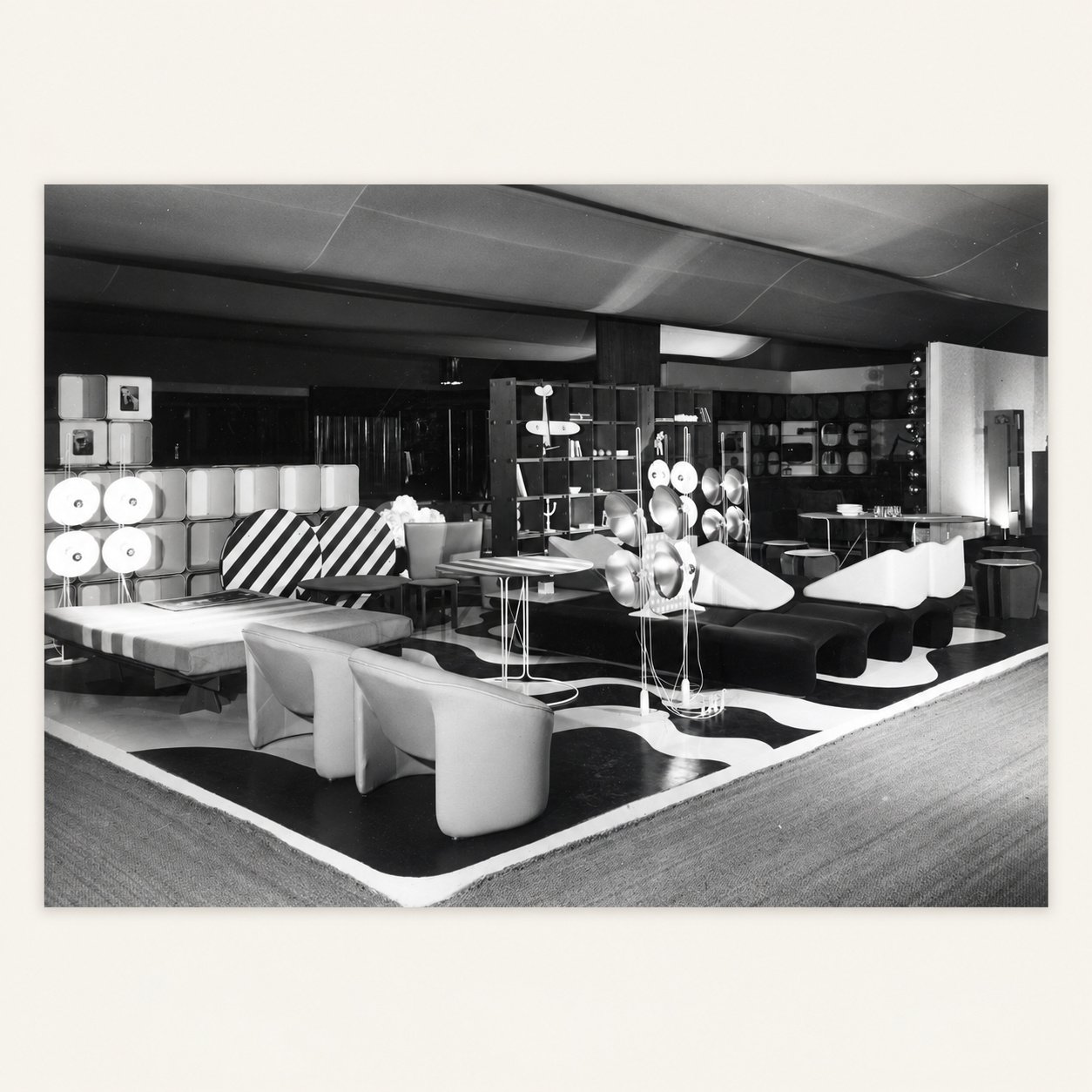
Olivier Mourgue / Airborne, Salon des Arts Ménagers, 1968. Collas Archives — Musée des Arts Décoratifs. All rights reserved — MAD / ADAGP. Photographer to be identified.
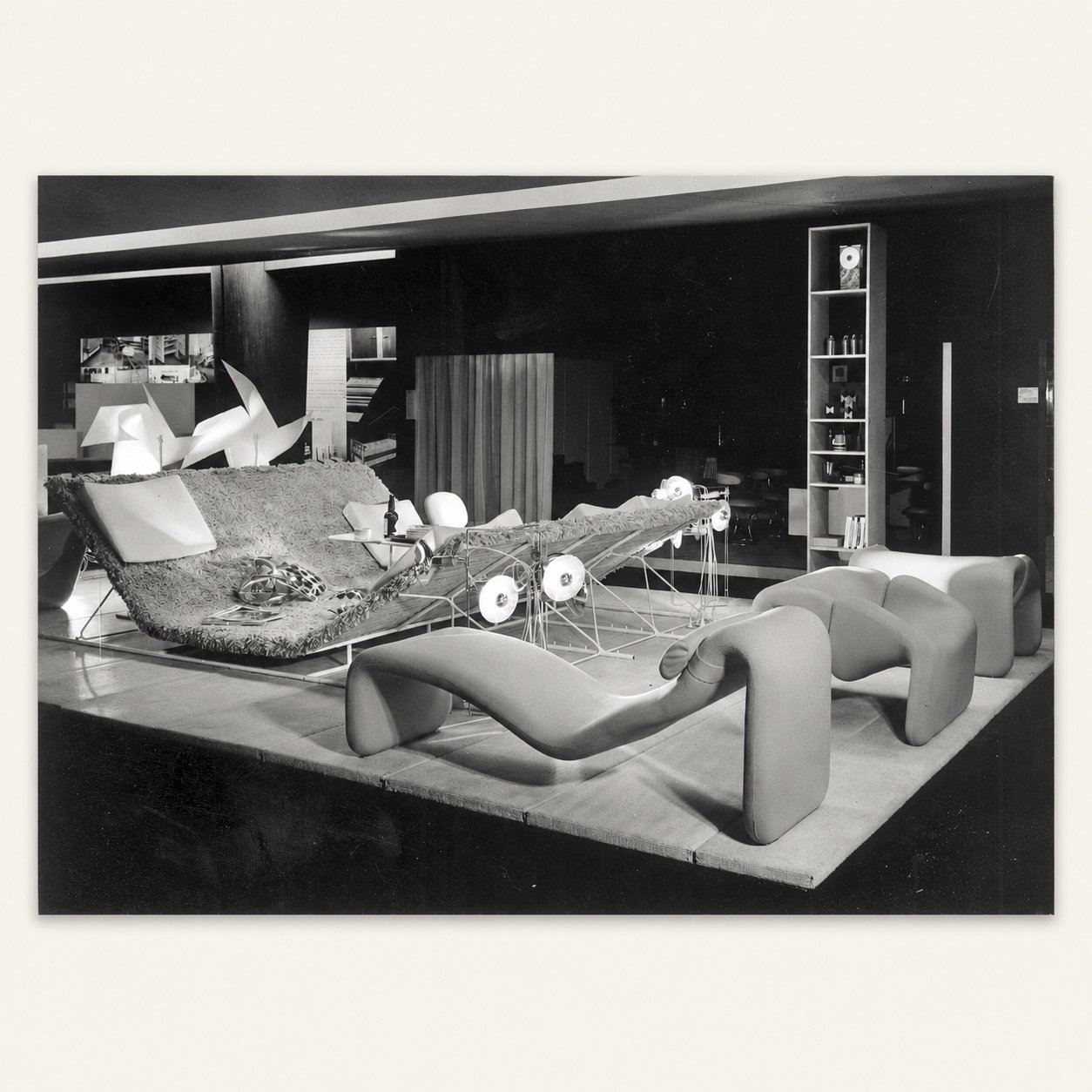
Olivier Mourgue / Airborne, Salon des Arts Ménagers, 1967. Collas Archives — Musée des Arts Décoratifs. All rights reserved — MAD / ADAGP. Photographer to be identified.
This approach reflects a broader transformation of French society: the spread of new materials, the development of industrial production, the emergence of new consumption patterns, and a questioning of domestic conventions. Olivier Mourgue therefore does not work in isolation; he fully belongs to this generation that seeks to adapt forms to new uses.
3. AIRBORNE AND INDUSTRIAL SUCCESS — DJINN
The collaboration with Airborne constitutes one of the major axes of Olivier Mourgue's career. The Djinn series, designed in the mid-1960s, condenses several of his concerns: light structure, synthetic foam, stretch textile, low and flexible silhouettes, mobility of elements and rejection of the rigidity of traditional furniture.
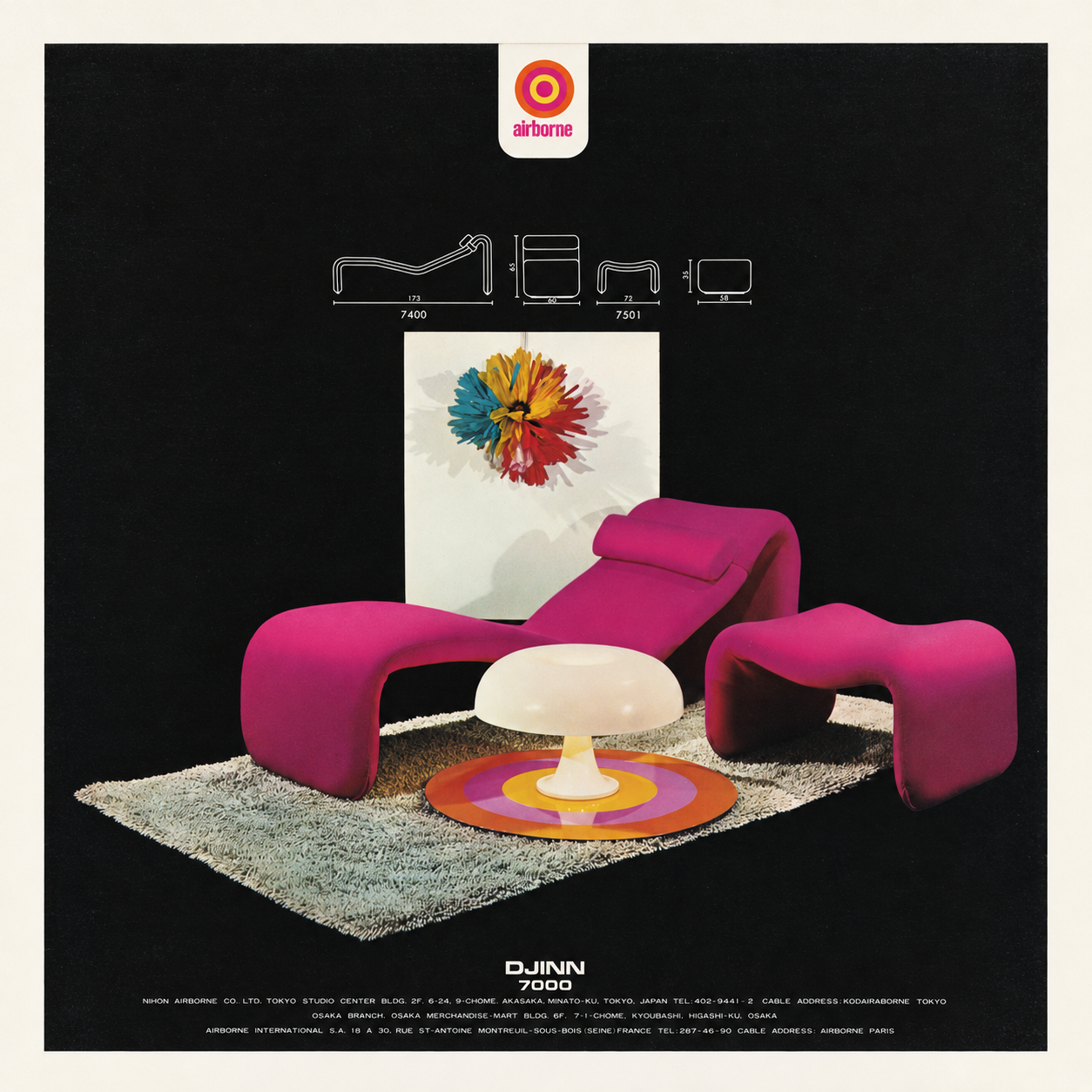
Olivier Mourgue, Djinn series, chaise longue 7400 and ottoman 7501, Airborne, catalogue 1969. All rights reserved — Airborne / ADAGP. Photo credit to be identified.
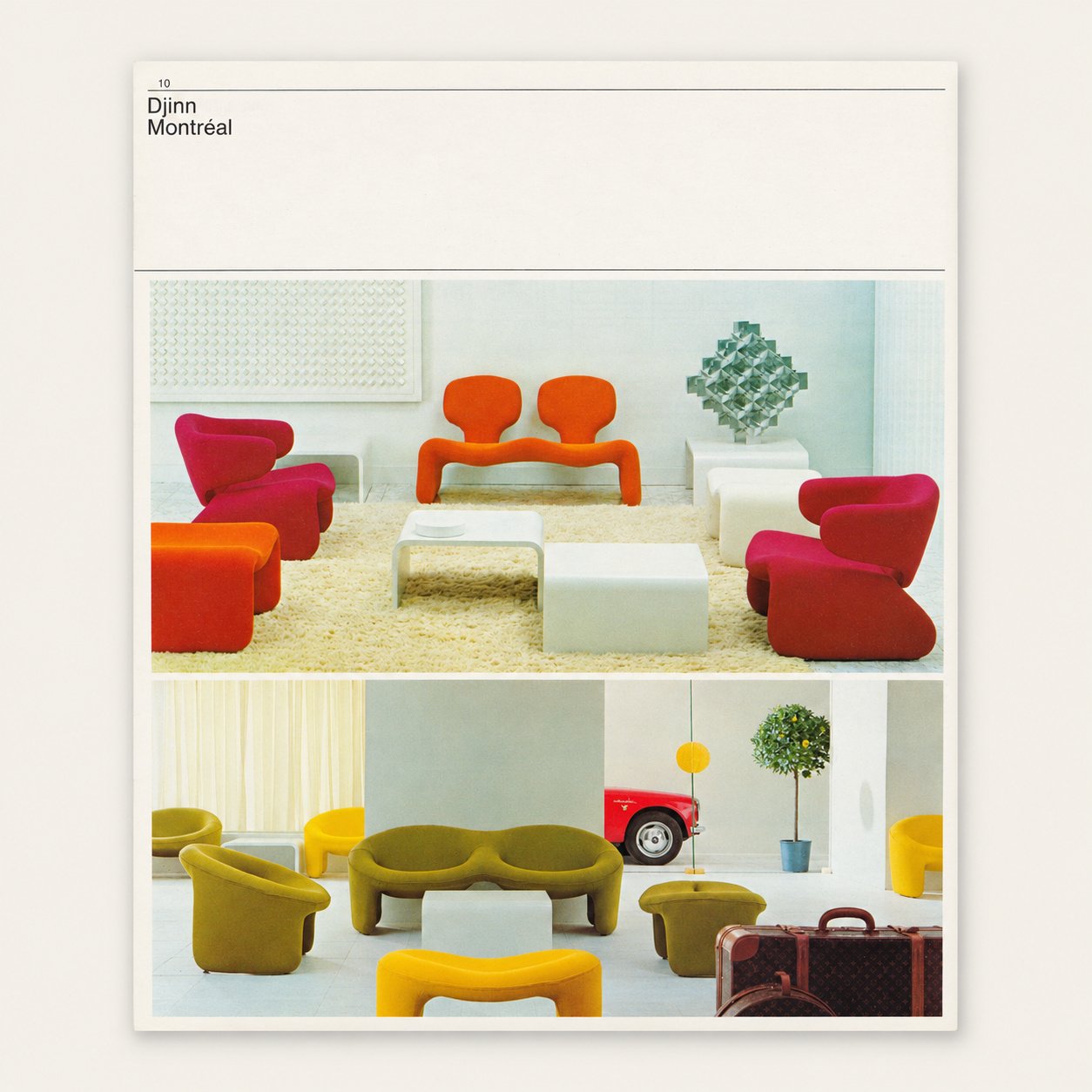
Olivier Mourgue, Djinn / Montreal, Airborne Collectivités, 1971. All rights reserved — Airborne / ADAGP.
The Centre Pompidou now holds several variations of the series and dates the Djinn models to 1964–1965. The collection includes armchairs, lounge chairs, chairs, chaise longues, poufs, and duo models. The underlying principle is therefore not that of an isolated seat, but rather that of a family of forms capable of composing an interior landscape. The Djinn seats also appear in 2001: A Space Odyssey by Stanley Kubrick, which greatly contributed to their international distribution.
The success of Djinn should not, however, overshadow the other research developed for Airborne: Joker, Whist, Tric-Trac, Montréal, Cubique, Bouloum and numerous projects intended for both the residential market and communities.
4. RESEARCH FOR HOUSING — NATIONAL FURNITURE
Beyond private publishing, Olivier Mourgue also works on public commissions and housing. His research for the Mobilier national shows a designer concerned with the complete organization of the home: integrated furniture, circulation, storage, daily uses and the capacity for evolution of spaces.
The "moving apartment" and projects related to collective housing demonstrate this ambition. Furniture is no longer simply added to a room; it becomes a tool of interior architecture. Mobile elements, storage solutions, seating, and living areas contribute to a comprehensive reflection on how a dwelling can adapt to its inhabitants.
Olivier Mourgue, research for housing. Mobilier national. All rights reserved — Mobilier national / ADAGP. Photo credit to be confirmed.
This part of his work is essential because it places Olivier Mourgue in a broader history of French research on modern housing, alongside the programs of the Mobilier national, institutional experiments and public commissions of the 1960s and 1970s.
5. DEMOCRATIC DESIGN — PRISUNIC AND MODULAR INTERIORS
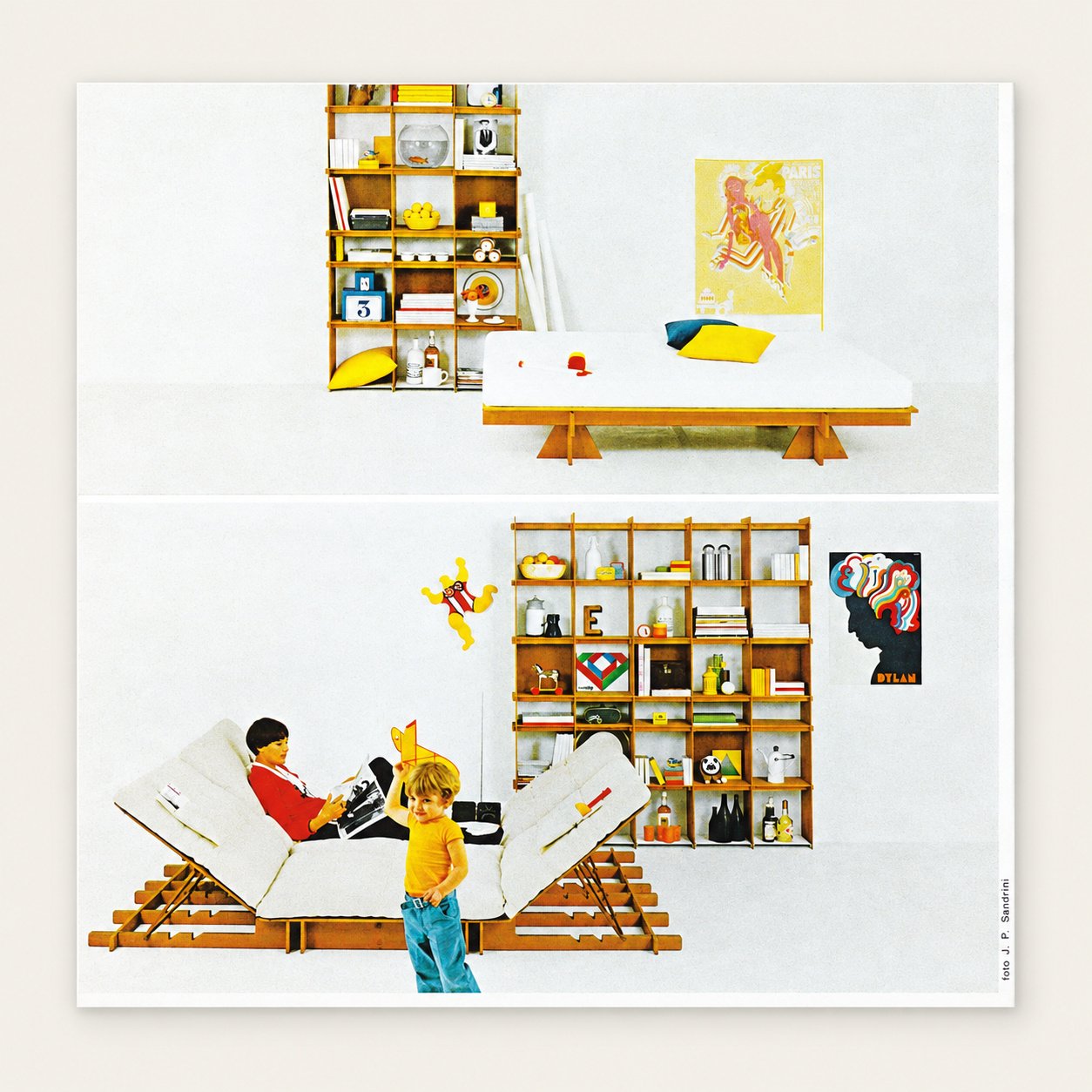
Olivier Mourgue, research for Prisunic. Domus n°473, April 1969. All rights reserved — Editoriale Domus / ADAGP. Photographer to be identified.
Olivier Mourgue is also interested in making design accessible to a wider audience. His collaboration with Prisunic reflects this desire to design accessible objects and systems adapted to ordinary domestic spaces.
Libraries, storage units, carpet-seats and modular equipment extend the thinking begun in its seating: how to do more with less? How to allow the user to recompose their environment? How to make furniture more flexible, more mobile and less authoritarian?
The rug-seat is particularly revealing of this approach. It challenges the traditional separation between furniture, textiles, and flooring. It proposes a different relationship to the body, less vertical, more informal, and contributes to the transformation of postures that permeates all design of the late 1960s.
6. MOBILITY AND NOMADISM
Mobility is gradually becoming a central theme. Olivier Mourgue imagines mobile workshops, transportable systems, autonomous equipment and projects that seek to reduce dependence on fixed architecture.
This research reveals a significant shift: the designer no longer seeks solely to improve domestic interiors, but to question the very permanence of housing. Travel, transportation, temporary living, and autonomy become subjects of design.
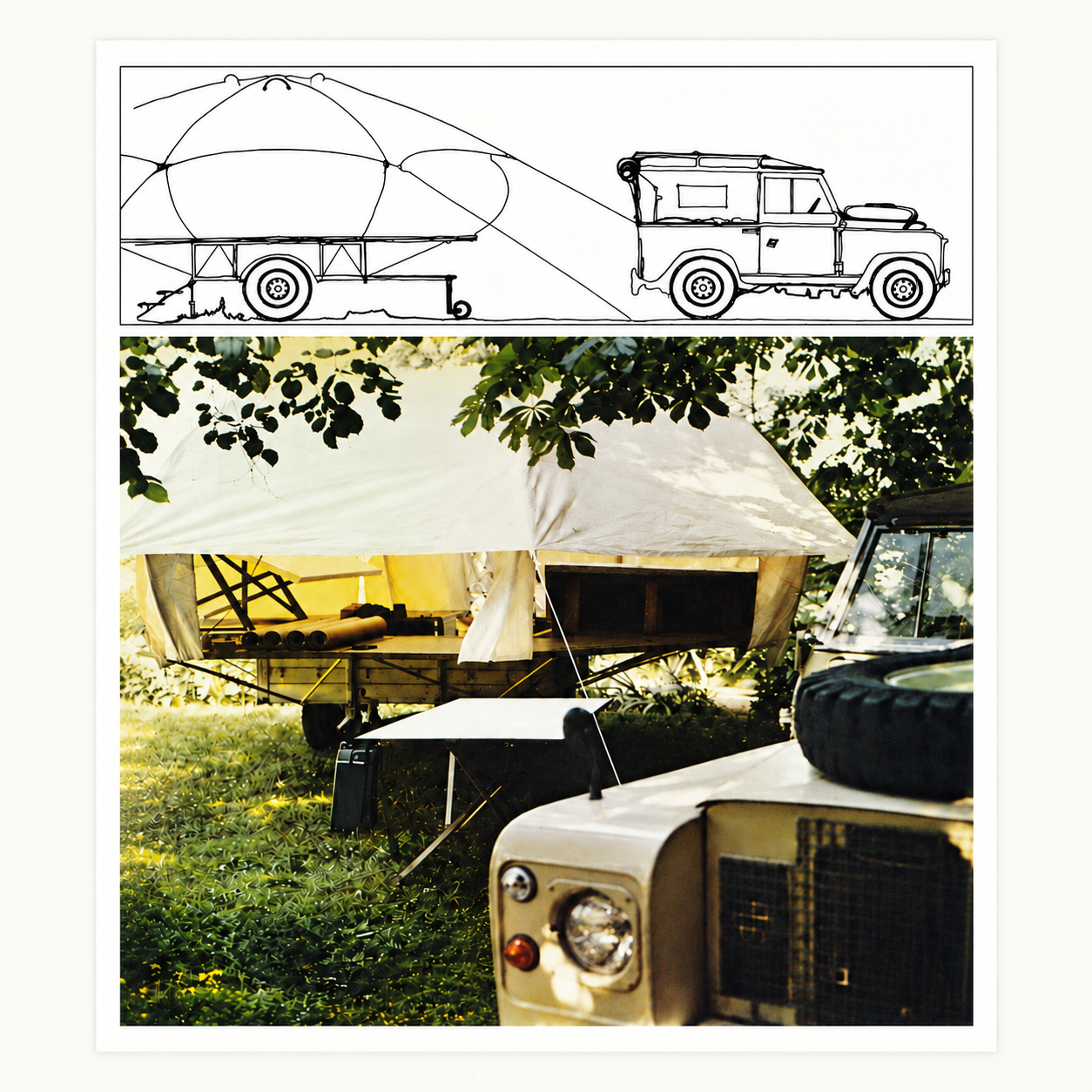
Olivier Mourgue, Mobile workshop. Abitare n°95–96. All rights reserved — Abitare / RCS / ADAGP. Photographer to be identified.
This direction reflects certain contemporary concerns surrounding modularity, lightweight housing, and nomadic lifestyles. It also demonstrates how Olivier Mourgue is gradually moving away from the sole status of furniture designer to become a designer of situations and uses.
7. BOULOUM — THE BODY, PLAY AND THE SCULPTURE-OBJECT
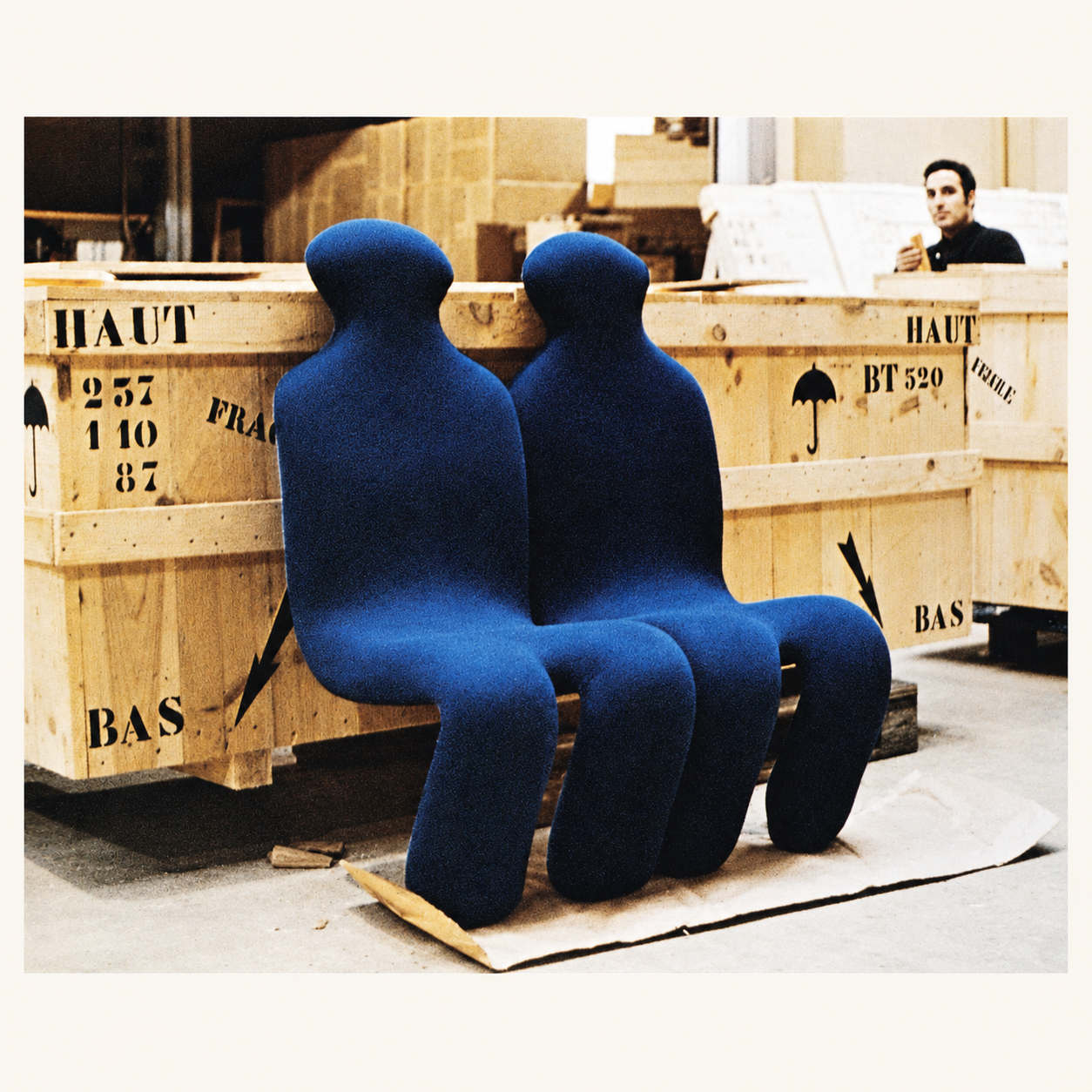
Olivier Mourgue, Bouloum, Airborne, Osaka, 1970. All rights reserved — ADAGP. Source and photo credit to be identified.
With Bouloum, the relationship between body and object becomes explicit. The anthropomorphic silhouette of the chair transforms the piece of furniture into a character. One is no longer quite sure whether to sit on it, look at it, move it, or play with it.
This ambiguity is fundamental. Olivier Mourgue is interested in objects that defy strict categorization. Bouloum is simultaneously a seat, a sculpture, a presence, and a graphic sign. Its playful nature should not be mistaken for mere formal whimsy: it is part of a deeper exploration of the emotional connection users can have with objects.
Presented in an international context, particularly around the Osaka World Expo in 1970, Bouloum became one of the models that best embody the transition from functional design to a freer, more organic universe closer to the imagination.
8. LIVING DIFFERENTLY — INTERIOR LANDSCAPES
Around 1970, Olivier Mourgue developed proposals that aimed to eliminate the isolated object in favor of veritable interior landscapes. His "conversation corners," experimental apartments, and flexible environments sought to create zones of use rather than traditional furniture arrangements.
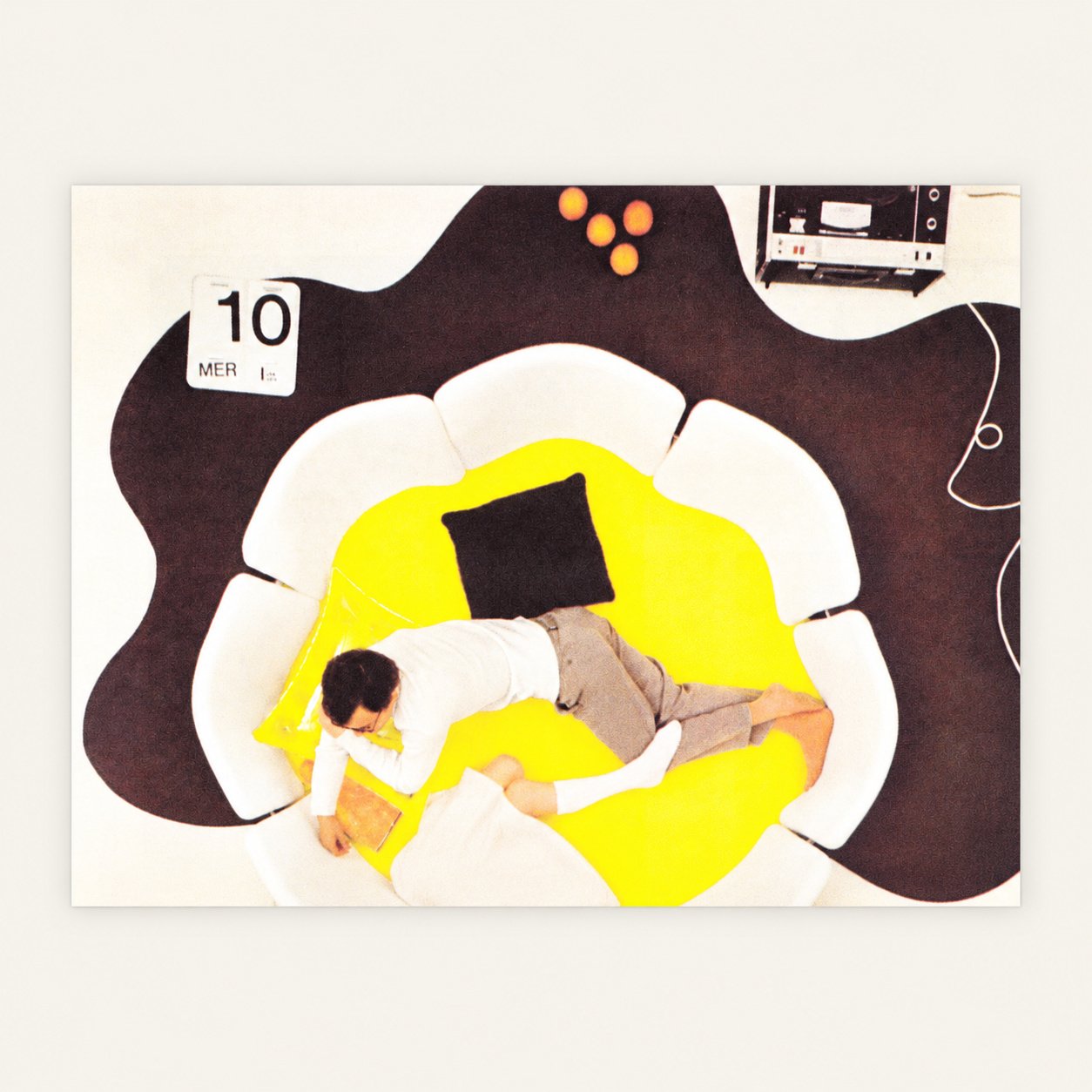
Olivier Mourgue, Conversation corner. Schöner Wohnen, 1972. All rights reserved — Schöner Wohnen / ADAGP. Photographer to be identified.
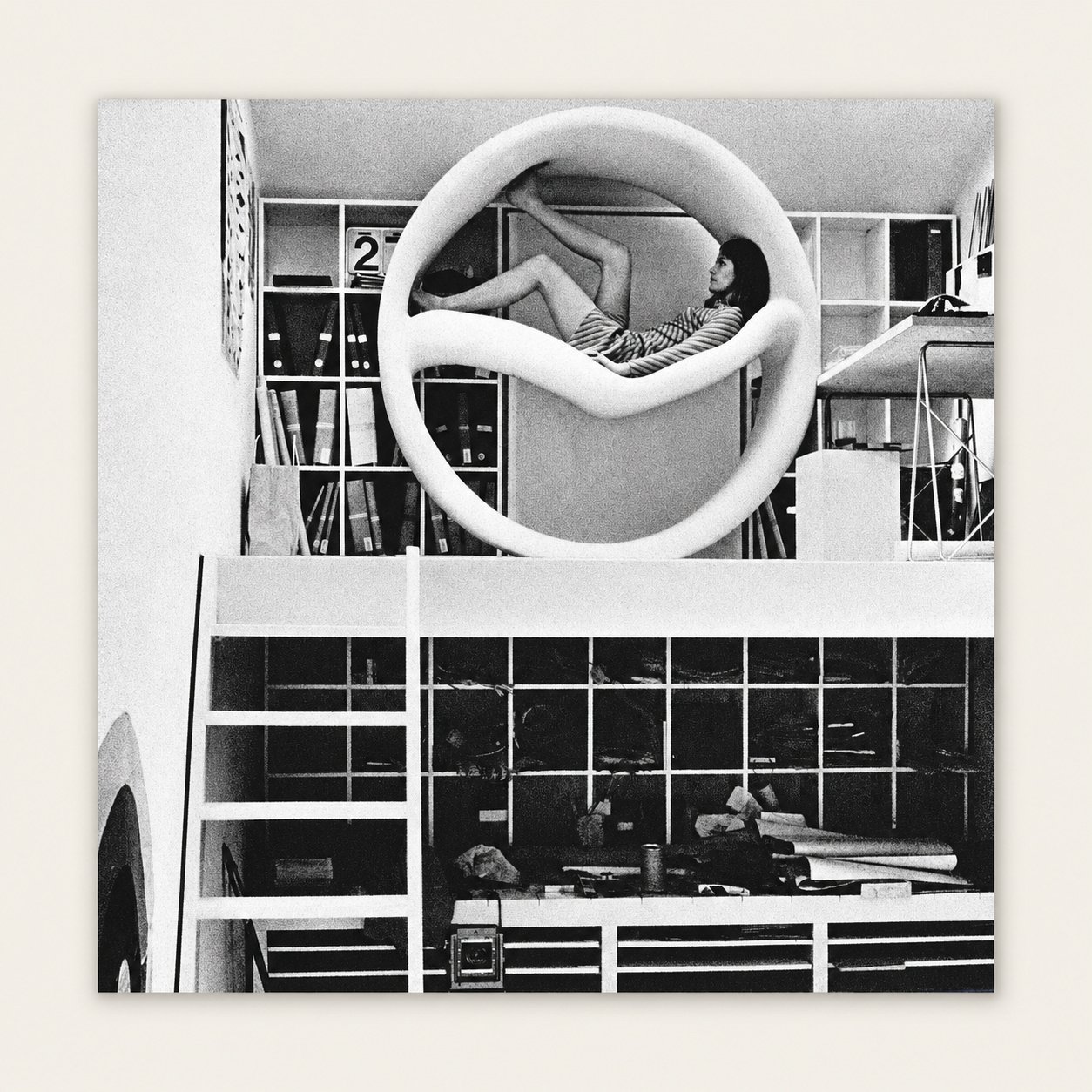
Olivier Mourgue, experimental apartment. Domus no. 452. All rights reserved — Editoriale Domus / ADAGP. Photographer to be identified.
This approach transforms the body's position in space. We sit lower, we lie down, we get closer to the ground, we gather together. The traditional hierarchies between living room, seat, table, and circulation become less distinct. The interior is conceived as a territory to be explored.
This research finds a particularly spectacular extension in comprehensive development projects and immersive environments. Olivier Mourgue no longer simply designs objects: he seeks to produce atmospheres.
9. CAFETERIA UNIT — INTERIOR ARCHITECTURE AND IMMERSION
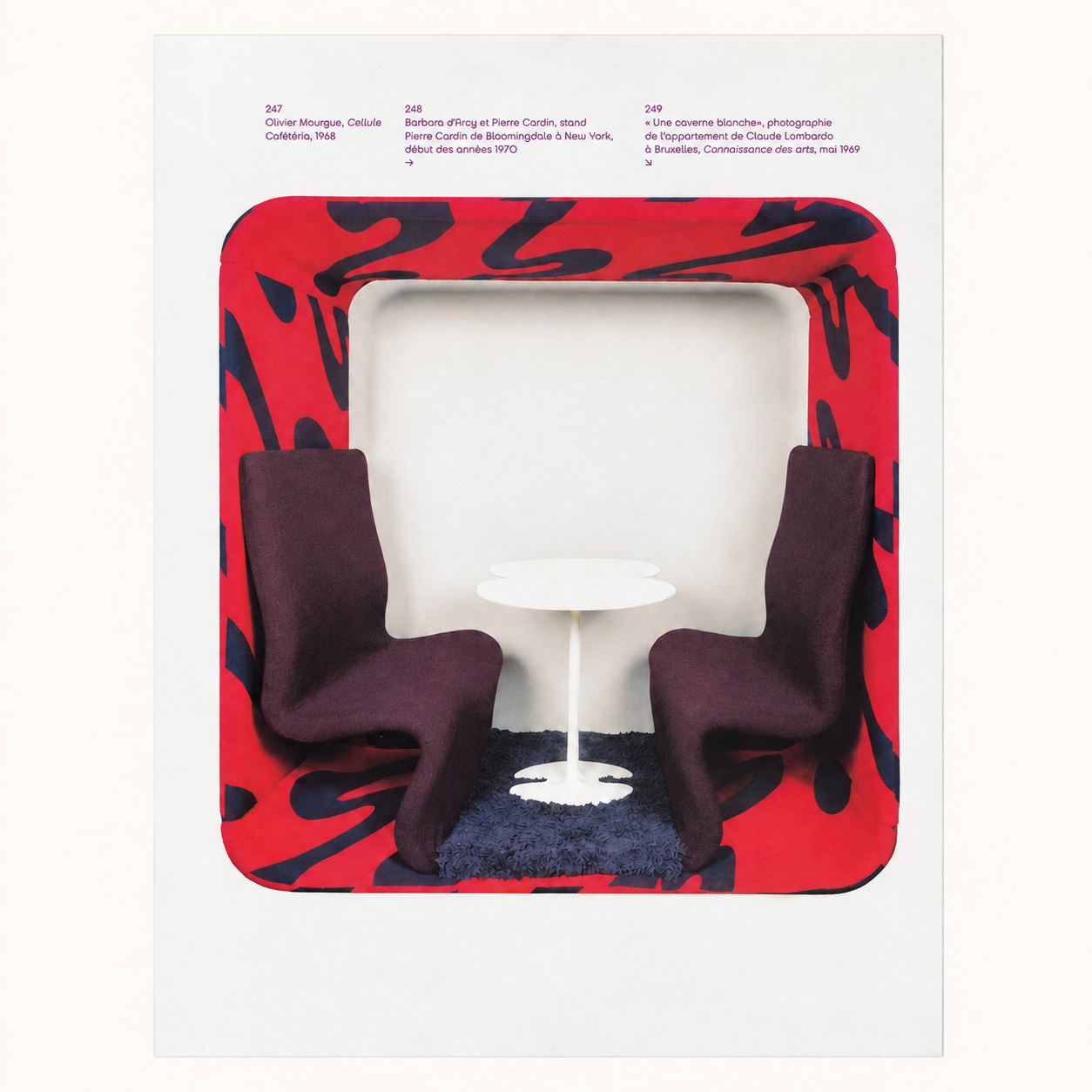
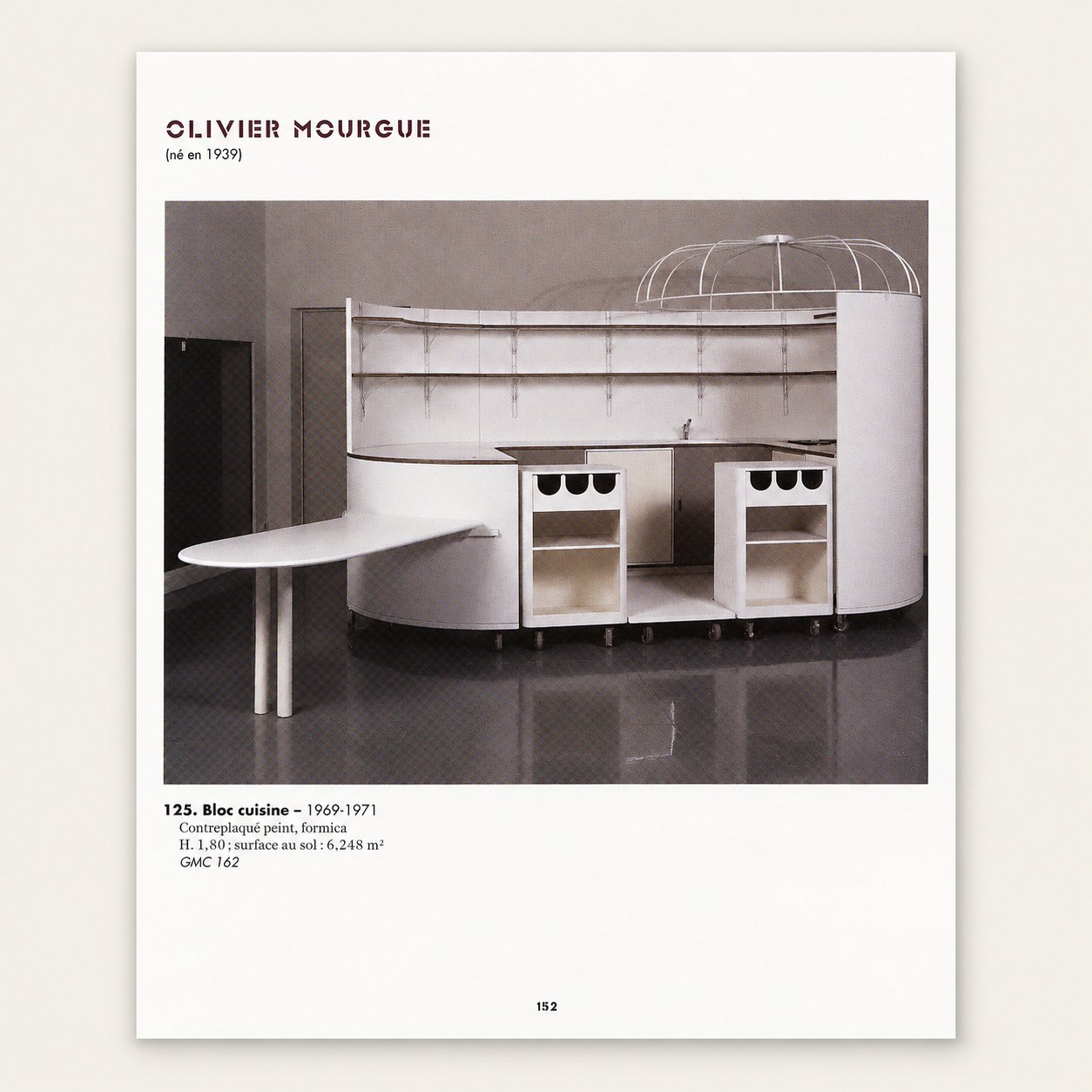
Olivier Mourgue, Cafeteria Unit. Source: Art Nouveau Revival, p. 240. All rights reserved — ADAGP. Photo credit to be identified.
The Cafeteria Unit illustrates this ability to design a space as a complete experience. Forms, colors, furniture and circulation are integrated into a single system.
This logic is found in several of Olivier Mourgue's projects: collective spaces, public spaces, research for industry, and forward-looking proposals. Interior architecture then becomes a laboratory in which he can experiment on a larger scale with the principles already present in his furniture: continuity, flexibility, envelopment, transformation.
10. VISIONA III, THE CANVAS HOUSE AND EXPERIMENTAL ENVIRONMENTS
In the early 1970s, Olivier Mourgue's research reached a particularly ambitious dimension with Visiona III, created as part of Bayer's experiments. There, he developed an environment in which materials, postures, and uses are conceived as a whole.
This research extends to other projects: a canvas house, mobile workshops, a portable wind turbine, character-seats, vehicle projects, and systems designed for transportation. The object is no longer the ultimate goal of the project. It becomes a means to question ways of living.
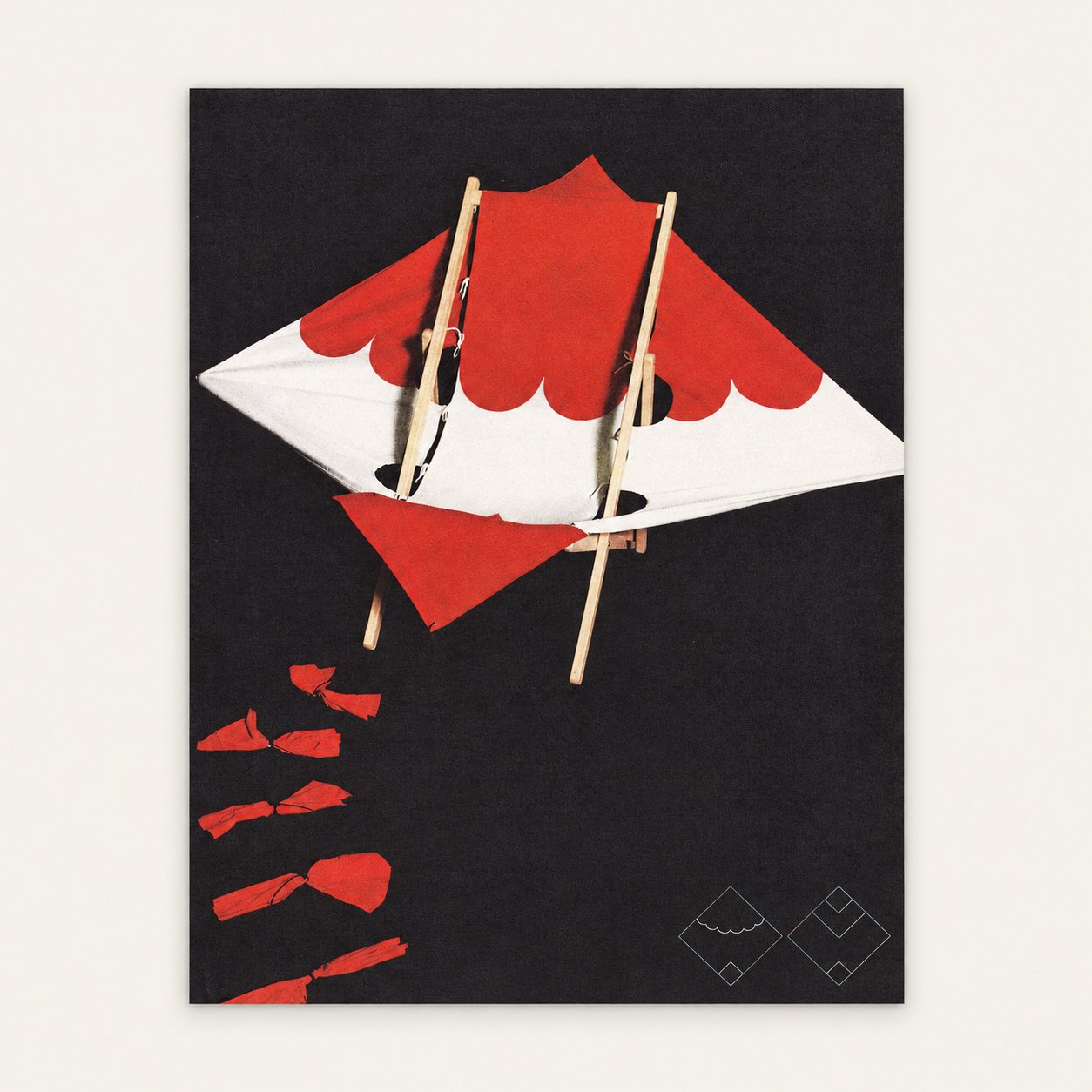
Olivier Mourgue, textile/transportable housing project. 100 Ideas. All rights reserved — 100 Idées / ADAGP. Photographer to be identified.
11. DEPARTURE FOR BRITTANY — ART, TEACHING AND TRANSMISSION
Olivier Mourgue's move to Brittany marked a new chapter. In 1976, a solo exhibition was dedicated to him at the Musée des Arts Décoratifs in Nantes. The same period coincided with the beginning of his teaching at the École des Beaux-Arts in Brest, where he remained until 2004.
This geographical shift is accompanied by a shift in practice. Olivier Mourgue is gradually developing a more personal body of work using textiles, wood, watercolor, and poetic devices. Animated canvases, climate boxes, small theaters, imaginary gardens, and transportable theaters compose a universe in which the imagination takes center stage.
During my research, I also interviewed several of his former students to understand his teaching methods. The recurring theme was that of an educator committed to experience, observation, and creative freedom. This dimension of transmission naturally complemented his career: after exploring objects, spaces, and uses, he dedicated a significant part of his life to sharing a way of seeing and thinking.
12. A CATALOGUE OF WORKS AND A MARKET STUDY
The thesis carried out between 2008 and 2010 was not limited to a historical study. It also included an important work of cataloging the production of Olivier Mourgue, with the objective of bringing together for the first time as broad a collection as possible of his creations between 1959 and 2010: furniture, lighting, spatial projects, prototypes, research and artistic works.
A market study complemented this research. Approximately 250 public auction results between 1997 and August 2010 were identified from Artprice, Artnet, auction.fr, the Gazette Drouot, sales catalogues and the archives of houses such as Sotheby's, Artcurial, Millon, Cornette de Saint Cyr or Tajan.
This study already demonstrated the overwhelming dominance of Djinn in the commercial perception of Olivier Mourgue's work, even though his output and research were far more diverse. One of the objectives of this page is precisely to rebalance this perception.
READINGS · THREE ENTRY POINTS
Annotated Bibliography
From archives to catalogues, three key points to understand the designer's intentions, his public commissions and his collaborations with publishers.
- 01 / RESEARCHIn search of the dream
Thibault Lannuzel · 2008–2010
Interviews, archives and study of the work, conducted with Olivier Mourgue. - 02 / PUBLIC PROCUREMENTNational Furniture Collection 1964–2004
40 years of creation · 2004
Montreal, housing and development placed in the context of public procurement. - 03 / THE PUBLISHERAirborne
Pierre Deligny · 2012
The history of the company and the spread of models like Joker and Djinn.
13. DIZAGN RESEARCH — 2026
Sixteen years after the defense, this work deserves to be reopened. New archives have circulated, some works have changed status, institutions have enriched their collections and the market for Olivier Mourgue has evolved considerably.
DIZAGN Research is therefore intended to become the living extension of this research: updating references, verifying dates, documenting models, studying provenances, new market data and progressively developing a legally secure iconographic corpus.
This page is not intended to replace the original thesis. It constitutes an editorial reading, designed to make a long-term research project accessible and to highlight the richness of a work that remains partially unknown.
COLLECTION · FROM ARCHIVE TO OBJECT
Olivier Mourgue at DIZAGN
The pieces in the gallery extend the research: observing the forms, materials and variations, then comparing them with period documents.
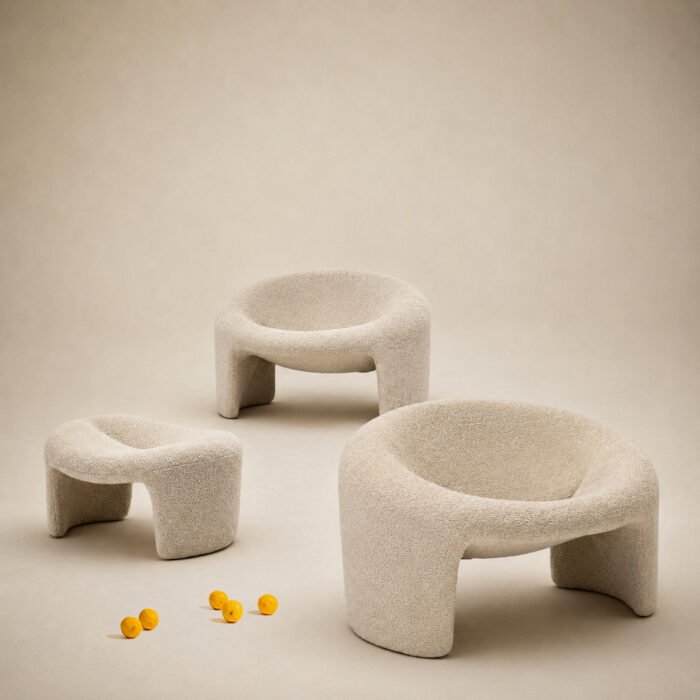 Montreal Armchairs
Airborne · 1967
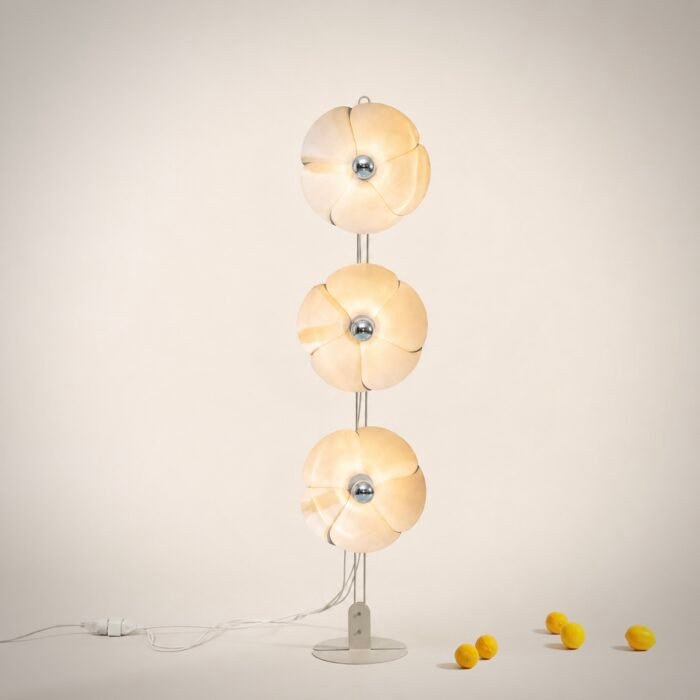 Streetlight 2093
Disderot · 1967
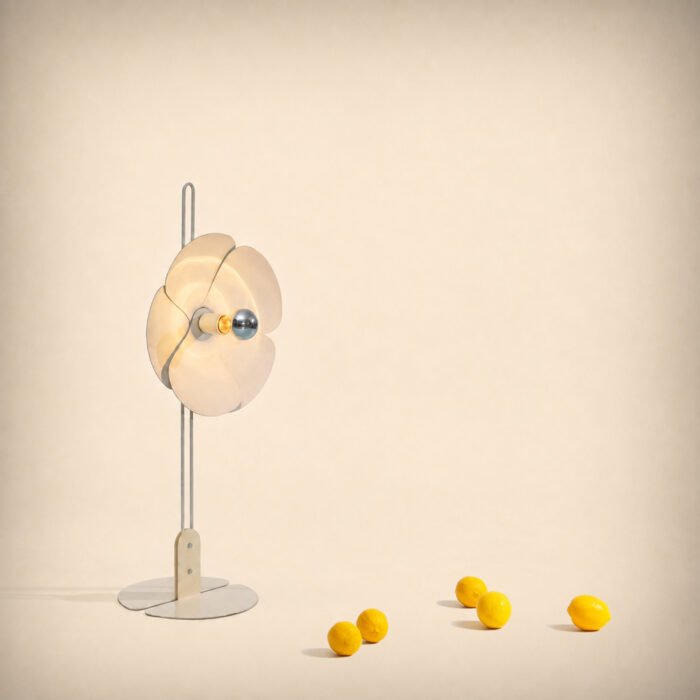 Lamp 2093
Disderot · 1967
The complete version brings together the catalogue entries and four archived pieces: Djinn and the different versions of Bouloum.
IN THE LONG TERM
Selective catalogue of works and models
Archives and primary sources
Market update 2010–2026
Full English version