FORMES UTILES GENERATION / RESEARCH
USEFUL FORMS
UAM · Household Arts Fair · Industrial Object
Long before the word "design" became established in the French vocabulary, Formes Utiles proposed a method: to select, show and defend objects whose form derives from function, material and the possibilities of industry.
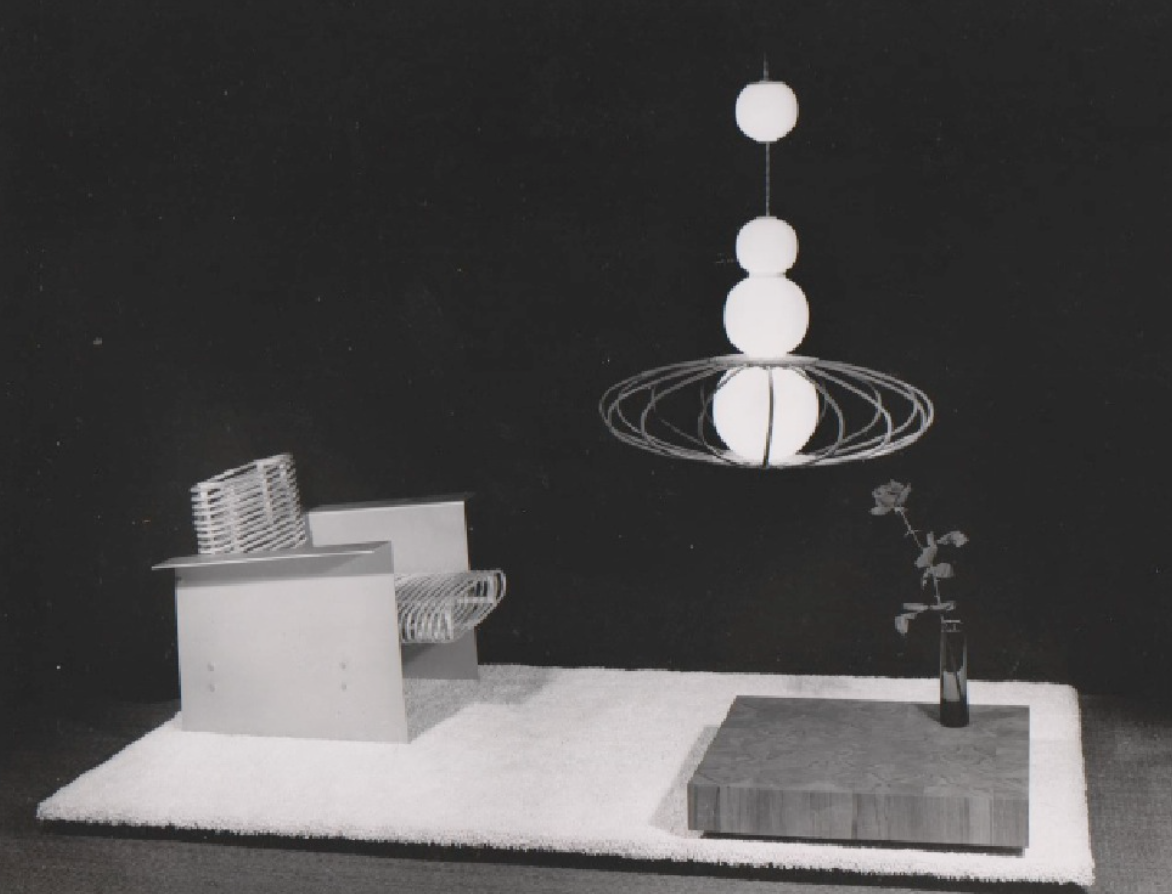
Janine Abraham and Dirk-Jan Rol, stand at the Salon of the Society of Decorative Artists, 1959. Black and white photograph, Janine Abraham and Dirk-Jan Rol Archives, Meudon. Contextual document on the exhibitions; this image is not presented as a view of the Useful Forms section.
FROM UAM TO USEFUL FORMS
The Union of Modern Artists had, from the interwar period onwards, defended a rationalist conception of applied arts and architecture. Francis Jourdain, René Herbst, Charlotte Perriand, Jean Prouvé, Louis Sognot, Marcel Gascoin, André Hermant, Jacques Dumond and others experimented there with a creation free from gratuitous ornament and attentive to series, materials and uses.
After the war, André Hermant and Jacques Dumond founded the Formes Utiles association in 1947. This initiative extended their modernist vision: to present objects not as isolated prestige pieces, but as elements of everyday life. Their presentation was inspired in particular by the "bazaar" concept championed by Francis Jourdain: utilitarian objects brought together, classified, and displayed as in a department store.
1947 — Foundation of the association Formes Utiles by André Hermant and Jacques Dumond.
1949–1950 — Exhibition «Useful Forms, Object of Our Time» at the Museum of Decorative Arts.
1951 — Formes Utiles is setting up at the Grand Palais as part of the Salon des arts ménages.
ONE CRITERION: ACCURACY
From 1951 onwards, the Useful Forms section of the Household Arts Exhibition became a prime venue for promoting contemporary industrial objects. The selection process was demanding: rigorous design, proportions, quality of finishes, suitability of the material to the function, and consideration of new manufacturing processes.
André Hermant's formula sums up this ambition: forms that manifest the harmony between the demands of matter and the aspirations of the spirit are useful and beautiful. The challenge, therefore, is not to produce a modern aesthetic for its own sake, but to bring forth a just form.
The manifesto published in 1955 clarified this orientation. When Formes Utiles became independent from the UAM in 1957, the association affirmed even more clearly a social reformism based on "beauty in utility".
THE HOUSEHOLD ARTS SHOW
The Household Arts Fair brings together precisely the conditions these young designers need: designers, publishers, manufacturers, the press, and the public are all present at the same time. Prototypes are displayed alongside mass-produced items, complete living spaces, and demonstrations of new materials.
For the Useful Forms Generation, the trade show thus becomes a true public laboratory. Repeated participation, competitions, and awards contribute to their visibility and facilitate meetings with the industry.
WHY "GENERATION USEFUL FORMS"?
The title of the doctoral research deliberately reflects this history. The eleven designers studied do not form an established school, but they participate assiduously in events where Formes Utiles imposes its criteria, and many of them are selected or awarded prizes.
The name therefore expresses both an intellectual lineage and a professional context: that of a generation seeking to reconcile form, function, industry and quality of use.
← Back to Useful Forms Generation
Source of work: Thibault Lannuzel, Generation Useful Forms — A study of a group of designers in France, 1945-1973, doctoral thesis, University Paris IV–Paris-Sorbonne, 2011–2016. Editorial draft.