
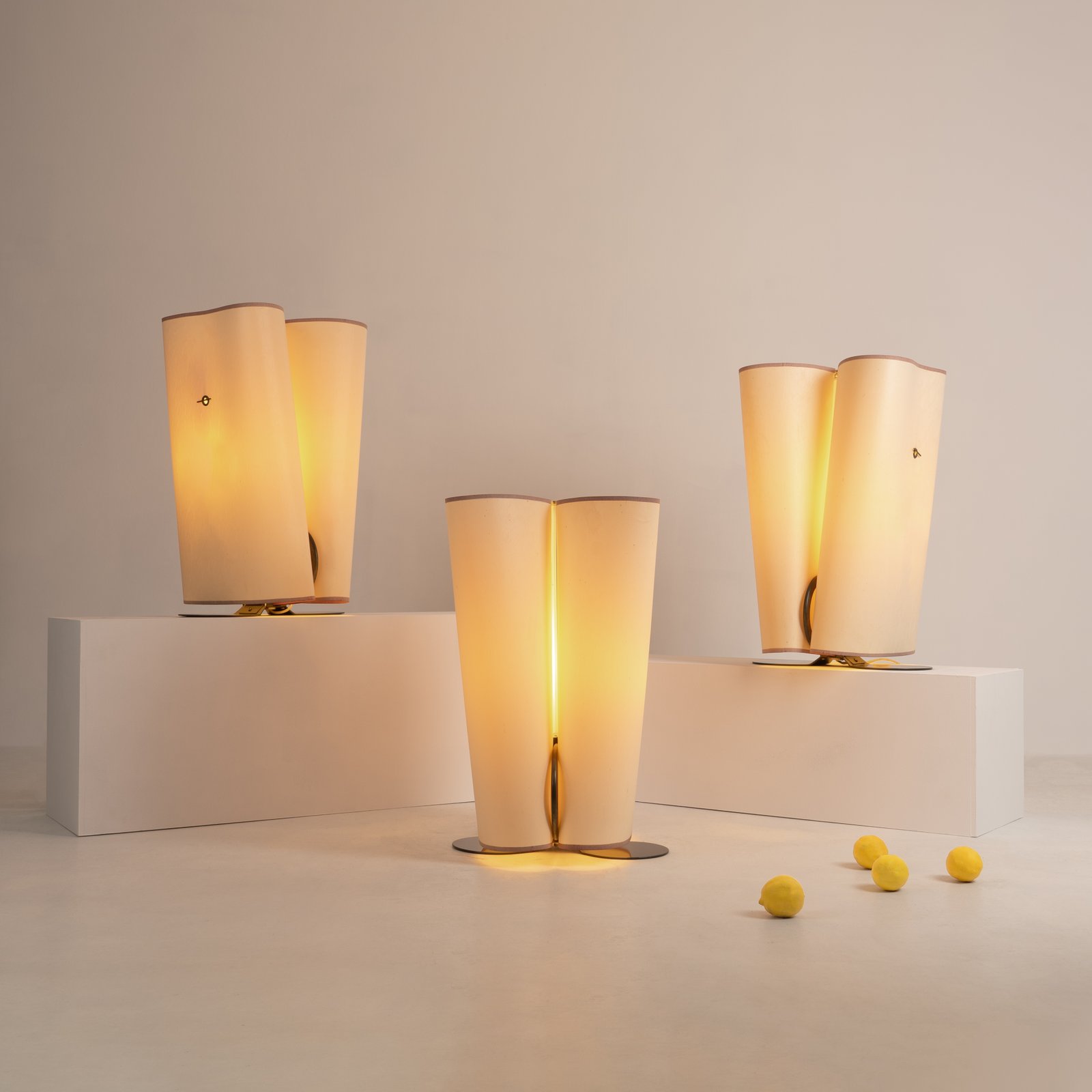
Abatina lamps by Tobia Scarpa, Flos, circa 1980. DIZAGN collection.
TOBIA SCARPA
BORN IN 1935 · ARCHITECT · DESIGNER · FURNITURE · LIGHTING · INDUSTRIAL ARCHITECTURE
Tobia Scarpa belongs to the great generation of post-war Italian design. An architect and designer, he developed with Afra Scarpa a body of work in which furniture, light, architecture and industry are approached with the same constructive requirement.
His designs for Cassina, Gavina, Flos and several major Italian companies combine a very fine understanding of materials with a constant attention to comfort, use and quality of manufacture.
BIOGRAPHY
Born in Venice in 1935, Tobia Scarpa grew up in an environment where architecture, craftsmanship, and design culture were closely intertwined. He trained in architecture in Venice and graduated in 1969. Well before that, he had already been involved in industrial design and, as early as 1958, experimented with glasswork under Venini in Murano.
Around 1960, Tobia Scarpa worked with Afra Bianchin, who later became Afra Scarpa, forming one of the most important design partnerships in Italy. Their collaborative work rejected the separation between architecture and object: an armchair, a lamp, or a factory all stemmed from the same design discipline.
The collaboration with Dino Gavina began in the early 1960s. The Scarpas notably designed the Bastiano sofa and the Vanessa bed, which demonstrate an interest in exposed structures, legible assemblies and the relationship between rigid frame and flexible elements.
Light also plays a crucial role. In Flos's early days, Tobia Scarpa participated in research on plastic materials and the "cocoon" technique. Flos notably documented Fantasma as early as 1960, as well as the Jucker lamp, inspired by the rigor of the Bauhaus. For Scarpa, lighting became a field for technical experimentation as much as a tool for constructing space.
With Afra, he also developed a major relationship with Cassina. The 925 armchair entered the collections of the Museum of Modern Art in New York, while Soriana became one of the couple's most celebrated creations. Awarded the Compasso d'Oro in 1970, Soriana challenged the traditional concept of seating: comfort is achieved through a flexible, compressed volume supported by an external metal structure.
This way of juxtaposing flexible form and technical structure is found in much of their furniture. The Scarpas work with wood, leather, metal, and industrial materials, striving to leave the construction logic visible. Refinement arises from the precision of detail rather than ornamentation.
Their work extends to numerous Italian publishers and manufacturers. Their furniture, seating, and lighting projects contributed to the golden age of Italian design, a period during which industry became a true laboratory for architects and designers.
Alongside his furniture design, Tobia Scarpa pursued a significant architectural career. His collaboration with the Benetton Group is particularly emblematic: he designed industrial buildings, production facilities, and administrative headquarters whose spatial quality far transcended mere utilitarian function. These complexes are regularly cited as prime examples of Italian industrial architecture from the second half of the 20th century.
He also works in restoration and museography, particularly on historical buildings and exhibition spaces. This ability to move from the object to the building demonstrates the continuity of his approach: understanding of the material, precision of the structure, attention to circulation, and a keen sense of light.
After Afra's death in 2011, Tobia Scarpa continued his work. Cassina renewed their collaboration with him in 2020, while Flos continues to present his work as a historical and contemporary reference. In 2008, he received a Compasso d'Oro for his lifetime achievement.
The Abatina lamps, produced by Flos around 1980 and featured in the DIZAGN selection, belong to this culture of light as an architectural instrument. Their lacquered metal structure and textile shade produce a controlled domestic light, in a characteristic balance between rigor and softness.
WORK AND FORMAL LANGUAGE
Tobia Scarpa's artistic language is based on highlighting structure. Wood, leather, metal, or textiles are never used to conceal the construction: each material retains its role and presence. The assembly often becomes a sculptural element in its own right.
This rigor does not preclude comfort or sensuality. The Scarpa brothers' work frequently juxtaposes a highly precise structure with thick cushions, leathers, soft surfaces, or diffused light. It is precisely this tension between technique and function that gives their creations their enduring character.
PUBLISHERS AND COLLABORATORS
Afra Scarpa · Venini · Gavina · Cassina · Flos · B&B Italia · Benetton · collaborations with many Italian furniture and lighting industries.
SELECTIVE CHRONOLOGY
1935 — born in Venice 1958 — research on glass at Venini 1960 — beginning of the collaboration with Gavina and initial research for Flos 1960s — furniture development with Afra Scarpa 1969 — architecture degree from Venice 1970 — Compasso d'Oro for Soriana 1970s–1990s — major furniture, lighting and industrial architecture projects circa 1980 — Abatina lamps for Flos · 2008 — Compasso d'Oro for lifetime achievement 2020 — new collaboration with Cassina.
SELECT BIBLIOGRAPHY
Giuliana Gramigna, Italian design directory · Cassina documentation dedicated to Afra and Tobia Scarpa · Flos archives and documentation · publications dedicated to post-war Italian design and the Compasso d'Oro.
PUBLIC COLLECTIONS
The creations of Afra and Tobia Scarpa are featured in major international design collections. Cassina notably documents the acquisition of the 925 armchair by the Museum of Modern Art in New York and the presence of other models in international museums.
TOBIA SCARPA AT DIZAGN
DIZAGN ARCHIVES — WORK SOLD
Document already passed through DIZAGN and kept online for documentary purposes.

DIZAGN Expertise → Thibault Lannuzel →
Main sources: Cassina; Flos; DIZAGN documentation. Manifest image: Abatina lamps, DIZAGN collection.