
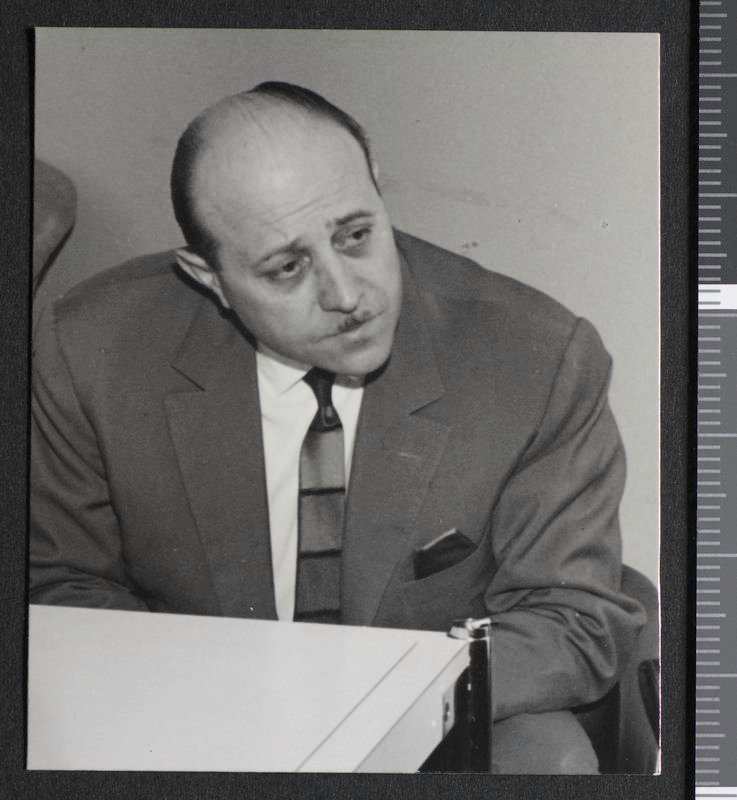
Roger Landault. Roger Landault Collection, Centre Pompidou / Kandinsky Library — all rights reserved.
ROGER LANDAULT
1919–1983 · DESIGNER · FURNITURE · INTERIOR ARCHITECTURE · SYNTHETIC MATERIALS
Roger Landault occupies a unique place in post-war French design. Trained at a very young age in Applied Arts, he spanned nearly four decades of creation, constantly adapting his vocabulary to technical and social transformations: from Reconstruction furniture in solid wood to thermoformed plastic sets of the 1970s.
This capacity for evolution is probably the guiding principle of his work. Landault never abandons the constructive precision of his training, but he refuses to confine furniture to a single aesthetic. Each new technique becomes for him an opportunity to reconsider form, use, and production.
BIOGRAPHY
Born in 1919, Roger Landault entered the Lycée des Arts Appliqués in Paris at the age of fourteen, in 1933. This early training immersed him in a culture where mastery of drawing, construction, and materials remained essential. When he began his career in the aftermath of the Second World War, France was rebuilding its housing stock and inventing new forms of furniture adapted to modern dwellings.
In 1945, Landault joined the Studium-Louvre, directed by Étienne-Henri Martin. The Studium was then an important center for the renewal of decorative arts and interior architecture. Landault quickly acquired a central position there: he succeeded Étienne-Henri Martin as artistic director and held this position until 1955. This decade allowed him to combine design, commercial presentation, and reflection on the new conditions of furniture production.
As early as 1946, his work attracted the attention of the ABC company, with which he would develop several successive programs. The Junior range, created between 1951 and 1954, directly addressed the needs of the post-war reconstruction: rational, clearly constructed furniture, capable of fitting into smaller domestic spaces. With Dakar and Rotterdam, developed between 1955 and 1959, Landault continued this exploration by designing stackable furniture in solid wood.
These collections demonstrate a conception of furniture as a system rather than a collection of independent objects. Storage units, tables, and household items can be combined to organize space. The Dakar and Rotterdam lines contributed to the designer's recognition and earned him the René-Gabriel Prize, an award created to encourage modern, high-quality furniture accessible to a wide clientele.
Landault continued his research with the Panama ranges, between 1959 and 1961, then Chatelaine and Rio in the early 1960s. These series show the progressive expansion of his palette: wood, metal, sheathed surfaces and new materials combine in furniture where Scandinavian influence can appear, without erasing the French rigor of construction.
Alongside his work for ABC, he collaborated with other manufacturers. Bouvier notably produced the 6517 chair from 1954. The archives held by the Kandinsky Library testify to the extent of his activity: furniture projects, layout plans, research for communities, seat studies, drawings and photographs cover areas ranging from private housing to public facilities.
During the 1960s, Landault increasingly addressed the question of furniture as an element of a comprehensive environment. The documents in the collection reveal his research for household arts, bedrooms, offices, hospital equipment, and communal spaces. His designs were no longer simply those of individual pieces of furniture: they organized uses, circulation, and relationships between various functions.
This evolution culminated in a dramatic material breakthrough in the 1970s. Landault embraced the possibilities offered by thermoformed plastic and, together with Steiner, developed Unibloc units. Tables and benches were combined into continuous structures, capable of furnishing communal spaces, restaurants, or new domestic environments. The object became almost a micro-architecture.
The Unibloc perfectly illustrates the designer's ability to transform his design language without abandoning his principles. The solid wood and cabinetmaking of his early work have given way to synthetic materials, but the underlying quest remains the same: to reduce components, clarify functions, and integrate multiple uses into a legible form. This adaptability explains the coherence of a career that spans the profound transformations of French design between 1945 and the 1980s.
Roger Landault died in 1983. In 2018, a significant family donation entered the collections of the Centre Pompidou. His archives, housed at the Kandinsky Library, include personal papers, project files, photographs, sketches, correspondence, books, and journals. This documentation now allows us to rediscover a body of work that, for a long time, received less media attention than that of some of his contemporaries, but which is essential for understanding the transition from post-war Reconstruction furniture to the industrial design of the 1970s.
WORK AND FORMAL LANGUAGE
Landault's work is marked by a remarkable methodological continuity despite the diversity of forms. In the 1950s, he favored the legibility of construction, solid wood, juxtaposed elements, and furniture designed in sets. The lines are clean, the joinery precise, and the possibility of combining several elements becomes an essential component of the design.
As industrial techniques evolved, he introduced new materials and more continuous volumes. The Unibloc models of the 1970s encapsulate this transformation: the seat, the table, and sometimes several places become a single thermoformed system. Landault thus moved from a modernity based on rational cabinetmaking to one based on functional integration and plastic materials.
PUBLISHERS AND COLLABORATORS
Studium-Louvre · ABC · Bouvier · Steiner · furniture and layout projects for housing and communities.
SELECTIVE CHRONOLOGY
1919 - birth · 1933 — entry to the Lycée des Arts Appliqués in Paris 1945 — entrance to the Studium-Louvre 1946 — start of collaboration with ABC 1951–1954 — Junior program 1954 — chair 6517 for Bouvier 1955 — first prize in the Furniture of France competition and end of the artistic direction of the Studium-Louvre 1955–1959 — Dakar and Rotterdam series, René-Gabriel Prize 1959–1961 — Panama, Chatelaine and Rio 1960s — research on community development and equipment 1970s — development of thermoformed plastic Unibloc units for Steiner 1983 - death · 2018 — family donation to the Centre Pompidou.
SELECT BIBLIOGRAPHY
Roger Landault Collection, Kandinsky Library — Centre Pompidou catalogue Mobi Boom, the explosion of design in France 1945–1975, Musée des Arts décoratifs, 2010 · documentation ABC, Bouvier and Steiner.
PUBLIC COLLECTIONS AND ARCHIVES
Centre Pompidou / National Museum of Modern Art — Design Collection · Kandinsky Library, Roger Landault Collection, 1945–1983. The Centre Pompidou notably holds drawings, plans and projects from the 2018 family donation, documenting domestic furniture, collective equipment and Unibloc research.
Consult the Roger Landault Collection at the Centre Pompidou.
ROGER LANDAULT AT DIZAGN
DIZAGN ARCHIVES — WORK SOLD
Document already passed through DIZAGN and kept online for documentary purposes.

René-Jean Caillette → DIZAGN Expertise → Thibault Lannuzel →
Main sources: Centre Pompidou / Kandinsky Library; DIZAGN documentation. Portrait: Roger Landault Collection — all rights reserved.