
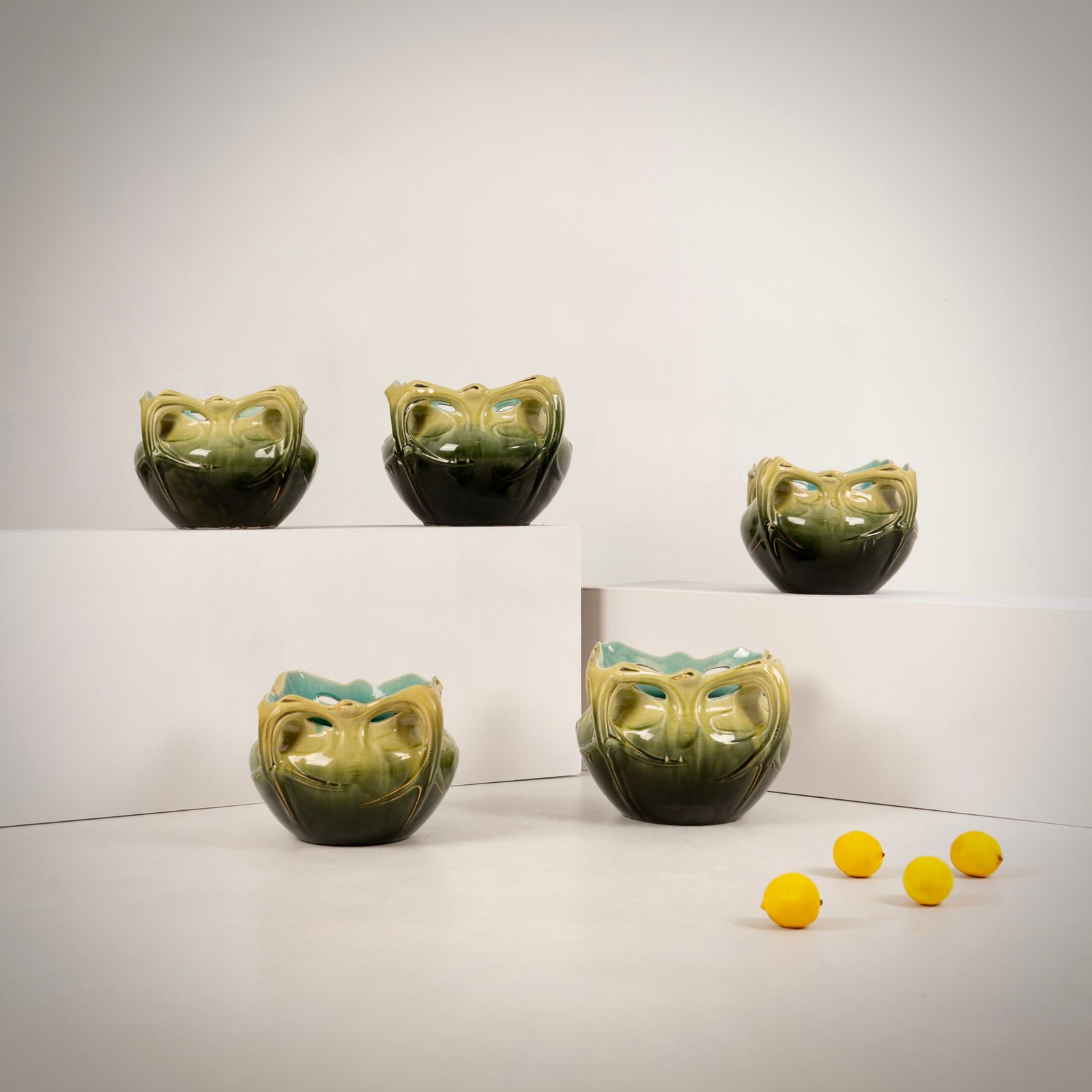
Set of De Bruyn ceramics, circa 1890–1900, presented by DIZAGN as «after Hector Guimard».
HECTOR GUIMARD
1867–1942 · ARCHITECT · DECORATOR · ART NOUVEAU · FURNITURE · METROPOLITAN
Hector Guimard is the most emblematic figure of French Art Nouveau architecture. He conceived buildings, furniture, ironwork and decorations as elements of a single whole, based on the continuity of line and the observation of living things.
From Castel Béranger to the entrances of the Paris Metro, he developed an immediately identifiable vocabulary, but always linked to the techniques and materials used.
BIOGRAPHY
Hector Guimard was born in Lyon in 1867 and trained in Paris at the École nationale des arts décoratifs and then at the École des beaux-arts. Very early on, he was interested in the idea of an architecture in which structure, decoration and furniture would be designed simultaneously.
The Castel Béranger, built in Paris in the 1890s, brought him decisive recognition. Guimard designed not only the architecture but also some of the decorations, ironwork, and furniture. The building became one of the manifestos of French Art Nouveau.
His style rejects the literal reproduction of historical styles. The lines curve, branch out, and seem to follow the logic of organic growth. This approach applies equally to iron, wood, stone, and graphic motifs.
From 1900 onwards, the entrances to the Paris Métro disseminated his vocabulary on an exceptional scale. Thanks to the use of mass-produced cast iron elements, Guimard demonstrated that a personal artistic language could be adapted to industrial manufacturing and a public program.
In its interiors, furniture plays a crucial role. Tables, chairs, benches, fireplaces, and woodwork are designed in relation to the walls and the overall volumes. The Musée d'Orsay notably preserves furniture from its architectural projects and documents this pursuit of unity.
Guimard's forms also found dissemination through contemporary manufacturers and decorative productions. This circulation, however, must be documented with caution: not all pieces exhibiting a similar organic vocabulary are necessarily original creations by the architect.
The De Bruyn ceramics offered by DIZAGN are specifically presented with the caveat "after Hector Guimard." This wording clearly distinguishes their stylistic proximity to his vocabulary from any direct attribution not demonstrated by an archive or documented model.
After the First World War, tastes changed and Art Nouveau gradually lost its dominant position. Guimard nevertheless continued his work before leaving France at the end of the 1930s. He died in New York in 1942.
Its rediscovery during the second half of the 20th century profoundly renewed the study of French Art Nouveau. Its archives and works are now preserved by several major institutions.
WORK AND FORMAL LANGUAGE
In Guimard's work, the line is not merely applied decoration: it organizes the structure. The wood curves, the cast iron branches out, the uprights and crossbeams thicken or narrow according to an almost vegetal logic. This continuity gives the objects a strongly architectural presence.
He also sought to adapt his forms to manufacturing processes. The modular elements of the Métro are the most famous example: industrialization becomes a means of disseminating a modern language rather than a constraint.
SELECTIVE CHRONOLOGY
1867 — born in Lyon 1880s — training in Paris 1894–1898 — Castel Béranger 1900 — development of the kiosks and surroundings of the Metropolitan 1900s — houses, mansions, furniture and decorative ensembles 1938 — Departure for the United States 1942 — death in New York.
SELECT BIBLIOGRAPHY
Alain Blondel and Yves Plantin, Guimard, furniture architect · Hector Guimard collection at the Musée des Arts décoratifs · documentation from the Musée d'Orsay dedicated to Art Nouveau furniture and ensembles.
PUBLIC COLLECTIONS
Musée d'Orsay, Paris; Musée des Arts Décoratifs, Paris; collections and archives dedicated to Hector Guimard in France and the United States. The RATP also preserves and documents the entrances and surroundings of the Paris Métro designed from 1900 onwards.
Musée d'Orsay — Hector Guimard furniture · RATP — Hector Guimard and the Metropolitan.
HECTOR GUIMARD AT DIZAGN
AVAILABLE WORK
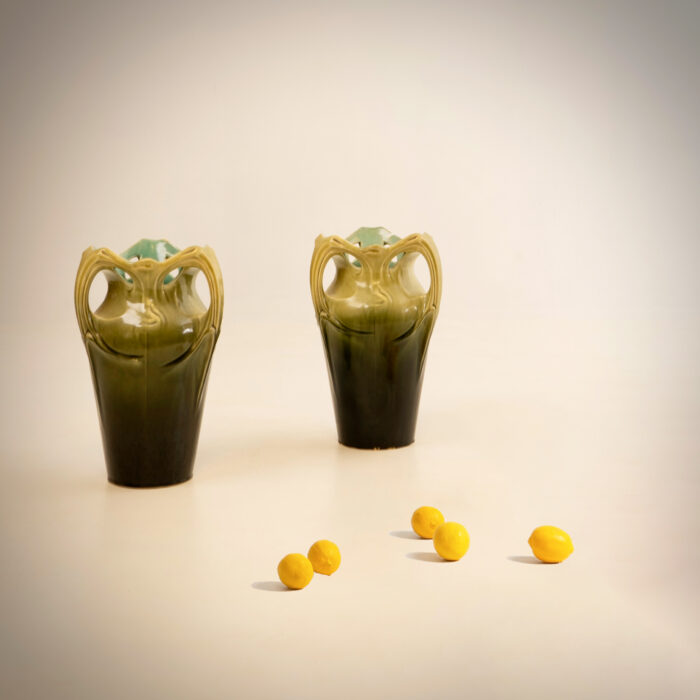
DIZAGN ARCHIVES — WORK SOLD
Document already passed through DIZAGN and kept online for documentary purposes.

Attribution: The De Bruyn ceramics presented by DIZAGN are described "after Hector Guimard"; this reservation is maintained and does not constitute an autograph attribution.
DIZAGN Expertise → Thibault Lannuzel →
Main sources: Musée d'Orsay; Musée des Arts décoratifs; Alain Blondel and Yves Plantin; DIZAGN documentation.