
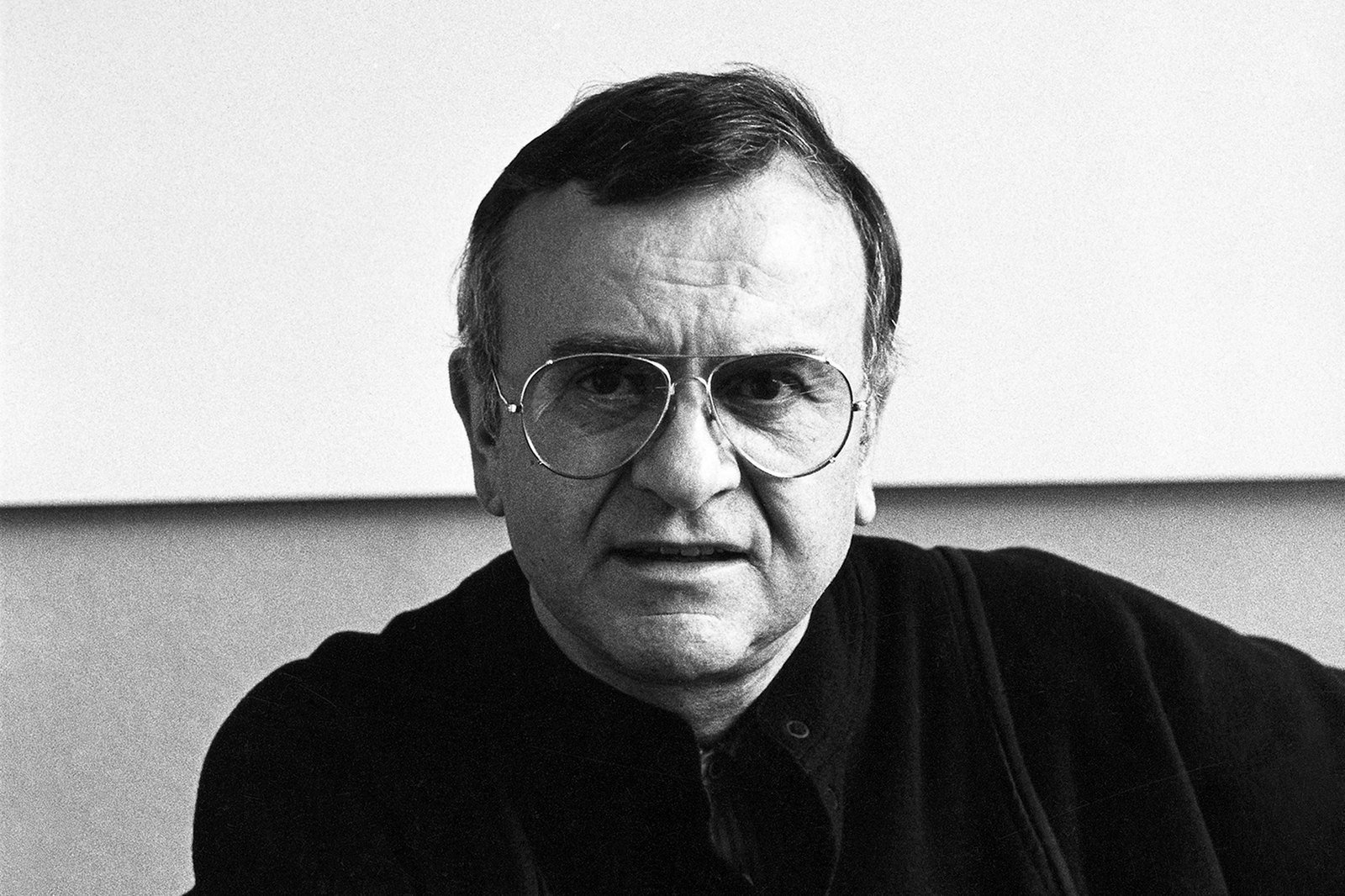
Roger Tallon — portrait, all rights reserved.
ROGER TALLON
1929–2011 · Industrial Design · Transportation · Signage · Graphic Design
Roger Tallon is one of the pioneers of French industrial design. While a large part of his generation still worked mainly in the field of furniture and interior decoration, he chose very early on to intervene directly in industry, from machine tools to transport, including electronics, tableware, graphic design and signage.
His work is distinguished by a comprehensive approach to the project: Tallon does not seek to give an attractive appearance to an existing object, but to analyze all of its functions, its use, its manufacture, its maintenance, its visual identity and its relationship to the user.
BIOGRAPHY
Born in Paris in 1929, Roger Tallon trained as an engineer before turning to industrial design, a discipline that was still relatively unstructured in France in the early 1950s. In 1952, at the age of twenty-three, he became head of graphic communication at Caterpillar France and worked as a consultant for several European subsidiaries of DuPont de Nemours.
In 1953, he joined Technès, an agency founded by Jacques Viénot, one of France's leading proponents of industrial design. Tallon quickly rose to the position of head of design and remained there until 1973. This period was pivotal: he worked on machine tools, handling equipment, electronics, vehicles, and household objects. His work for Fenwick, Gambin, La Mondiale, Téléavia, and Derny already demonstrated a desire to consider the object as a complete system rather than simply as a form.
The Taon motorcycle, designed for Derny in 1957, and the Téléavia P111 portable television in the early 1960s became emblematic of this approach. Tallon focused on compactness, ergonomics, the legibility of controls, and how the user could immediately understand an object. His famous formula—form does not derive from a single function but from the analysis of all functions—summarizes this method.
However, its activities were not limited to industry alone. In the 1960s, Technès became a hub for exchange between engineers, designers, graphic artists, and other artists. Tallon associated with Yves Klein, César, Arman, and Claes Oldenburg. This close relationship fostered experimental projects situated at the intersection of art, furniture, and the environment. The portrait-chairs designed with César, the Module 400 spiral staircase, and the 3T tableware collection exemplify this openness.
In parallel, Roger Tallon played a major role in education. In 1963, he created one of the first French departments dedicated to industrial design at the École nationale supérieure des Arts décoratifs (National School of Decorative Arts). He also participated in the international structuring of the profession within the ICSID (International Conference on Industrial Design). For him, the designer should not be a stylist intervening at the end of the process, but an active participant in the project from its inception.
In 1970, he was the artistic director of the French pavilion at the Osaka World Expo. Three years later, he left Technès and founded Design Programmes. The name clearly expresses his ambition: to design not just isolated objects, but coherent systems combining products, interior architecture, communication, and graphic identity.
This approach finds significant application in transportation. Tallon collaborates with SNCF and RATP on railway equipment, interior design, signage, and network image. Corail, TGV, TGV Atlantique, TGV Duplex, the Montmartre funicular, and metro projects all demonstrate a collaborative approach where ergonomics, usability, traffic flow, maintenance, and visual identity are considered together.
In 1984, he participated in the creation of ADSA+Partners alongside Pierre Paulin and Michel Schreiber. His research on transportation then took on an even greater dimension. He also contributed to graphic design—notably for the magazine Art Press, for which he designed the visual identity and the model —, Lip watches, lighting fixtures, tableware and numerous industrial projects.
In 2008, Roger Tallon donated his entire professional archive to the Musée des Arts Décoratifs: drawings, plans, photographs, press kits, contracts, design deposits, models, and research documents. This collection, spanning nearly sixty years of creative work, allows us to appreciate the full scope of his oeuvre. Tallon died in Paris in 2011. Retrospectives at the Centre Pompidou and later at the Musée des Arts Décoratifs have cemented his central place in the history of French industrial design.
WORK AND FORMAL LANGUAGE
Tallon's work is characterized less by a recognizable style than by a method. His projects start from use, technique, and the production system. The forms can be very different—geometric, modular, flexible, or mechanical—but they always respond to an overall logic.
This approach explains his interest in programs: modular staircases, seating systems, railway equipment, signage, transport furniture, or product ranges. The designer becomes, in his work, an organizer of relationships between the object, its environment, the company that produces it, and the person who uses it.
PUBLISHERS AND COLLABORATORS
Technès · Téléavia / Thomson · Derny · Lip · Sentou · Porcelaines Raynaud · Erco · SNCF · RATP · Alstom · Design Programmes · ADSA+Partners · Art Press · collaborations with Jacques Viénot, Yves Klein, César, Arman, Pierre Paulin and Michel Schreiber.
SELECTIVE CHRONOLOGY
1929 — born in Paris 1952 — Caterpillar France 1953 — entry to Technès 1957 — Taon motorcycle for Derny · 1963 — creation of the industrial design department at ENSAD and Téléavia P111 · 1966 — Module 400 and experimental seats 1967 — 3T service 1970 — artistic direction of the French pavilion in Osaka 1973 — Foundation of Design Programs and development of Lip watches 1970s–1990s — SNCF/RATP, Corail, TGV and signage programs 1984 — ADSA+Partners 1993–1994 — retrospective at the Centre Pompidou 2008 — donation of archives to the Museum of Decorative Arts 2011 — death in Paris.
SELECT BIBLIOGRAPHY
Roger Tallon, the journey of an industrial designer, Centre Georges Pompidou, 1993–1994 Roger Tallon, design in motion, Musée des Arts décoratifs, 2016–2017 · Roger Tallon Collection, Library of the Musée des Arts décoratifs · documentation of the collections of the Centre Pompidou.
PUBLIC COLLECTIONS AND ARCHIVES
Centre Pompidou / National Museum of Modern Art · Museum of Decorative Arts, Paris — which houses the Roger Tallon Fund and numerous works · public collections related to French transport equipment and networks.
Roger Tallon at the Centre Pompidou · Roger Tallon Collection at the Museum of Decorative Arts.
ROGER TALLON AT DIZAGN
No Roger Tallon product sheet is currently published under his name in the DIZAGN selection. This page therefore currently serves as a documentary resource; it will be linked to future Tallon pieces added to the catalog.
DIZAGN Expertise → Thibault Lannuzel →
Main sources: Musée des Arts décoratifs; Centre Pompidou; DIZAGN documentation. Portrait credit: Library of the Musée des Arts décoratifs / Roger Tallon Collection — all rights reserved.