
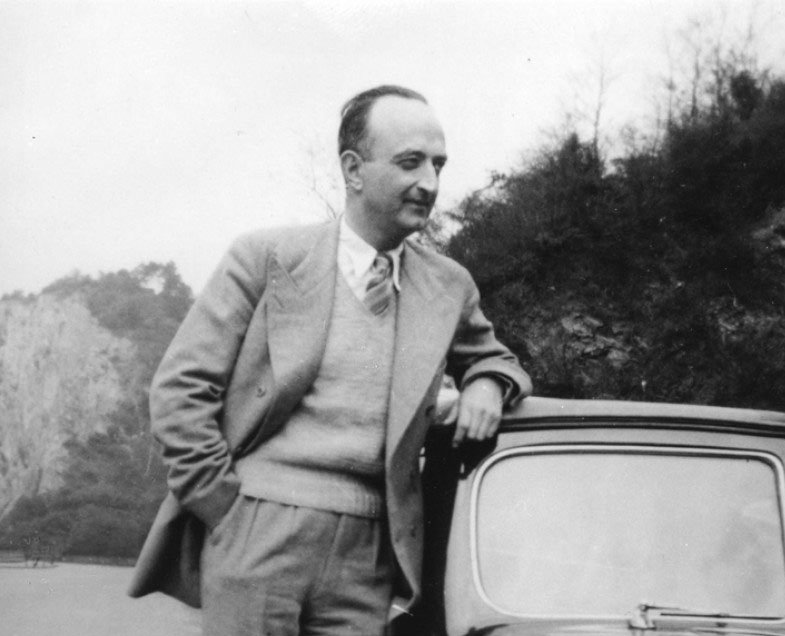
Jean Royère, circa 1930 — archive portrait, all rights reserved.
JEAN ROYÈRE
1902–1981 · Interior Designer · Furniture · Lighting · Interior Architecture
Jean Royère is one of the most unique French decorators of the 20th century. Rejecting the strictest functionalism, he built a universe where color, curves, humor, and ornament regained a central place without ever sacrificing the coherence of the space.
His Polar Bear armchairs, his Liane lighting fixtures, his plant or geometric motifs and his ensembles made from Paris to the Middle East compose an immediately identifiable body of work, but whose richness far exceeds a few models that have become iconic.
BIOGRAPHY
Born in Paris in 1902 into a cultured family, Jean Royère began his professional life in import-export. However, as he approached thirty, he abandoned this path to devote himself entirely to interior design. He chose a hands-on apprenticeship in the workshops of the Faubourg Saint-Antoine, where he became familiar with the demands of Parisian cabinetmaking and the practical aspects of furniture making.
His first major commission dates from 1931. For his uncle Jacques Raverat, he designed garden furniture with elongated lines, already a departure from the conventions of monumental Art Deco. Shortly after, his chrome-plated metal decor for the Brasserie Le Carlton on the Avenue des Champs-Élysées brought attention to this still relatively unknown young decorator.
In 1934, the manufacturer Pierre Gouffé entrusted him with the responsibility of his contemporary furniture section. This position offered Royère a true laboratory: he could compare his designs with their execution, experiment with materials and develop a personal grammar while working within the framework of a production company.
The 1937 International Exposition marked an early breakthrough. Seventeen pieces were commissioned from him, and his work was noted for its inventiveness. Two years later, at the 1939 Salon des Artistes Décorateurs, he presented a boudoir that marked a turning point. Colors became bolder, animal and plant motifs appeared, and furniture gradually broke free from modernist rigidity.
The Elephant armchair, the Clover chair, the Mushroom floor lamp, and the Bouquet wall lamp foreshadow the poetic world that would blossom after the war. For Royère, ornament is not merely added decoration; it contributes to the structure and rhythm of the space. A leg can become an arabesque, a light fixture can invade the wall like a plant, a seat can transform into an almost animalistic form.
In 1942, he opened his own agency at 5 rue d'Argenson in Paris, then, in 1949, a large gallery at 182 rue du Faubourg Saint-Honoré. These locations allowed him to control the entire project, from the design of the furniture to the presentation of the sets and their distribution to a private and institutional clientele.
The post-war period marked the full maturity of his design language. The Boule sofa—later commonly known as the Polar Bear—appeared in the second half of the 1940s. Its rounded, fully upholstered mass seemed to abolish the traditional structure of the seat. Royère simultaneously explored free forms, sinuous legs, straw marquetry, rattan, colorful fabrics, and metal tubing.
His work, however, extends far beyond domestic furniture. In 1948, he was commissioned to design the reception rooms for the French consulate in Alexandria. In 1950, he furnished the reception rooms of the new French legation in Helsinki, notably installing brightly colored Boule chairs. These public commissions thus gave institutional visibility to a highly personal style.
Royère simultaneously developed an exceptional international career. He opened offices in Cairo in 1946, in Beirut in 1947, in Lima in 1955 and then in São Paulo in 1957. In the Middle East, his association with the Lebanese architect Nadim Majdalani opened up major hotel and residential projects for him.
He worked at the Capitol in Beirut in 1953, at the Ambassador Hotel in Jerusalem in 1955 and at the Amman Club in 1958. His clientele included royal families and leaders of the Middle East, among them King Hussein of Jordan, the Saudi royal family and the Shah of Iran, for whom he notably designed a cinema in 1958.
This cosmopolitan dimension informs his vocabulary. Royère does not seek to impose a uniform French style on foreign contexts; he absorbs local materials, motifs, and techniques. His interiors can blend raffia, rattan, metal, precious woods, fabrics, and vibrant colors without losing their unity.
The 1950s and 1960s also saw the emergence of some of his most famous light fixtures. The Liane, with its sinuous metal tube, appears to grow along the wall and can be adapted to the dimensions of a room. This evolving and almost organic character transforms the lighting into an architectural element.
In 1972, after more than forty years of activity and a truly international career, Royère retired. He then divided his time between France and the United States. He died in 1981 in Hershey, Pennsylvania.
The rediscovery of his work relied on extensive archival research. The Jacques Lacoste Gallery holds more than ten thousand documents relating to Royère—working plans, drawings, and early photographs—which now allow for a more precise attribution, provenance, and chronology of his models. His creations are also included in the collections of the Centre Pompidou and numerous international institutions.
WORK AND FORMAL LANGUAGE
Royère rejects the idea that modernity should necessarily eliminate ornament. His work uses curves, color, and pattern as constructive elements. The chair sometimes becomes a continuous volume; the light fixture traces a line in space; the storage unit is transformed through its proportions, materials, or decoration.
The repertoire is extremely varied: organic forms, crosshatching, chevrons, plant motifs, tubular metal, straw marquetry, vibrant fabrics, and enveloping volumes. This diversity remains unified by a very precise attention to scale and interior composition.
WORKSHOPS AND COLLABORATIONS
Pierre Gouffé · Jean Royère agency, rue d'Argenson then Faubourg Saint-Honoré · international collaborations, notably with the architect Nadim Majdalani · workshops and boutiques in Cairo, Beirut, Lima and São Paulo.
SELECTIVE CHRONOLOGY
1902 — born in Paris 1931 — first commission for Jacques Raverat 1934 — entry to Pierre Gouffé's home 1937 — seventeen sets for the International Exhibition 1939 — boudoir at the Salon des artistes décorateurs 1942 — opening of its agency on rue d'Argenson 1946–1947 — openings in Cairo and Beirut 1948 — French consulate in Alexandria 1949 — Faubourg Saint-Honoré gallery 1950s — Polar Bear, Liane and major international orders 1955–1957 — locations in Lima and São Paulo 1972 — cessation of decorating activity 1981 — deaths in the United States.
SELECT BIBLIOGRAPHY
Pierre-Emmanuel Martin-Vivier, Jean Royère, Norma, 2002 · Galerie Jacques Lacoste, Jean Royère, Line, form, color, 2022 · Jean Royère archive collection, Jacques Lacoste Gallery · documentation of the Centre Pompidou collections.
PUBLIC COLLECTIONS AND ARCHIVES
Centre Pompidou / National Museum of Modern Art: storage furniture, tables, bed, dressing table and other creations by Jean Royère · archives of the Jacques Lacoste Gallery, more than 10,000 documents relating to his work.
Jean Royère at the Centre Pompidou · Biography and archives — Jacques Lacoste Gallery.
JEAN ROYÈRE AT DIZAGN
DIZAGN ARCHIVES — WORK SOLD
Document already passed through DIZAGN and kept online for documentary purposes.

Attribution: The pair presented by DIZAGN is described as being "in the style of Jean Royère." It is not presented as an authenticated work by Jean Royère, and this reservation regarding attribution must be maintained.
DIZAGN Expertise → Thibault Lannuzel →
Main sources: Centre Pompidou; Jacques Lacoste Gallery archives; DIZAGN documentation. Portrait: all rights reserved.