
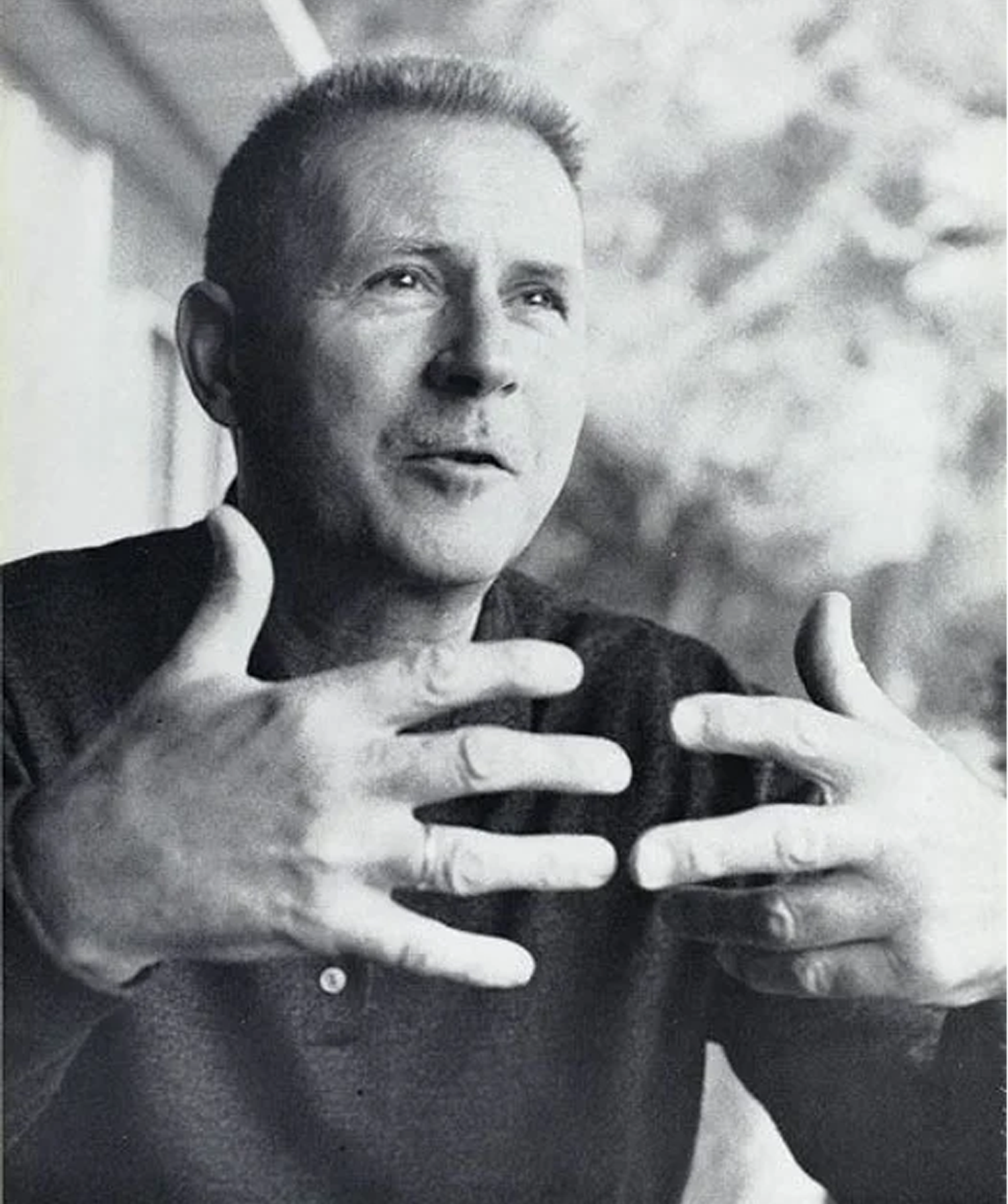
Jean Prouvé — archive portrait, all rights reserved.
JEAN PROUVÉ
1901–1984 · BUILDER · DESIGNER · ARCHITECTURE · FURNITURE · PREFABRICATION
Throughout his life, Jean Prouvé refused to separate furniture from building, design from manufacturing, or architecture from industry. He defined himself less as an architect or designer than as a "builder": a practitioner who conceived form based on the material, mechanical forces, manufacturing process, and the possibility of mass production.
This position makes him one of the most important figures of the 20th century. From the folded sheet metal chair to the demountable house, from the facade panel to the industrialized school, all his work rests on the same conviction: a correct form must make visible the way in which it is constructed.
BIOGRAPHY
Jean Prouvé was born in Paris in 1901 but grew up in Nancy in an exceptional environment. His father, Victor Prouvé, a painter, sculptor, and engraver, belonged to the founding circle of the École de Nancy; Émile Gallé was his godfather. The ideal of this generation—to bring art, craft, and industry closer together in order to make creation accessible to the greatest number—formed the cultural foundation of his career.
From 1916 onwards, Prouvé trained in metalwork with master blacksmiths. He learned directly from the material: cutting, heating, bending, assembling, and welding. This hands-on experience would prove decisive. Unlike a designer who then entrusts their project to a manufacturer, Prouvé always conceived the design and its execution simultaneously.
In 1923, he opened his own workshop in Nancy. His early work was still in the realm of artistic ironwork, but he gradually abandoned decoration in favor of forms derived from structural logic. From the mid-1920s onward, he used thin, folded sheet metal to create furniture and architectural elements. The folding process allowed him to give a thin metal sheet a strength comparable to that of a much more massive element.
In 1929, he participated in the founding of the Union of Modern Artists (UAM). The UAM brought together creators who wished to break with the traditional hierarchy of the decorative arts and champion a modernity linked to function, contemporary materials, and industrial production. Prouvé found there an intellectual milieu close to his own convictions.
The Jean Prouvé workshops, established in Nancy and later expanded to Maxéville from 1947 onwards, became a true laboratory. School furniture, chairs, desks, tables, partitions, demountable houses, facade panels, and prefabricated elements were all designed with seamless continuity. The workshop allowed for the creation of prototypes, their testing, and their immediate modification. For Prouvé, this close connection between design and production was essential.
In furniture design, he developed an immediately recognizable vocabulary. The rear legs of his chairs, which are subjected to more stress than the front legs, are often thickened or contoured to reflect the forces they bear. The famous Standard chair illustrates this principle: its silhouette is not an independent graphic design, but the result of a mechanical observation of the seat and the body.
The same reasoning guides the tables, desks, chairs, and communal furniture. Prouvé uses bent sheet metal, tubing, solid wood, or plywood, depending on their properties. The joints remain visible and demountable. A piece of furniture is conceived as a small construction; conversely, a building is broken down into components that can be manufactured in a workshop and quickly assembled on site.
The Reconstruction period offered Prouvé a major field of experimentation. He developed several systems of demountable and prefabricated houses, notably to meet urgent housing needs. The axial portal frame, lightweight facade panels, and standardized components made it possible to envision a transportable architecture, quick to assemble, and capable of variation without abandoning mass production.
His personal house in Nancy, completed in 1954, is a particularly clear demonstration of this thinking. Built on a difficult site using lightweight elements and components derived from his industrial research, it shows that the economy of materials can produce an architecture of great spatial richness.
The loss of its industrial facility in Maxéville in the early 1950s was a painful blow. Prouvé nevertheless continued its work as a consultant and builder. From 1957 onwards, it worked in particular with CIMT on numerous façade systems and participated in major projects: school facilities, industrial buildings, airports, offices, and architectural projects in France and abroad.
In parallel, he taught at the Conservatoire national des arts et métiers from 1957 to the early 1970s. His courses were based on drawing and constructive analysis: rather than teaching a style, Prouvé taught students to understand how things hold together, how they are produced, and how the choice of a material engages the entire project.
In 1971, he chaired the jury for the international competition for the future Centre Georges Pompidou. He championed the project by Renzo Piano and Richard Rogers, whose structure and technical systems were deliberately left exposed. In retrospect, this decision appears perfectly consistent with his own conception of architecture.
Until the end of his life, Jean Prouvé continued to design, advise, and revisit some of his models. He died in Nancy in 1984. His work, long admired primarily by architects and designers, has become a major international reference. Yet it remains difficult to reduce to mere aesthetics: its true modernity lies in a method based on materials, experience, fabrication, and the constant search for the right constructive solution.
WORK AND FORMAL LANGUAGE
At Prouvé, form reflects strength. A leg, a panel, a crossbar, or a shell is never arbitrarily dimensioned. Bent sheet metal provides rigidity and economy; wood is used when it contributes warmth or mechanical efficiency; the joints are designed for assembly, disassembly, and repair.
This logic produces an aesthetic without requiring separate effort. The pieces may appear highly graphic—compass legs, triangular profiles, embossed panels—but these features primarily reflect a structural function. It is this coherence between appearance, use, and fabrication that explains their enduring visual power.
WORKSHOPS, PUBLISHERS AND COLLABORATIONS
Jean Prouvé workshops, Nancy and Maxéville · CIMT · Steph Simon · collaborations with Charlotte Perriand, Pierre Jeanneret, Le Corbusier and numerous architects · contemporary re-editions notably by Vitra and Tecta.
SELECTIVE CHRONOLOGY
1901 — born in Paris 1903 — family settling in Nancy 1916–1921 — learning ironwork and metalwork 1923 — opening of his workshop in Nancy 1929 — co-founding of the UAM 1931 — development of the Jean Prouvé Workshops 1944 — Mayor of Nancy after the Liberation 1947 — industrial installation in Maxéville 1954 — Jean Prouvé house in Nancy 1957 — collaboration with CIMT and teaching at CNAM 1971 — Chair of the jury for the Centre Pompidou competition 1984 — death in Nancy.
SELECT BIBLIOGRAPHY
Jean Prouvé, Architecture through industry, Zurich, 1971 · Vitra Design Museum, Jean Prouvé — Die Poetik des technischen Objects, 2005 · Jean Prouvé Fund, Centre Pompidou / Kandinsky Library · official documentation Jean Prouvé and Vitra.
PUBLIC COLLECTIONS
Centre Pompidou / National Museum of Modern Art and Kandinsky Library · Museum of Modern Art, New York · Vitra Design Museum, Weil am Rhein · Museum of Decorative Arts and numerous international collections of design and architecture.
Jean Prouvé at the Museum of Modern Art · Biography and archives of Jean Prouvé.
JEAN PROUVÉ AT DIZAGN
DIZAGN ARCHIVES — WORK SOLD
Document already passed through DIZAGN and kept online for documentary purposes.

The DIZAGN sheet above concerns a Tecta edition of the Grand Repos armchair and should be read as such; the precise documentation of the edition remains separate from the history of the original prototypes by Jean Prouvé.
DIZAGN Expertise → Thibault Lannuzel →
Main sources: Jean Prouvé archives; Centre Pompidou; Vitra Design Museum; Museum of Modern Art; DIZAGN documentation. Portrait: all rights reserved.