
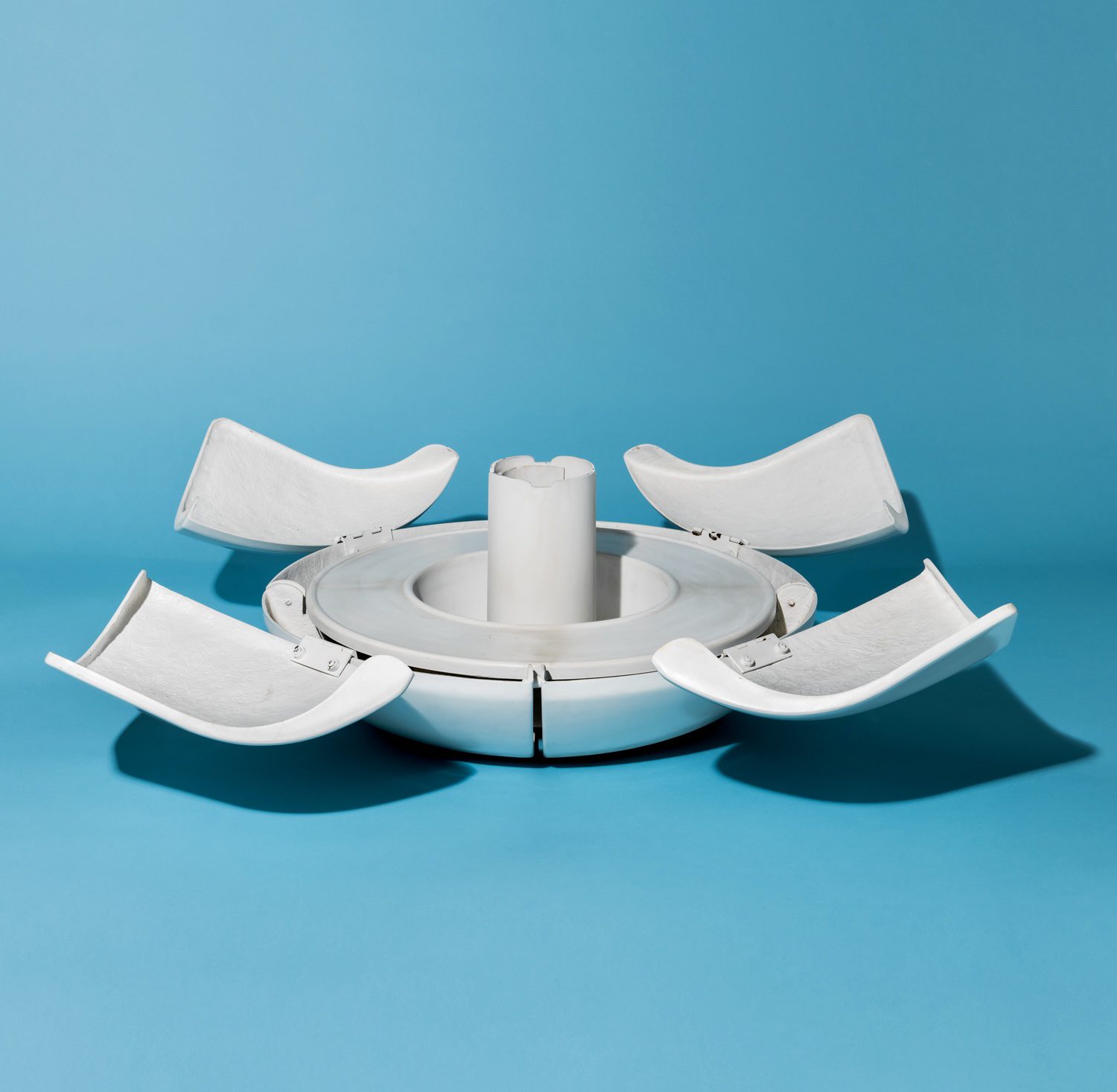
Papaya table/bar, prototype by Jean-Pierre Laporte, 1969. DIZAGN Collection.
JEAN-PIERRE LAPORTE
BORN IN 1944 · FRENCH DESIGNER · ÉCOLE BOULLE · ENSAD · PLASTICS · SCULPTURAL FURNITURE
Jean-Pierre Laporte belongs to the generation of French designers who, at the end of the 1960s, exploited the possibilities offered by resins, fiberglass and plastic materials.
His chairs and objects are characterized by continuous volumes, clean curves and an almost sculptural conception of function.
BIOGRAPHY
Jean-Pierre Laporte was born in Bordeaux in 1944. He discovered furniture at a very young age through his father's professional environment, which was linked to Thonet France. This proximity to publishing allowed him to directly observe the relationship between design, manufacturing and distribution.
He trained at the École Boulle and then at the École nationale supérieure des Arts décoratifs. He associated with designers committed to the renewal of French furniture and collaborated in particular with Marc Held and Pierre Guariche before opening his own design office in 1969.
His initial research focused on plywood and seating, but new plastic materials quickly became central. Laporte exploited fiberglass and resins to obtain continuous volumes impossible to achieve with traditional woodworking techniques.
The year 1969 was particularly important. He presented several experimental projects at the Salon of the Société des Artistes Décorateurs. The Centre Pompidou holds the Girolle armchair and the Macaron pouf, both dated 1969, which illustrate this desire to produce autonomous, rounded and strongly sculptural forms.
The Papaye table/bar, preserved by DIZAGN, belongs to this same period. A prototype and unique piece, it is made of fiberglass and white gelcoat. Its circular shape and central leg merge into a continuous volume that transforms an everyday piece of furniture into a spatial object.
Laporte continued his research in the early 1970s; the Diabolo stool, dated 1972 and kept at the Centre Pompidou, extends his interest in simple volumes obtained by molding.
From 1976 onwards, he also developed a significant interior design business with the company EBAD in Dreux, working with interior architects and designers on furniture and finishing projects. This industrial experience complemented his design practice.
The rediscovery of his creations from the years 1965–1975 has made it possible to place Laporte among the essential actors of French plastic experimentation, alongside the research carried out at the same time by Pierre Paulin, Marc Held, Michel Cadestin or Maurice Calka.
WORK AND FORMAL LANGUAGE
At Laporte, the material largely determines the form. Molding eliminates visible joinery, creating chairs, tables, and stools from a continuous surface. The curves are generous yet controlled; they respond as much to the material's strength as to the presence of the body.
The white, frequently used, reinforces the sculptural reading and highlights the shadows and changes in plane.
SELECTIVE CHRONOLOGY
1944 — born in Bordeaux 1960s — training at the École Boulle and the ENSAD 1969 — creation of the design office, Girolle armchair, Macaron pouf and Papaye prototype 1972 — Diabolo stool 1976 — development of EBAD activity in Dreux following years — layout, furniture and reissues of historical designs.
SELECT BIBLIOGRAPHY
Karoll Audibert, 65–75 Jean-Pierre Laporte, ten years of creation, Edouard Edwards, Paris, 2010 · Jean-Pierre Laporte archives · Centre Pompidou documentation.
PUBLIC COLLECTIONS
The Centre Pompidou preserves several major creations by Jean-Pierre Laporte, including the Girolle armchair (1969), the Macaron pouf (1969) and the Diabolo stool (1972).
JEAN-PIERRE LAPORTE AT DIZAGN
DIZAGN ARCHIVES — WORK SOLD
Document already passed through DIZAGN and kept online for documentary purposes.
DIZAGN Expertise → Thibault Lannuzel →
Main sources: Centre Pompidou; Karoll Audibert; Jean-Pierre Laporte archives; DIZAGN documentation.