
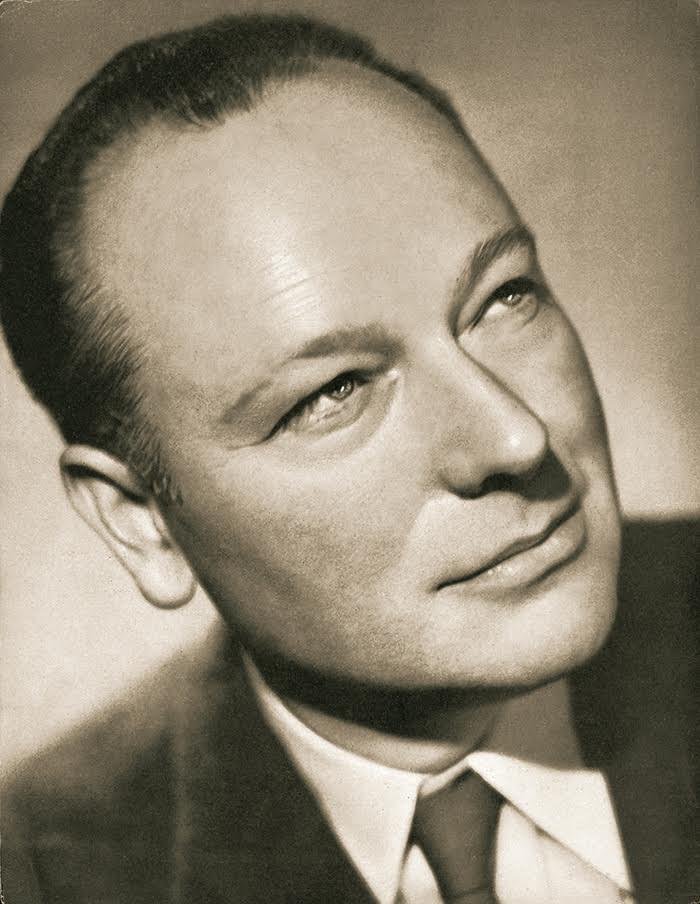
Jacques Adnet — archive portrait, all rights reserved.
JACQUES ADNET
1900–1984 · ARCHITECT AND DECORATOR · INTERIOR DESIGNER · FURNITURE DESIGNER · COMPAGNIE DES ARTS FRANÇAIS
Jacques Adnet occupies a central place in 20th-century French decorative arts. Trained in the tradition of the interior designer but deeply open to modernism, he directed the Compagnie des Arts Français for more than thirty years and developed furniture where luxurious materials interact with metal, leather and deliberately modern structures.
His career links the 1920s to the Reconstruction and the major programs of the Fourth Republic. The hundreds of pieces of furniture commissioned by the State, his interior design of embassies, official offices and prestigious venues testify to a practice where the object and interior architecture remain inseparable.
BIOGRAPHY
Jacques Adnet was born in 1900 in Châtillon-Coligny. In 1916, he entered the École des Arts Décoratifs in Paris with his twin brother, Jean. The two brothers worked together until 1928, signing their furniture and objects under a shared name. This early period placed them at the heart of the renewal of the decorative arts that preceded and accompanied the 1925 International Exposition.
After his training, Jacques Adnet worked notably with Maurice Dufrêne and Tony Selmersheim. In 1925, the brothers exhibited at the International Exhibition of Modern Decorative and Industrial Arts within La Maîtrise, the art workshop of Galeries Lafayette directed by Dufrêne.
In 1927, Jacques Adnet received a grant from the Blumenthal Foundation. The following year marked a decisive turning point: Maurice Dufrêne appointed him artistic director of the Compagnie des Arts Français, a decoration and publishing house founded in 1919 by Louis Süe and André Mare and then taken over by Galeries Lafayette.
Adnet immediately gave the Company a more avant-garde direction. He invited or collaborated with designers such as Charlotte Perriand, Djo-Bourgeois, Francis Jourdain, and René Herbst. The Company's renovated gallery was inaugurated in October 1928, explicitly affirming a desire to position the house within modernity.
In the 1930s, Adnet developed a personal style at the crossroads of Art Deco and Modernism. Volumes became more geometric, structures were simplified, and materials played an increasingly important role in the expression of furniture. Precious woods, glass, metal, shagreen, and reflective surfaces could be combined without compromising the object's legibility.
The war and the Reconstruction transformed the context of his practice. From the 1940s onwards, the French administration placed numerous orders with him. The Mobilier national (National Furniture Collection) holds an exceptional collection of his creations and documents more than two hundred pieces of furniture commissioned between 1943 and 1958.
These commissions allow us to measure the extent of his official activity. Adnet worked in Jacques Jaujard's office at the Kinsky Hotel in 1945, in President Vincent Auriol's office at the Château de Rambouillet from 1947, in the smoking room of the Élysée Palace in 1953 and in the UNESCO meeting room in 1958. He also designed furniture for several French embassies, notably to the Holy See and in Canberra.
Furniture from this period often combines a metal frame with leather or vinyl upholstery. The tubing, fittings, stitching, and saddle stitching are visible and become design elements. This interplay between technical precision and luxurious finish is one of the most recognizable hallmarks of his mature work.
The desk, designed in 1956 for the Public Works administration and now held at the Mobilier National (National Furniture Collection), exemplifies this synthesis: a metal frame, cherrywood elements, varnished copper, and a leather-covered top. The piece is modern in its construction while retaining the tactile quality and refinement associated with the French furniture maker.
Adnet also participates in tapestry-covered ensembles and surrounds himself with numerous artists and craftsmen. His concept of the decorator remains collective: the interior project brings together cabinetmakers, metalworkers, upholsterers, ceramists, painters and textile designers around a coherent program.
After the war, he became president of the Society of Decorative Artists. This position confirmed his institutional role within the profession and his position as a link between the great tradition of the interior designer and the new forms of post-war design.
In 1959, Adnet left his position as director of the Compagnie des Arts Français and took over the leadership of the École nationale supérieure des Arts Décoratifs. He directed the institution until 1970, initiating its transformation towards a more contemporary teaching model. The end of his career was thus largely devoted to the transmission of knowledge and pedagogical reform.
Jacques Adnet died in 1984. The archive collection held at the Library of the Musée des Arts Décoratifs, acquired through a bequest in 1994, comprises biographical documents, photographs, correspondence, press clippings, and project files covering more than half a century of his work. It complements a significant body of work held by the MAD and the Mobilier National.
WORK AND FORMAL LANGUAGE
Adnet cultivates a luxurious modernity that relies neither on historical ornamentation nor austerity. Polished metal, copper, glass, wood, shagreen, and above all, leather are used to emphasize the structure. Sheaths, seams, and fastenings do not conceal the assembly; they make it more legible.
The furniture often retains a simple geometry—rectangular desk, console, bookcase, armchair—but the precision of the proportions and details gives it a strong presence. In the seating of the late 1950s, the leather-covered metal tubing directly transforms the structure into a graphic line.
COMPANY OF FRENCH ARTS AND COLLABORATIONS
Compagnie des Arts Français, artistic direction 1928–1959 · La Maîtrise / Galeries Lafayette · collaborations with Maurice Dufrêne, Charlotte Perriand, Djo-Bourgeois, Francis Jourdain, René Herbst, Gilbert Poillerat and numerous craftsmen · commissions from the Mobilier national.
SELECTIVE CHRONOLOGY
1900 — born in Châtillon-Coligny 1916 — entered the School of Decorative Arts with his brother Jean 1925 — International Exhibition, The Mastery 1927 — Blumenthal scholarship 1928 — Artistic direction of the Compagnie des Arts Français 1930s — development of a luxurious modernism 1943–1958 — more than two hundred pieces of furniture ordered by the State 1947 — presidential office in Rambouillet 1953 — smoking room of the Élysée Palace 1958 — UNESCO furniture 1959 — management of ENSAD 1970 - retirement · 1984 - death.
SELECT BIBLIOGRAPHY
Jacques Adnet Collection, Library of the Museum of Decorative Arts · documentation and work files of the Mobilier national · Yvonne Brunhammer, studies devoted to French decorative arts and 20th century decorators · catalogues of the Society of Decorative Artists and the Compagnie des Arts Français.
PUBLIC COLLECTIONS AND ARCHIVES
Musée des Arts décoratifs, Paris: Jacques Adnet Collection, 1927–1984, as well as drawings, photographs and furniture · Mobilier national: important collection of desks, libraries, seats and official sets, including the furniture from Rambouillet, UNESCO and French embassies.
Jacques Adnet Collection — Museum of Decorative Arts · Office from 1956 — National Furniture.
JACQUES ADNET AT DIZAGN
DIZAGN ARCHIVES — WORK SOLD
Document already passed through DIZAGN and kept online for documentary purposes.

Attribution: The pair of armchairs presented by DIZAGN is described as "attributed to Jacques Adnet." This attribution is cautious and should not be considered certain without further documentation.
DIZAGN Expertise → Thibault Lannuzel →
Main sources: Musée des Arts décoratifs; Mobilier national; DIZAGN documentation. Portrait: all rights reserved.