

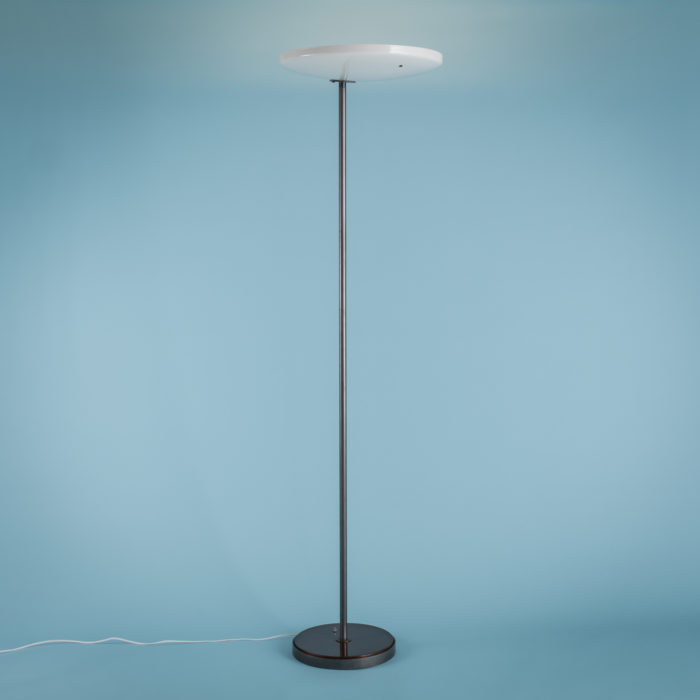
Large floor lamp by Georges Frydman, EFA, 1958. DIZAGN Collection.
GEORGES FRYDMAN
BORN IN 1924 · FRENCH DESIGNER · EFA · FUNCTIONAL FURNITURE · RENÉ GABRIEL PRIZE 1966
Georges Frydman developed rational furniture for modern living spaces during the 1950s and 1960s. With EFA, founded in 1954, he sought to combine quality design, mass production, and economical construction.
Tables, storage units and lighting fixtures are based on clear geometry, thin metal structures and a measured use of wood and industrial materials.
BIOGRAPHY
Georges Frydman was born in Mulhouse on August 16, 1924. He studied at the Regional School of Architecture in Toulouse before turning to furniture and home furnishings. His career developed in the post-war period, at a time when French architects and designers were seeking to meet the needs of a rapidly changing housing sector.
In 1954, he created EFA and developed a furniture collection designed for publishing. The objective was to offer modern furniture whose design could be reconciled with manufacturing constraints and with an affordable price: storage units, tables, seats and lighting were conceived as coherent elements of a domestic equipment.
Frydman readily employs tubular or profiled metal, combined with wood, laminate, and lacquered surfaces. The structures remain slim and legible. The tabletops or cabinets sometimes appear to float above the bases, creating a feeling of lightness.
His furniture is presented and published in the press dedicated to modern housing. The large floor lamp from 1958 preserved by DIZAGN particularly illustrates this research: a long metal rod, a large reflector and a few wooden elements are enough to construct a silhouette that is both technical and domestic.
Nesting tables, or "Cascatelles," exploit modularity and interlocking. They reflect the designer's interest in the mobility of uses and in furniture that adapts to changes in the home.
In 1966, Georges Frydman received the René Gabriel Prize, an important distinction in French mass-produced furniture. This recognition confirmed the place of his work within a generation that sought to reconcile modern aesthetics, functionality, and widespread distribution.
Frydman's work remains less publicized than that of some contemporaries, but its rediscovery allows us to better understand the diversity of French design during the Trente Glorieuses and the role of independent publishers in modern equipment.
WORK AND FORMAL LANGUAGE
Frydman favors orthogonal lines, slender legs, and rational joinery. Materials are distributed according to their function: metal for the structure, wood or laminate for the surfaces, and lacquer for color and protection.
This restraint produces elegant furniture without spectacular effects. Detail, proportion, and the balance of masses constitute the essence of the design language.
SELECTIVE CHRONOLOGY
1924 — born in Mulhouse 1954 — creation of EFA · 1958 — large lamppost presented by DIZAGN around 1960 — nesting tables and standard furniture 1966 — René Gabriel Prize 1960s–1970s — continued search for furniture and equipment.
SELECT BIBLIOGRAPHY
EFA commercial documentation Joy and beauty in the home, around 1960 · publications devoted to French furniture of the 1950s–1960s and to the René Gabriel prize.
INSTITUTIONAL REFERENCE
The AGORHA database of the National Institute of Art History documents Georges Frydman as a furniture designer, born in Mulhouse on August 16, 1924, founder in 1954 of the Functional Equipment of Housing — future EFA company — and winner of the René Gabriel prize in 1966. INHA / AGORHA — Georges Frydman.
GEORGES FRYDMAN AT DIZAGN
DIZAGN ARCHIVES — WORKS SOLD
Pieces already processed by DIZAGN and kept online for documentary purposes.

DIZAGN Expertise → Thibault Lannuzel →
Main sources: EFA commercial documentation; period publications; DIZAGN documentation.