
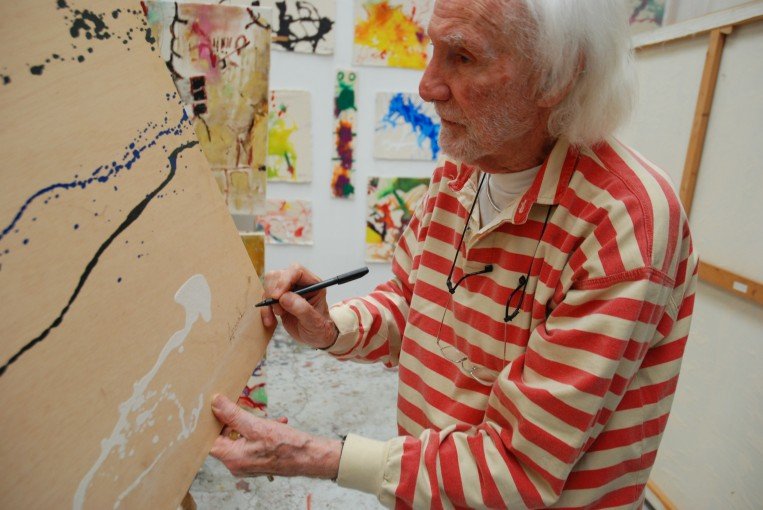
François Arnal in his studio. Source: Gallifet — all rights reserved.
FRANÇOIS ARNAL
1924 — 2012 · ARTIST · DESIGNER · FOUNDER OF ATELIER A
François Arnal occupies a unique position at the border of art and design. A figure of Art Informel in the 1950s, a painter present in the collections of the Centre Pompidou, he is also the founder of Atelier A, a radical experiment which, from 1969 onwards, attempted to take artistic creation out of the painting and integrate it into everyday life.
In just six years, Atelier A became a laboratory for breaking down barriers between artists, designers, objects and furniture. Arnal did not abandon painting: rather, he sought to extend the artist's role to production, use and society.
BIOGRAPHY
Born in 1924 in La Valette-du-Var, François Arnal studied law and literature but chose painting as his true way of life. Arriving in Paris in 1948, he became part of the post-war context and became one of the representatives of a gestural and material abstraction close to Art Informel.
In the early 1950s, his paintings developed allusive forms and a constantly evolving materiality. A trip to Mexico and the United States, followed by a stay in Tahiti, broadened his vocabulary. Upon his return to France, he continued his research in which spraying, dripping, glazing, and imprints challenged the distinction between pictorial surface, gesture, and object.
The Centre Pompidou holds several major works from this period, including The Accident from 1957 and Negative pattern from 1960. They testify to Arnal's place in post-war French abstraction and his interest in traces, accidents, mechanical structures and signs taken from reality.
In the 1960s, this questioning gradually led Arnal to challenge the traditional separation between art and life. May 1968 acted as a catalyst. In 1969, he created Atelier A, a publishing house designed to produce furniture, lighting, and objects conceived by artists and designers from different disciplines.
The ambition is both aesthetic and social: to make art accessible to a wider audience and to make the artist an active participant in everyday life. Atelier A operates with unusual freedom, blending enthusiasm, improvisation, and experimentation. For six years, more than thirty creators have participated in the adventure; artists and designers have conceived nearly two hundred models.
Arman, César, Annette Messager, Rod Adzak, and many other artists were invited to imagine objects that could leave the traditional exhibition space and enter the home. François Arnal himself designed several dozen models. Atelier A thus became a space where industrial objects, multiples, sculpture, and furniture mutually influenced one another.
Arnal's creations for Atelier A are often based on the repurposing of familiar components. A clamp becomes a table leg; a tube, a wire, a wheel, or a mechanical device is displaced from its original function. The furniture does not seek to conceal its construction: on the contrary, it exposes the principle that allows it to stand, roll, fold, or assemble.
This logic is particularly evident in the tables with "clamp" legs, whose chrome elements can accommodate different tabletops. The object presents itself as an open-ended device rather than a fixed form. The almost DIY character of some pieces is intentional: it affirms the possibility of alternative production methods and challenges the bourgeois conventions of traditional furniture.
Atelier A closed in 1975. Arnal then fully returned to painting and developed new series, notably around the Meeps, imaginary characters from a fictional civilization. Until the end of his life, he pursued a body of work marked by fluidity, curiosity, and a rejection of fixed categories. François Arnal died in Paris in 2012.
The rediscovery of Atelier A, particularly thanks to the monograph published by Éditions Norma in 2003, has placed this endeavor within a broader history of radical design and the interplay between art and object. It allows us to understand that Arnal's work as a designer was not a peripheral episode in his career as a painter: it directly extended his desire to transform the relationship between creation and life.
WORK AND FORMAL LANGUAGE
In his furniture designs, Arnal applies a logic similar to that of his pictorial work: he moves, assembles, repurposes, and makes the process visible. Clamps, chrome tubing, wire, wheels, and industrial materials are chosen for their ability to create an immediate relationship between structure and use.
The forms are often minimal but never neutral. A table can be reduced to four clamps; a chair becomes a drawing in space; a chaise longue can evoke a mechanical device. This economy gives the objects a conceptual presence that brings them closer to both sculpture and furniture.
WORKSHOP A — PUBLISHING AND COLLABORATIONS
Atelier A, 1969–1975 · collaborations and editions with Arman, César, Annette Messager, Rod Adzak and numerous artists and designers · production of furniture, lighting and objects in small series.
SELECTIVE CHRONOLOGY
1924 — born in La Valette-du-Var 1948 — Settling in Paris and developing informal painting 1950s — travels and pictorial research 1957 — The Accident · 1960 — Negative pattern · 1969 — creation of Atelier A 1969–1975 — experimental editions of objects and furniture 1975 — end of Workshop A and a firm return to painting 2003 — publication of the definitive monograph dedicated to Atelier A 2012 — death in Paris.
SELECT BIBLIOGRAPHY
Françoise Jollant-Kneebone & Chloé Braunstein-Kriegel, Workshop A, where art and object meet, Norma, 2003 · Patrick Favardin & Guy Bloch-Champfort, Interior designers of the 60s–70s, Norma, 2007 · Centre Pompidou documentation dedicated to François Arnal · archives and documentation Atelier A.
PUBLIC COLLECTIONS
Centre Pompidou / National Museum of Modern Art, Paris: paintings and works by François Arnal, in particular The Accident (1957) and Negative pattern (1960). His work is also documented in publications and collections devoted to radical design and the relationship between art and object in the 1960s–1970s.
François Arnal at the Centre Pompidou · Monograph Atelier A — Norma Editions.
FRANÇOIS ARNAL AT DIZAGN
DIZAGN ARCHIVES — WORK SOLD
Document already passed through DIZAGN and kept online for documentary purposes.

DIZAGN Expertise → Thibault Lannuzel →
Main sources: Centre Pompidou; Éditions Norma; Gallifet; DIZAGN documentation. Portrait: all rights reserved.