
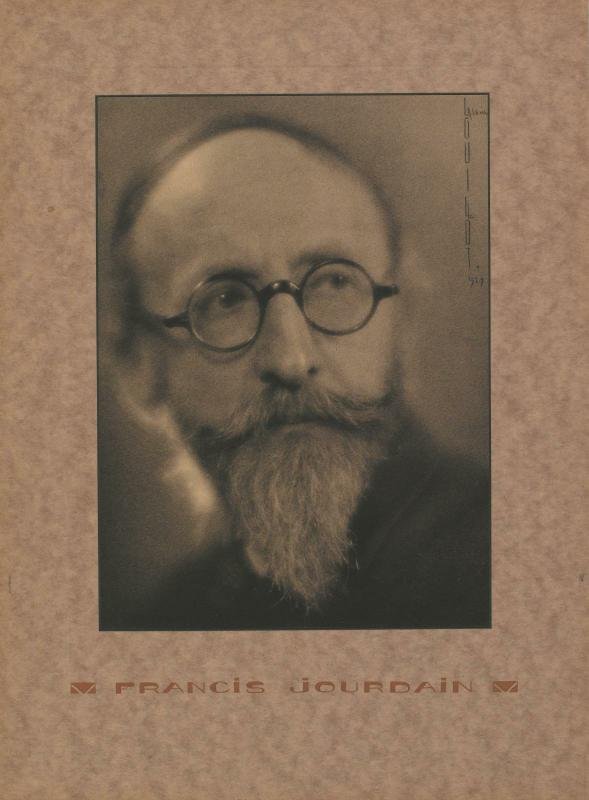
Francis Jourdain, 1925, photograph by Laure Albin-Guillot. Centre Pompidou — all rights reserved.
FRANCIS JOURDAIN
1876–1958 · PAINTER · DECORATOR · FURNITURE · CERAMICS · SOCIAL MODERNITY
Francis Jourdain is one of the founding figures of French decorative modernity. A painter in his early days, a ceramist, furniture designer and decorator, he championed from the outset a functional and social conception of the object: simple, honest forms, adapted to contemporary homes and capable of being produced at an affordable cost.
Long before the term "design" became established in France, Jourdain thus posed several of the questions that would structure the modern movement: series, modularity, economy of materials, relationship to industry and social responsibility of the creator.
BIOGRAPHY
Born in Paris in 1876, Francis Jourdain grew up in a particularly active artistic environment. His father, the architect Frantz Jourdain, played a major role in Parisian cultural life and was one of the founders of the Salon d'Automne. This close proximity to painters, architects, writers, and artisans provided young Francis with an education that was less academic and more deeply open to the debates of his time.
Jourdain initially devoted himself to painting. He frequented avant-garde circles and developed a figurative style attentive to everyday life. Very early on, however, he became interested in the applied arts, convinced that creativity should not be limited to paintings or luxury objects. Furniture, ceramics, and decoration became for him means of directly influencing the living environment.
This approach took on particular importance at the turn of the 20th century. While Art Nouveau often favored curved lines, ornamentation, and costly craftsmanship, Jourdain gradually opted for a more minimalist style. His furniture was constructed from simple volumes, wood with clearly defined surfaces, and direct joinery. Decoration was not eliminated out of dogmatism; it simply ceased to be independent of function.
The dining room he presented at the 1911 Salon d'Automne, now documented by the Musée d'Orsay, represents a crucial milestone. Jourdain offered coherent furniture designed for modern living rather than social display. The furniture becomes an integral part of a whole, with clear proportions and a constant focus on function.
In 1912, he founded Ateliers Modernes. The ambition was explicitly social: to mass-produce simple, combinable "interchangeable furniture" capable of furnishing the homes of families unable to afford traditional cabinetmaking. Jourdain opened a shop on rue de Sèze in Paris where he sold furniture, ceramics, lighting, and decorative objects.
This program made him one of the French pioneers of modular furniture. Interchangeability is not just a commercial solution: it allows furniture to be adapted to the dimensions of the home, the buyer's budget, and their evolving needs. The home design becomes open, transformable, and less dependent on a fixed set.
Jourdain also works with ceramics. His glazed pieces demonstrate a direct relationship with the material and color, often freer than in his furniture. This dual practice helps to understand his modernism: the rationality of the furniture does not imply a disappearance of sensitivity. It is combined with a tactile, chromatic, and artisanal exploration in smaller-scale objects.
During the 1920s, he continued his advocacy for functional and economical furniture. His commitment brought him closer to other designers who rejected decorative luxury as the sole horizon of the applied arts. In 1929, he participated in the founding of the Union of Modern Artists, alongside figures such as Robert Mallet-Stevens, Charlotte Perriand, and other architects and decorators eager to bridge the gap between design, industry, and contemporary life.
The UAM championed a holistic conception of modernity: architecture, furniture, lighting, graphic design, and equipment had to respond to new social and technological conditions. Jourdain, who had been working on these issues for nearly twenty years, emerged as a guiding figure within the group. His work provided an important precedent for the younger generation.
In the 1930s, he continued to exhibit and design housing complexes while also developing his writing. The political and social dimension of his thought became increasingly explicit. For Jourdain, improving housing was not simply a matter of taste: it directly impacted living conditions, work, and access to culture.
After the Second World War, he remained a reference point for designers committed to mass-produced furniture and the idea of accessible modern furnishings. His career thus connects several generations: that of the decorative arts at the beginning of the century, that of the UAM (Union of Modern Artists), and, indirectly, that of the designers of the Reconstruction era who would in turn take up the question of rational, demountable, and industrially produced furniture.
Francis Jourdain died in Paris in 1958. His work is not limited to functionalism or furniture design: it constitutes a continuous reflection on how the artist can intervene in everyday life. This coherence explains the essential place he occupies in the genealogy of modern French design.
WORK AND FORMAL LANGUAGE
Jourdain's furniture is distinguished by its understated construction. The volumes are geometric, the surfaces flat, the storage integrated, and the functions immediately identifiable. The design avoids historical references and applied ornamentation; it seeks a beauty derived from proportion, use, and material.
Ceramics allows him a freer artistic expression. Glazes, colors, and surface irregularities introduce a sensitive dimension that complements the rigor of the furniture. His work as a whole thus reveals less a uniform style than an ethic: to create honest, useful objects suited to everyday life.
WORKSHOPS AND COLLABORATIONS
Modern Workshops · Autumn Salon · Union of Modern Artists · collaborations and exchanges with the architects and decorators of early 20th-century French modernism.
SELECTIVE CHRONOLOGY
1876 — born in Paris 1890s — beginnings as a painter 1900s — development of applied arts, furniture and ceramics 1911 — dining room set in the Autumn Salon 1912 — creation of Modern Workshops and distribution of interchangeable furniture 1920s — furniture, ceramics and reflections on modern housing 1929 — participation in the founding of the UAM 1930s–1950s — continuation of the activity of creator, author and engaged intellectual · 1958 — death in Paris.
SELECT BIBLIOGRAPHY
Catalogues of the Salon d'Automne · documentation from the Musée d'Orsay devoted to the collections of Francis Jourdain · archives and publications of the Union des Artistes Modernes · studies devoted to French furniture of the early 20th century and to the origins of functionalism.
PUBLIC COLLECTIONS
Musée d'Orsay, Paris: Francis Jourdain's collections and furniture, particularly those related to the Salon d'Automne; Centre Pompidou / Musée national d'art moderne: portrait of Francis Jourdain by Laure Albin-Guillot, 1925, as well as documentation relating to the avant-garde and the modern movement.
Francis Jourdain at the Musée d'Orsay · Portrait of Francis Jourdain at the Centre Pompidou.
FRANCIS JOURDAIN AT DIZAGN
AVAILABLE WORK

DIZAGN ARCHIVES — WORK SOLD
Document already passed through DIZAGN and kept online for documentary purposes.

DIZAGN Expertise → Thibault Lannuzel →
Main sources: Musée d'Orsay; Centre Pompidou; DIZAGN documentation. Portrait: Laure Albin-Guillot, 1925 — all rights reserved.