
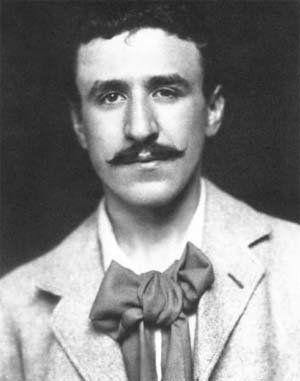
Charles Rennie Mackintosh — archival portrait, public domain.
CHARLES RENNIE MACKINTOSH
1868–1928 · ARCHITECT · DESIGNER · GLASGOW STYLE · FURNITURE · INTERIOR DESIGN
Charles Rennie Mackintosh is one of the most original figures of European modernity around 1900. An architect, designer and draftsman, he developed in Glasgow a language where geometry, verticality, stylized floral motifs and references to Scottish tradition meet.
Her furniture cannot be separated from her architecture. Chairs, tables, screens, lighting fixtures and decor are conceived as elements of a complete spatial composition, from Catherine Cranston's tea rooms to Hill House and the Glasgow School of Art.
BIOGRAPHY
Charles Rennie Mackintosh was born in Glasgow in 1868. He trained as an architect in a rapidly industrializing city and simultaneously attended evening classes at the Glasgow School of Art. This dual training—professional practice and artistic education—would prove decisive for a body of work that rejected the separation between architecture and decorative arts.
At the Glasgow School of Art, he met Margaret Macdonald, Frances Macdonald, and Herbert McNair. The four artists formed the group known as "The Four," whose drawings, posters, objects, and decorative projects contributed to the emergence of the Glasgow Style. Their work garnered attention far beyond Scotland and circulated within the Vienna Secession and European avant-garde circles.
Mackintosh joined the firm of Honeyman & Keppie, where he gradually developed his architectural practice. The Glasgow School of Art project, whose main phases unfolded from the late 1890s to the early 20th century, became his most famous architectural work. The building combines an extremely rational layout with exceptional attention to light, detail, and furnishings.
In 1897, Catherine Cranston commissioned him to design a tea room located at 114 Argyle Street in Glasgow. Mackintosh conceived the entire project and designed the furniture for the various rooms. It was in this context that the high backrest appeared, which would become one of his most recognizable signatures.
The Musée d'Orsay holds a chair created for this set, dating from around 1898. Made of stained and varnished oak, it has a very vertical silhouette: the backrest extends well beyond the seated body and acts as an architectural element in the room. Mackintosh himself used this model in his apartment and exhibited several examples at the Vienna Secession exhibition in 1900.
This participation in the Viennese scene was crucial. Mackintosh maintained relationships with Josef Hoffmann and influenced the designers who would form the Wiener Werkstätte. His vocabulary combined very strict geometry with highly stylized plant motifs, notably the rose, creating a unique balance between austerity and delicacy.
The private houses he designed at the turn of the century extended these explorations. Windyhill and then Hill House were conceived as total works of art: the building's structure, woodwork, colors, textiles, furniture, and objects all contributed to a single composition. Margaret Macdonald collaborated closely on several of these interiors, notably through her decorative panels.
Miss Cranston's tea rooms constitute another essential laboratory. Mackintosh experimented there with different relationships between furniture and public space. High backrests served to create areas of intimacy, filter views, or structure the room without resorting to traditional partitions.
The Willow Tea Rooms, opened in 1903, takes this logic to its extreme. The seats, with their unusual proportions, become almost architectural fragments. Their verticality, geometry, and graphic presence demonstrate that Mackintosh never conceived of the chair as an autonomous object placed in a room.
After 1914, Mackintosh's career faced more difficulties. He left Glasgow, stayed in Suffolk, and then settled in London. His later years were largely devoted to watercolor painting, particularly landscapes and botanical studies. He died in London in 1928.
Its international rediscovery intensified after the Second World War. Its influence then became clearly apparent in the history of architecture and modern design. Contemporary manufacturers, notably Cassina, reintroduced several of its models into industrial production while distinguishing between reissues and historical examples.
The Argyle chair presented by DIZAGN belongs precisely to this history of re-edition. It is a Cassina production from around 1970, based on the 1898 design, and not a contemporary example. The historical model held at the Musée d'Orsay allows us to understand the formal lineage, while the Cassina re-edition testifies to Mackintosh's recognition as a master of 20th-century modern design.
WORK AND FORMAL LANGUAGE
Mackintosh's design language is built on the tension between verticality and horizontality, solidity and emptiness, geometry and nature. In his chairs, the backrest often becomes a grid or a screen, while the seat remains deliberately minimalist. The furniture thus organizes space as much as it fulfills a function.
Color also plays a crucial role: dark woods, white surfaces, and accents of purple, pink, or green help to differentiate the atmospheres. Floral motifs are simplified to the point of becoming almost abstract, foreshadowing several trends of European modernism.
WORKSHOPS, COLLABORATIONS AND PUBLISHING
Honeyman & Keppie · Margaret Macdonald Mackintosh · Frances Macdonald · Herbert McNair · Catherine Cranston · Glasgow School of Art · relations with Josef Hoffmann and the Vienna Secession · modern reissues by Cassina in the I Maestri collection.
SELECTIVE CHRONOLOGY
1868 — born in Glasgow 1880s — architectural training and courses at the Glasgow School of Art 1890s — constitution of «The Four» · 1897 — Argyle Street Tea Rooms · around 1898 — first high-backed chairs of the Argyle type 1900 — exhibition at the Vienna Secession 1902–1903 — Hill House 1903 — Willow Tea Rooms 1910s — latest major interior design commissions 1928 — death in London 1970s — significant distribution of Cassina reissues.
SELECT BIBLIOGRAPHY
Roger Billcliffe, Charles Rennie Mackintosh: The Complete Furniture, Furniture Drawings and Interior Designs · documentation from the Musée d'Orsay · archives of the University of Glasgow and the Glasgow School of Art · Cassina documentation, I Maestri collection.
PUBLIC COLLECTIONS
Musée d'Orsay, Paris: important collection of furniture by Charles Rennie Mackintosh, including the high-back chair created for Argyle Street around 1898 · Glasgow Museums · Hunterian, University of Glasgow · Victoria and Albert Museum and other major international collections.
Argyle Chair, circa 1898 — Musée d'Orsay · Charles Rennie Mackintosh—Cassina.
CHARLES RENNIE MACKINTOSH AT DIZAGN
DIZAGN ARCHIVES — WORK SOLD
Document already passed through DIZAGN and kept online for documentary purposes.

Edition: The Argyle chair presented by DIZAGN is a Cassina edition circa 1970, made from the model designed for Argyle Street in 1897–1898. It should not be presented as an original 1898 example.
DIZAGN Expertise → Thibault Lannuzel →
Main sources: Musée d'Orsay; Cassina; Roger Billcliffe; DIZAGN documentation. Portrait: public domain.