
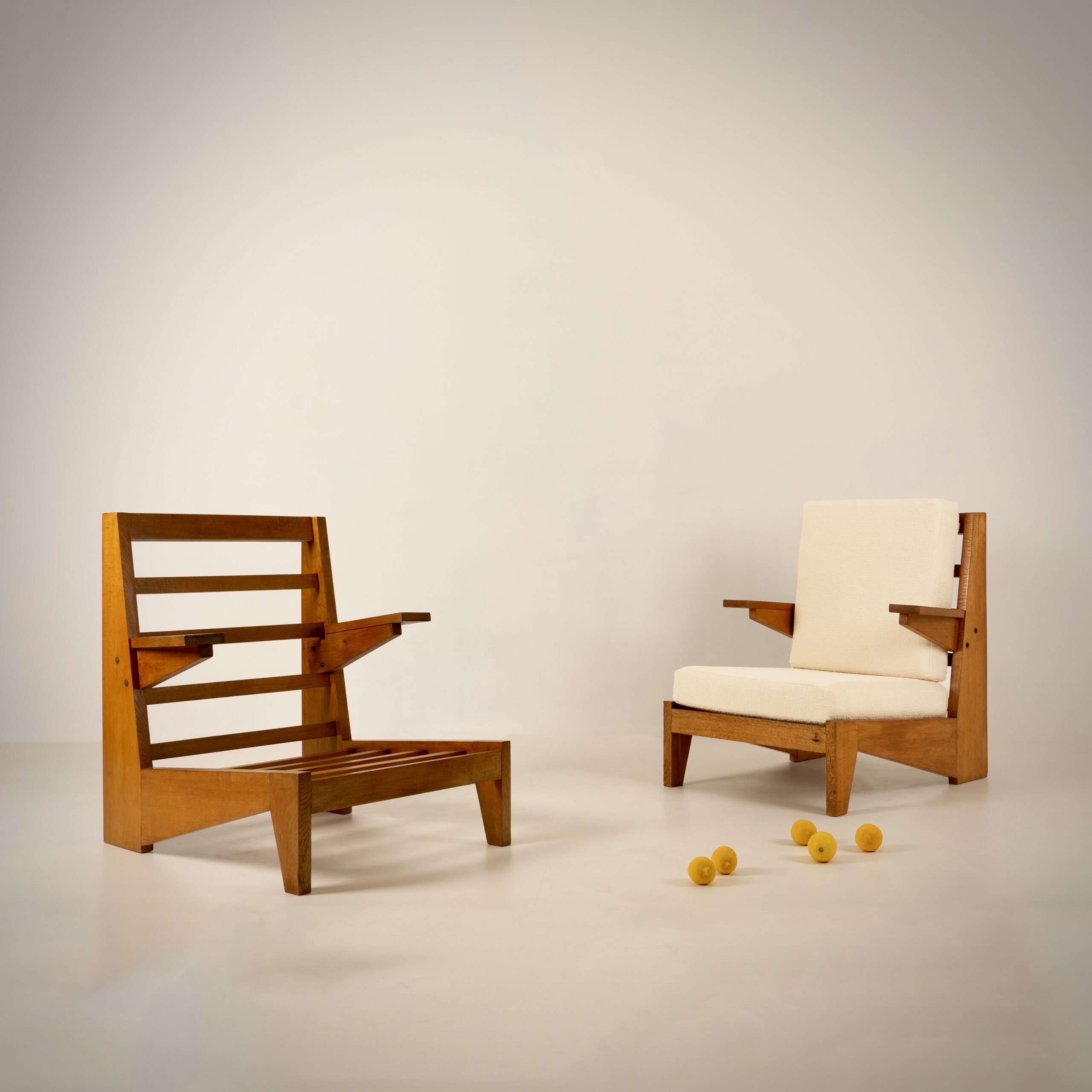
Pair of armchairs by Bernard Durussel, France, 1948. DIZAGN Collection.
BERNARD DURUSSEL
1926–1995 · Decorator · Designer · Camondo School · Useful Forms · Post-War Furniture
Bernard Durussel belongs to the young generation of French decorators who renewed housing after the Liberation. Trained at the École Camondo, he developed rational, light furniture with attention to construction from the late 1940s onwards.
His armchairs from 1948 bear witness to this research: a legible wooden frame, contained volumes and comfort achieved without decorative excess.
BIOGRAPHY
Bernard Durussel was born in Paris on June 7, 1926. He was among the students admitted to the Centre d'art et de techniques, the future École Camondo, in the mid-1940s. This training placed the young decorator at the heart of the debates on reconstruction, housing equipment and the need for furniture adapted to new lifestyles.
After his studies, Durussel worked for the Jansen company and then began an independent business in 1947. His first furniture pieces — desks, storage units and seats — showed an interest in simple structures, accessible materials and the possibility of rational production.
In 1948, he participated in the Salon of the Society of Decorative Artists. The armchairs now held by DIZAGN date from this formative period. Their oak construction emphasizes the legibility of the frame and a direct relationship between the structure and the cushions.
Durussel participated in the events that accompanied the emergence of Formes Utiles and French post-war modern furniture. His work was published in the specialized press, notably Art and Industry And Art and Decoration, which reflect the new research of the younger generation.
Like many of Camondo's former students, he seeks to bring creation, use, and production closer together. His furniture avoids gratuitous decorative effects: proportions, assembly, comfort, and choice of materials construct the identity of each piece.
The relative scarcity of his furniture on the market and in private collections explains the documentary value of the identified examples today. They shed light on a crucial period of transition between the tradition of the interior decorator and the rise of modern French design.
WORK AND FORMAL LANGUAGE
Durussel's furniture favors clean lines, visible structures, and an economy of materials. Wood is used as a framework rather than as a decorative element. Upholstered sections complement the structure without concealing it.
This approach places it within the trend of functional French furniture from the late 1940s, close to the concerns championed by salons, schools of decorative arts and groups involved in modern equipment.
SELECTIVE CHRONOLOGY
1926 — born in Paris 1944 — training at the Centre for Art and Techniques / Camondo School 1947 — beginning of independent activity after a stint at Jansen 1948 — presentation of furniture at the Salon of the Society of Decorative Artists 1948–1949 — publications in the specialized press 1995 - death.
SELECT BIBLIOGRAPHY
Art and Industry, October 1948 Art and Decoration, 1949 · documentation of the Camondo School and Decorative Arts dedicated to former students and post-war furniture.
INSTITUTIONAL REFERENCE
Camondo Research documents Bernard Durussel, born in Paris on June 7, 1926, as one of the thirteen students admitted in 1944 to the first graduating class of the Centre d'art et de techniques. The same source details his time with Jansen and then the beginning of his independent career in 1947.
BERNARD DURUSSEL AT DIZAGN
DIZAGN ARCHIVES — WORK SOLD
Document already passed through DIZAGN and kept online for documentary purposes.

DIZAGN Expertise → Thibault Lannuzel →
Main sources: Camondo School; ; Art and Industry ; Art and Decoration ; DIZAGN documentation.