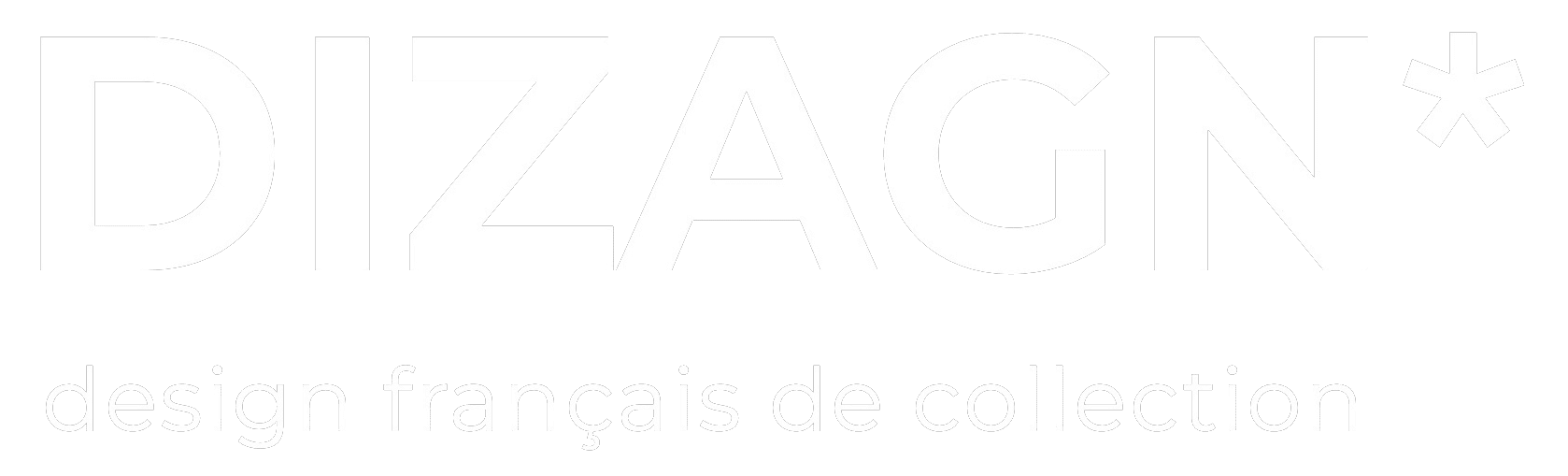

Modernist chair by André Sornay, circa 1928. DIZAGN Collection.
ANDRÉ SORNAY
1902–2000 · Decorator · Designer · Lyon · Modernism · Nailing
From the late 1920s onwards, André Sornay developed a unique body of work in Lyon, at the crossroads of Art Deco and Modernism. He made furniture construction an aesthetic language and developed technical processes that allowed his work to be immediately identifiable.
His work is now recognized for the radical nature of its lines, the precision of its assemblies, and the characteristic use of nailing.
BIOGRAPHY
André Sornay was born in Lyon in 1902 into a family of furniture makers whose business dated back to 1868. Trained at the École des Beaux-Arts in Lyon, he took over the family business in 1919, at the age of seventeen, after his father's death. From 1920 onwards, he gradually abandoned the production of period furniture to steer the company towards contemporary creations with clean lines.
While Lyon furniture remained strongly attached to decorative traditions, Sornay was interested in European avant-gardes, modern architecture, and a more constructive approach to furniture design. His early creations from the late 1920s show simplified structures, geometric profiles, and a rejection of applied ornamentation.
His most identifiable contribution is the so-called "nailing" technique. Patented in the early 1930s, it consists of directly attaching veneer panels to the structure using small, regularly spaced nails. This device is both technical and decorative: the alignment of the metal heads emphasizes the construction lines and becomes a true visual signature.
The system also allows Sornay to design furniture in small series, with streamlined components and assembly. He develops tables, chairs, bookcases, desks, and storage units in which the structure always remains legible.
His work engages in a dialogue with the research of the Bauhaus, the Union of Modern Artists, and international modernism, while retaining a very strong regional identity. Sornay does not seek to imitate Parisian models: he develops an independent method based on constructive detail.
After the Second World War, he continued his research and adapted his work to new lifestyles. However, his work remained less well-known than that of the great Parisian decorators for a long time. Its rediscovery is due to archival research, exhibitions, and the monograph published by the Galerie Marcelpoil.
The chair preserved by DIZAGN, dating from around 1928, belongs to the transitional period during which Sornay gradually abandoned traditional decorative references in favor of more radical furniture. Its chromed tubular frame and vinyl seat testify to the designer's early interest in modern materials.
WORK AND FORMAL LANGUAGE
Sornay's furniture is distinguished by its rigorous geometry and the visibility of its construction. The decoration is not added afterward: it arises from the assembly, the rhythm of the nails, the contrasts of materials, and the design of the structures.
This approach explains the enduring modernity of his work. His furniture may be simple, sometimes almost austere, but its technical precision produces a strong graphic identity.
SELECTIVE CHRONOLOGY
1902 — born in Lyon 1919 — took over the family business at seventeen 1922 — first public presentation at the Lyon Furniture Fair 1925 — International Exhibition of Decorative Arts, Lyon and Saint-Étienne pavilion around 1928 — Modernist chair presented by DIZAGN 1932 — development of the nailing process 1945 — Fire at the factory and disappearance of a large part of the archives 1950 — invention of the «Tigette Sornay» 2000 - death.
SELECT BIBLIOGRAPHY
Alain Marcelpoil, Annik Béras, Olivier Lassalle, André Sornay: an avant-garde designer, Galerie Marcelpoil, 2010 · archives and documentation of the Galerie Marcelpoil.
DOCUMENTARY REFERENCE
The Marcelpoil Gallery preserves and publishes an important body of documentation devoted to André Sornay, his models, his patents and his construction processes.
ANDRÉ SORNAY AT DIZAGN
DIZAGN ARCHIVES — WORK SOLD
Document already passed through DIZAGN and kept online for documentary purposes.
DIZAGN Expertise → Thibault Lannuzel →
Main sources: Galerie Marcelpoil; Alain Marcelpoil, Annik Béras and Olivier Lassalle; DIZAGN documentation.